CM Samrat Choudhary Hails Modi's 12-Year PM Tenure
Synopsis
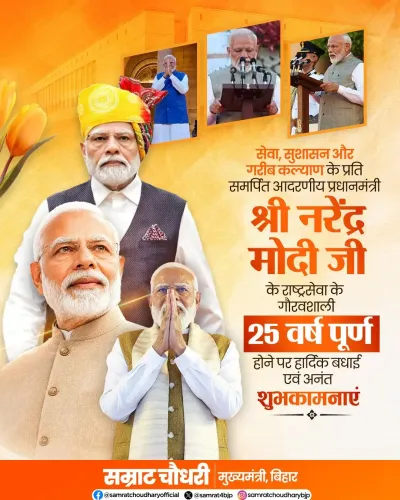
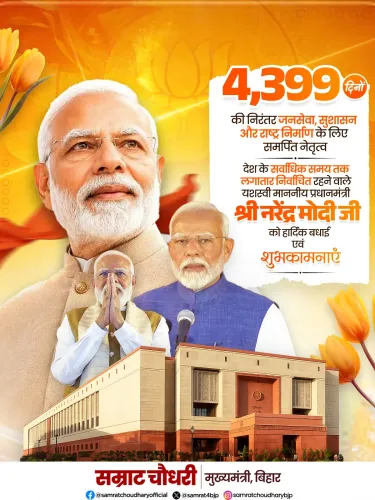
Bihar Chief Minister Samrat Choudhary on 10 June 2026 hailed Prime Minister Narendra Modi for completing 4,399 consecutive days in office — twelve uninterrupted years — calling it a symbol of unwavering public trust, development-oriented leadership, and the resolve for a developed India.
Key Takeaways
Bihar Chief Minister Samrat Choudhary posted a tribute to PM Narendra Modi on 10 June 2026 .
The post marks 4,399 consecutive days of Modi serving as Prime Minister — described as the longest uninterrupted elected tenure in the post.
Modi has served three successive terms since first being sworn in on 26 May 2014 , with re-elections in 2019 and 2024 .
Choudhary framed the milestone as reflecting 'nation first' spirit, public service, and good governance.
The tribute was posted under the hashtag #LongestServingElectedPMModi , indicating coordinated BJP messaging.
The next Lok Sabha elections are due by 2029 , and the party is expected to use such milestones in its political outreach.
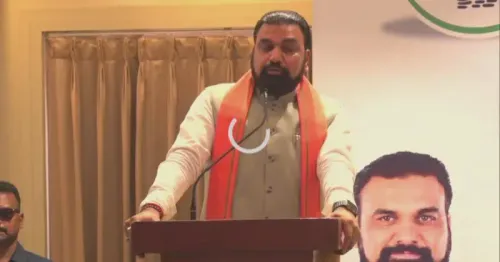
Bihar Chief Minister Samrat Choudhary on Wednesday, 10 June 2026, took to X to mark what he described as a historic milestone for Prime Minister Narendra Modi — completing 4,399 consecutive days as India's longest-serving continuously elected Prime Minister, a span of twelve uninterrupted years in office.
Context
In his post, Choudhary wrote: 'राष्ट्र प्रथम की भावना, जनसेवा के प्रति समर्पण और सुशासन के संकल्प के साथ' ['With the spirit of nation first, dedication to public service, and the resolve for good governance'], Prime Minister Modi has achieved a historic feat. He added: 'सेवा के 12 वर्ष, विश्वास के 4,399 दिन' ['12 years of service, 4,399 days of trust'] — framing the tenure as a continuous campaign of nation-building.
The tribute was posted under the hashtag #LongestServingElectedPMModi, signalling a coordinated effort within the Bharatiya Janata Party (BJP) to highlight the milestone publicly.
Policy Backdrop
Narendra Modi was first sworn in as Prime Minister on 26 May 2014 following the BJP-led National Democratic Alliance's victory in the 2014 Lok Sabha elections. He secured re-election after the 2019 general elections and was sworn in for a third consecutive term on 9 June 2024 following the 2024 Lok Sabha elections.
Three successive electoral mandates have kept Modi and the BJP-led NDA at the centre of national governance without interruption since 2014. Party leaders have consistently cited this continuity as evidence of voter endorsement of the government's development agenda.
Stakeholders and Impact
Choudhary, who serves as Chief Minister of Bihar and is a senior BJP leader, represents a key voice in the party's eastern India base. His tribute reflects the broader pattern within the party of amplifying governance milestones to consolidate voter sentiment ahead of future electoral cycles.
For BJP supporters and the wider electorate, such milestones are typically used to underscore political stability and the perceived continuity of flagship central schemes — from infrastructure programmes to social welfare initiatives — that have been rolled out across successive terms.
What's Next
With the next Lok Sabha elections due by 2029, the party is expected to continue drawing attention to governance benchmarks and scheme delivery as part of its political messaging. Observers will watch whether this milestone prompts further policy announcements or a fresh push on Viksit Bharat — the government's stated vision of a developed India — as a central campaign theme.
The tribute from a state-level leader of Bihar's stature also signals that the BJP's organisational machinery remains aligned in projecting Modi's leadership record as a unifying electoral asset across India's states.
Point of View
399 days in office as a symbol of voter trust rather than simply a calendar fact, the party converts a governance anniversary into an electoral asset. The coordinated hashtag signals this is not an isolated post but part of a wider messaging exercise within the BJP's organisational structure. With 2029 on the horizon, such moments serve a dual purpose: consolidating the base and projecting continuity as a virtue in a country where political instability has historically been a voter concern.
NationPress
25 Oct 2026
Frequently Asked Questions
How many days has Narendra Modi been Prime Minister?
According to Bihar Chief Minister Samrat Choudhary's post on 10 June 2026, Prime Minister Narendra Modi has completed 4,399 consecutive days in office, spanning twelve uninterrupted years since May 2014.
When did Narendra Modi first become Prime Minister of India?
Narendra Modi was first sworn in as Prime Minister of India on 26 May 2014 following the BJP-led NDA's victory in the 2014 Lok Sabha elections.
How many terms has Narendra Modi served as Prime Minister?
Narendra Modi has served three consecutive terms as Prime Minister — beginning in 2014, re-elected in 2019, and sworn in for a third term on 9 June 2024 after the 2024 general elections.
Who is Samrat Choudhary?
Samrat Choudhary is the Chief Minister of Bihar and a senior leader of the Bharatiya Janata Party (BJP).
What is the significance of the hashtag LongestServingElectedPMModi?
The hashtag #LongestServingElectedPMModi was used by BJP leaders including Bihar CM Samrat Choudhary to mark Prime Minister Modi's milestone of becoming India's longest-serving continuously elected Prime Minister.