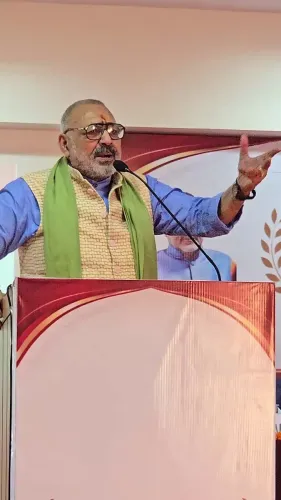
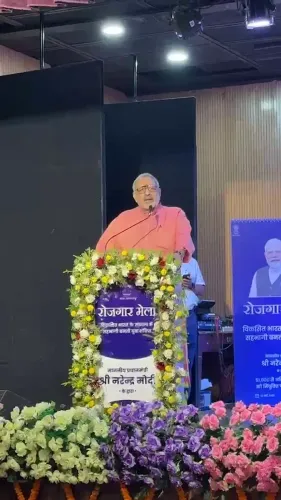
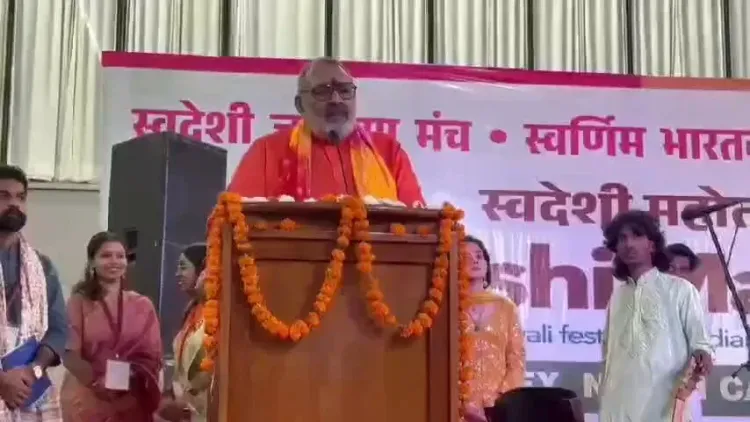
Giriraj Singh links Swadeshi to Viksit Bharat 2047 vision
Synopsis
Union Textiles Minister Giriraj Singh framed Swadeshi as the foundation of a self-reliant, export-ready India, calling on citizens to adopt indigenous production, champion innovation, and prioritise green energy to achieve the Viksit Bharat @2047 vision.
Key Takeaways
Giriraj Singh , Union Textiles Minister, posted on 25 October 2026 linking Swadeshi to the Viksit Bharat @2047 vision.
Singh identified three pillars: Swadeshi adoption, innovation, and green energy prioritisation.
He highlighted India's growing export capacity in both the defence and textiles sectors as evidence of national capability.
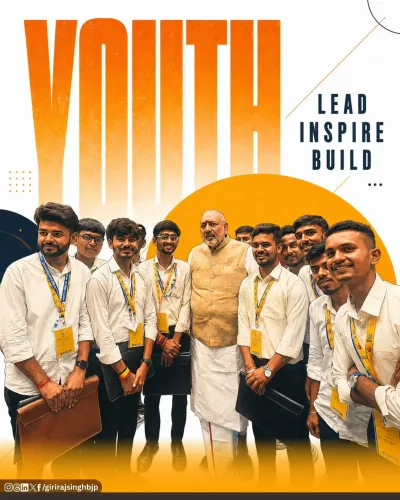
Young entrepreneurs were cited as a key proof point for the success of India's self-reliance policies.
The post reinforces the Atmanirbhar Bharat campaign framework launched by PM Modi in May 2020 .
Green energy's explicit inclusion signals an evolution of the Swadeshi narrative toward the energy transition.
From defence factories to textile looms, Union Textiles Minister Giriraj Singh is making the case that India's self-reliance drive is not nostalgia — it is architecture. On Sunday, 25 October 2026, the senior BJP leader posted on X, framing Swadeshi (indigenous production) as the foundation of a stronger, export-ready India, and calling on citizens and entrepreneurs to help realise the Viksit Bharat @2047 goal.
In his post, Singh wrote: 'Swadeshi is not merely an idea, but the cornerstone of a self-reliant and empowered India. From the defence sector to textiles, India's growing export capacity and the success of young entrepreneurs reflect the capability of the new India. Let us adopt Swadeshi, promote innovation, and prioritise green energy to contribute to realising the resolve of ViksitBharat@2047.'
Swadeshi as a 21st-century export strategy
The word Swadeshi carries deep historical weight in India — it was a cornerstone of the independence movement's economic resistance. Singh's framing deliberately modernises that legacy: self-reliance, in his telling, is not about turning inward but about building the industrial muscle to compete outward. The pairing of textiles and defence is deliberate. Both are sectors where India has made high-profile indigenisation pushes since 2020, and both are named in the original Atmanirbhar Bharat campaign that Prime Minister Narendra Modi launched in May 2020.
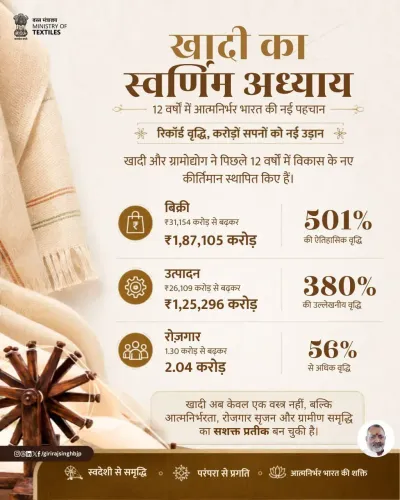
For Singh as Textiles Minister, the connection is professional as much as political. India's textile and apparel sector is one of the country's largest employment generators, and export performance in the segment has become a key metric for the ministry. Linking it to the Swadeshi idea — and to young entrepreneurs — signals the government's intent to position homegrown brands and manufacturers as drivers of growth, not just domestic suppliers.
Green energy joins the self-reliance equation
Perhaps the most forward-looking element of Singh's post is the explicit mention of green energy as a pillar of the Viksit Bharat framework. Historically, Swadeshi and Atmanirbhar rhetoric has centred on manufacturing and agriculture. Inserting green energy into that conversation signals that India's self-reliance narrative is being updated to encompass the energy transition — a significant shift as the country balances coal dependence with ambitious renewable targets.
The Viksit Bharat @2047 vision — to transform India into a fully developed nation by the centenary of independence — provides the long-term scaffolding for all three pillars Singh names: Swadeshi adoption, innovation, and clean energy. The target year gives the mission urgency without a short electoral timeline, making it a durable government-wide rallying point across ministries.
Young entrepreneurs as the proof of concept
Singh's specific callout to 'young entrepreneurs' is pointed. It anchors the ideological argument to a flesh-and-blood constituency — startup founders, first-generation manufacturers, apparel exporters building labels from tier-2 cities. This is the demographic the government has courted aggressively through schemes from Make in India to the Production Linked Incentive programmes. Their success, Singh argues, is not anecdotal; it is evidence that the policy direction is working.
What to watch: textile sector export data in the coming months and the rollout of green manufacturing incentives will be the real-world test of whether this vision is translating into measurable outcomes — or remains an inspiring headline.
Point of View
He draws a policy line from the post-2020 Atmanirbhar push directly into the 2047 horizon, making self-reliance feel like a continuum rather than a campaign. The addition of green energy is the newest thread: it suggests the government is beginning to integrate the climate economy into its nationalist manufacturing narrative, a convergence that will shape industrial policy debates in the years ahead. Whether electoral momentum can be sustained on a 21-year vision will depend on whether export and employment numbers keep pace with the rhetoric.
NationPress
25 Oct 2026
Frequently Asked Questions
What is Viksit Bharat @2047?
Viksit Bharat @2047 is the Indian government's vision to transform India into a fully developed nation by 2047 , the centenary of independence, spanning goals across manufacturing, infrastructure, health, and sustainability.
What did Giriraj Singh say about Swadeshi?
Giriraj Singh said Swadeshi is 'not merely an idea' but the cornerstone of a self-reliant and empowered India, calling on citizens to adopt it alongside innovation and green energy to achieve the Viksit Bharat @2047 goal.
What is Atmanirbhar Bharat and when was it launched?
Atmanirbhar Bharat — meaning 'Self-Reliant India' — is a campaign launched by Prime Minister Narendra Modi in May 2020 to promote domestic production and reduce import dependence across sectors including defence and textiles.
Why is Giriraj Singh talking about textiles and defence together?
Both textiles and defence are priority sectors under India's Atmanirbhar Bharat policy, where indigenisation has been pushed hardest since 2020 . As Textiles Minister, Singh frames their combined export growth as proof of India's industrial capability.
What role does green energy play in India's Swadeshi push?
Singh's post explicitly adds green energy to the self-reliance framework, signalling that India's Viksit Bharat vision includes building domestic clean-energy capacity as part of the broader manufacturing and sustainability agenda.