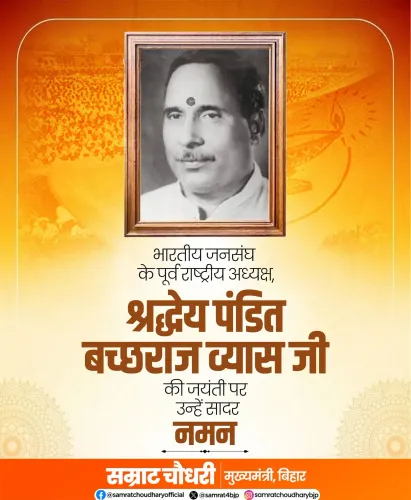
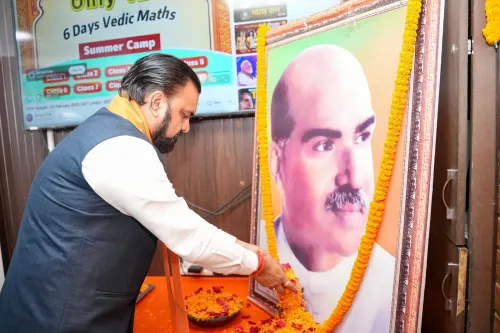
CM Samrat Choudhary marks Bharatiya Jana Sangh Foundation Day

Synopsis
Bihar Chief Minister Samrat Choudhary on 21 October 2026 marked the Bharatiya Jana Sangh Foundation Day, saluting the 1951 party founded by Syama Prasad Mookerjee and affirming its legacy of nationalism and public welfare as the ideological bedrock of today's BJP.
Key Takeaways
Bihar CM Samrat Choudhary posted Foundation Day greetings for the Bharatiya Jana Sangh on 21 October 2026 .
The Jana Sangh was founded on 21 October 1951 by Syama Prasad Mookerjee as a nationalist alternative to the Congress.
Its core platform centred on national service, nationalism, integral humanism and anti-corruption.
After merging into the Janata Party in 1977 , the Jana Sangh's leadership re-emerged as the BJP in 1980 .
BJP leaders across states mark this anniversary annually to assert ideological continuity between the 1951 party and today's BJP.
Seventy-five years after Syama Prasad Mookerjee planted the first flag of cultural nationalism in Indian politics, the party he founded on 21 October 1951 continues to cast a long shadow over the country's political imagination. Bihar Chief Minister Samrat Choudhary marked the occasion on Wednesday, 21 October 2026, with a post on X that saluted the Bharatiya Jana Sangh's founding ideals.
Choudhary wrote: 'Bharatiya Janasangh ke sthapna divas ki hardik shubhkamnayein' — 'Heartfelt greetings on the Foundation Day of the Bharatiya Jana Sangh.' He described the party as one built on the core values of 'national service, nationalism and public welfare,' and added that its ideology 'played an important role in giving Indian politics a new direction.' The ideals and principles of the Jana Sangh, he said, would 'continue to inspire work in the national interest.'
The party that became the BJP
The Bharatiya Jana Sangh did not arrive quietly. Syama Prasad Mookerjee, a Bengali politician and former Union minister, broke with the Nehru government over its Kashmir policy and economic direction, and launched the Jana Sangh on 21 October 1951 as a nationalist alternative to the dominant Congress. Its platform rested on integral humanism, anti-corruption and robust national defence — positions that set it sharply apart from Nehruvian statism.
The party's journey was interrupted but never truly ended. After merging into the Janata Party in 1977, its core constituency and leadership re-emerged as the Bharatiya Janata Party in 1980. That ideological thread — from Mookerjee's Jana Sangh to the BJP of today — is precisely the lineage BJP leaders invoke every October.
Why BJP leaders keep returning to this anniversary
For the BJP and its state units, the Jana Sangh Foundation Day is not mere historical ceremony. It is an annual reaffirmation of ideological continuity — a public declaration that the party governing from Patna to New Delhi traces its roots directly to Mookerjee's nationalist project. Choudhary's post, filed under the hashtag #BharatiyaJanaSangh, follows a pattern repeated by BJP leaders across states every 21 October: stress the unbroken arc from 1951 to the present, and frame today's governance agenda as the fulfilment of those founding promises.
In Bihar's political context, the anniversary also serves a local purpose — anchoring the ruling party's identity in a state where coalition arithmetic and caste dynamics constantly shift. Invoking the Jana Sangh's legacy of nationalism and public welfare is a reminder, directed at both cadres and voters, of where the BJP says it comes from and what it says it stands for.
Point of View
The tribute also carries state-level significance: in a politically complex state, invoking Mookerjee's legacy signals to the party's base that its nationalist moorings remain firm. The pattern of near-identical tributes from BJP leaders across India on this date underscores how the party uses historical memory as an active political instrument, not merely a commemorative gesture.
NationPress
21 Oct 2026
Frequently Asked Questions
When was the Bharatiya Jana Sangh founded?
The Bharatiya Jana Sangh was founded on 21 October 1951 by Syama Prasad Mookerjee as a nationalist political alternative to the Indian National Congress.
Who founded the Bharatiya Jana Sangh?
Syama Prasad Mookerjee , a Bengali politician and former Union minister, founded the Bharatiya Jana Sangh in 1951, motivated by disagreements with the Nehru government's policies on Kashmir and economic planning.
What is the relationship between the Jana Sangh and the BJP?
After the Jana Sangh merged into the Janata Party in 1977 , its core leadership and ideology re-emerged as the Bharatiya Janata Party (BJP) in 1980 , making the Jana Sangh the BJP's direct ideological predecessor.
Why do BJP leaders celebrate Jana Sangh Foundation Day?
BJP leaders mark the anniversary every 21 October to assert ideological continuity — publicly connecting today's party to the Jana Sangh's founding values of nationalism, integral humanism and public welfare.
What did Bihar CM Samrat Choudhary say about Jana Sangh Foundation Day?
CM Choudhary extended greetings and said the Jana Sangh's ideology 'played an important role in giving Indian politics a new direction,' adding that its ideals would 'continue to inspire work in the national interest.'