CM Samrat Choudhary pays tribute to Captain Lakshmi Sahgal
Synopsis
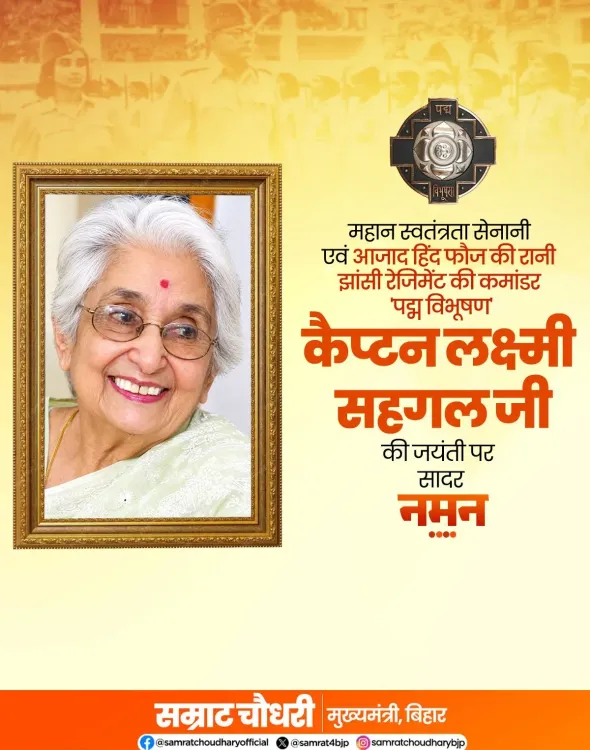
Bihar Chief Minister Samrat Choudhary marked the birth anniversary of Captain Lakshmi Sahgal — commander of the Azad Hind Fauj's all-women Rani of Jhansi Regiment and Padma Vibhushan awardee — calling her a timeless symbol of courage and sacrifice in India's freedom struggle.
Key Takeaways
Bihar CM Samrat Choudhary paid tribute to Captain Lakshmi Sahgal on her birth anniversary on 24 October 2026 via a post on X.
Sahgal commanded the Rani of Jhansi Regiment , the all-women armed unit of the Azad Hind Fauj , formed in 1943 under Subhas Chandra Bose .
She was honoured with the Padma Vibhushan , India's second-highest civilian award, for her role in the independence movement.
The tribute reflects a consistent pattern among Indian political leaders of publicly invoking the INA's armed-resistance legacy on key anniversaries.
The Rani of Jhansi Regiment's name draws on the symbolism of the 1857 warrior queen Rani Lakshmibai , framing Sahgal's unit within a longer tradition of Indian women's resistance.
She led an all-women combat regiment against a colonial empire — and Bihar Chief Minister Samrat Choudhary marked her birth anniversary on Saturday, 24 October 2026 with a heartfelt tribute on X, honouring a freedom fighter whose story still echoes in the national conscience.
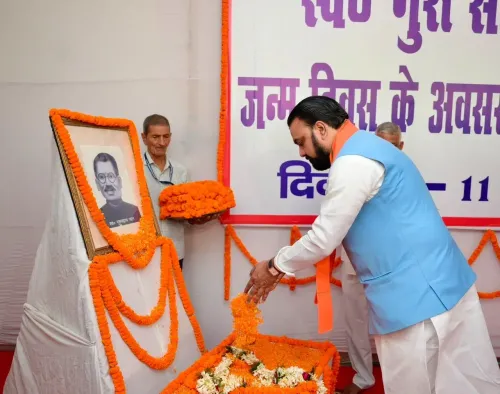
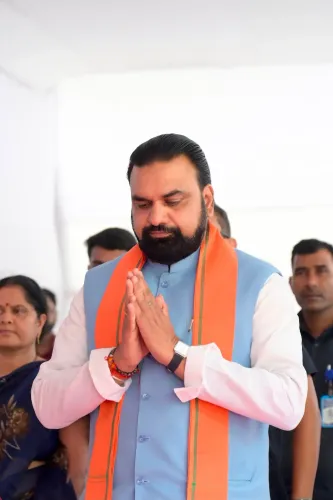
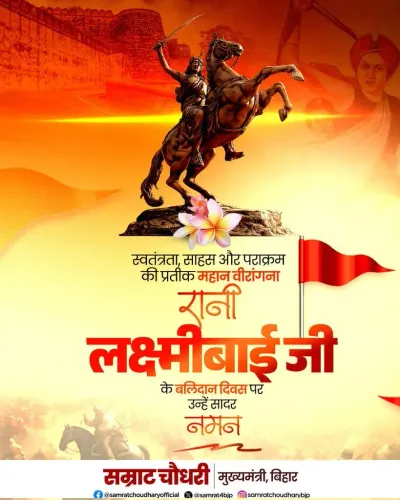
In his post, CM Choudhary saluted Captain Lakshmi Sahgal as a symbol of 'indomitable courage, sacrifice, and patriotism,' noting that her struggle and dedication to the nation's freedom 'will continue to inspire the countrymen forever.' The tribute was posted in Hindi and accompanied by an image, signalling a deliberate moment of public remembrance.
The commander who broke every barrier
Captain Lakshmi Sahgal was appointed by Subhas Chandra Bose to command the Rani of Jhansi Regiment — the all-women armed unit of the Azad Hind Fauj (Indian National Army), formed in 1943 to mount armed resistance against British colonial rule. At a time when women's participation in combat roles was virtually unthinkable, Sahgal drilled, led, and inspired a regiment that became one of the most enduring symbols of the INA's radical ambition.
Her contributions to the independence movement were formally recognised by the Indian state with the Padma Vibhushan, the country's second-highest civilian honour. Beyond soldiering, she was also a practising physician who dedicated decades of post-independence life to serving marginalised communities — a legacy that outlasted the battlefield.
Why the INA tribute tradition carries political weight
Across the political spectrum, Indian leaders regularly invoke the Azad Hind Fauj on birth and death anniversaries of its key figures. These commemorations are not merely ceremonial — they tap into a specific strand of nationalist memory centred on armed sacrifice and resistance, distinct from the non-violent movement led by the Indian National Congress. For a BJP leader like CM Choudhary, honouring Sahgal and Bose's INA is consistent with a broader effort to reclaim and amplify the legacy of the armed independence movement in public discourse.
The Rani of Jhansi Regiment's name itself carries layered symbolism — invoking Rani Lakshmibai of Jhansi, the warrior queen of 1857, to frame Sahgal's regiment as part of a centuries-long tradition of Indian women in arms against colonial power.
Point of View
Particularly for BJP leaders seeking to anchor the party's nationalism in the armed-resistance tradition rather than exclusively in the Gandhian mainstream. CM Choudhary's post on Sahgal's anniversary fits neatly into this pattern, reinforcing the BJP's broader project of amplifying Subhas Chandra Bose and his associates as nationalist icons. Notably, honouring Sahgal — a woman commander — also allows the party to project gender-inclusive patriotism. The consistency of such commemorations across state and central leadership suggests they are a deliberate strand of political messaging, not just personal sentiment.
NationPress
24 Oct 2026
Frequently Asked Questions
Who was Captain Lakshmi Sahgal?
Captain Lakshmi Sahgal was a freedom fighter and physician who commanded the Rani of Jhansi Regiment, the all-women combat unit of the Azad Hind Fauj (Indian National Army), during World War II. She was appointed by Subhas Chandra Bose and was later honoured with the Padma Vibhushan.
What was the Rani of Jhansi Regiment?
The Rani of Jhansi Regiment was the all-women armed wing of the Azad Hind Fauj, formed in 1943. It was named after the warrior queen Rani Lakshmibai of Jhansi and commanded by Captain Lakshmi Sahgal under the leadership of Subhas Chandra Bose.
Why did Bihar CM Samrat Choudhary post about Lakshmi Sahgal?
CM Samrat Choudhary posted a tribute on X to mark Captain Lakshmi Sahgal's birth anniversary on 24 October 2026, honouring her legacy of courage, sacrifice, and patriotism in India's freedom struggle.
What award did Captain Lakshmi Sahgal receive?
Captain Lakshmi Sahgal was awarded the Padma Vibhushan, India's second-highest civilian honour, for her contributions to the country's independence movement.
What is the Azad Hind Fauj?
The Azad Hind Fauj, or Indian National Army, was an armed force formed by Subhas Chandra Bose in 1943 to fight British colonial rule in India through armed resistance, distinct from the non-violent independence movement of the Indian National Congress.