CM Samrat Choudhary pays tribute to Matangini Hazra on death anniversary
Synopsis
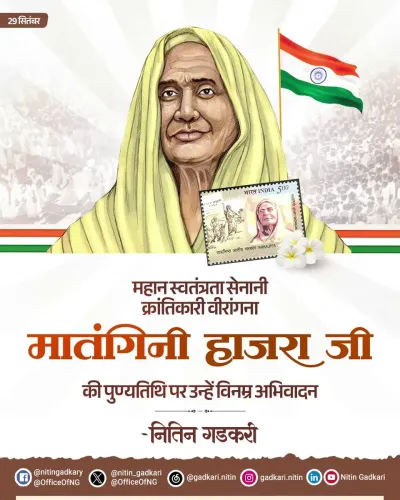
Bihar Chief Minister Samrat Choudhary on 29 September 2026 paid tribute to Matangini Hazra, the 72-year-old Tamluk freedom fighter shot dead by British police while carrying the national flag during the 1942 Quit India Movement, on her death anniversary.
Key Takeaways
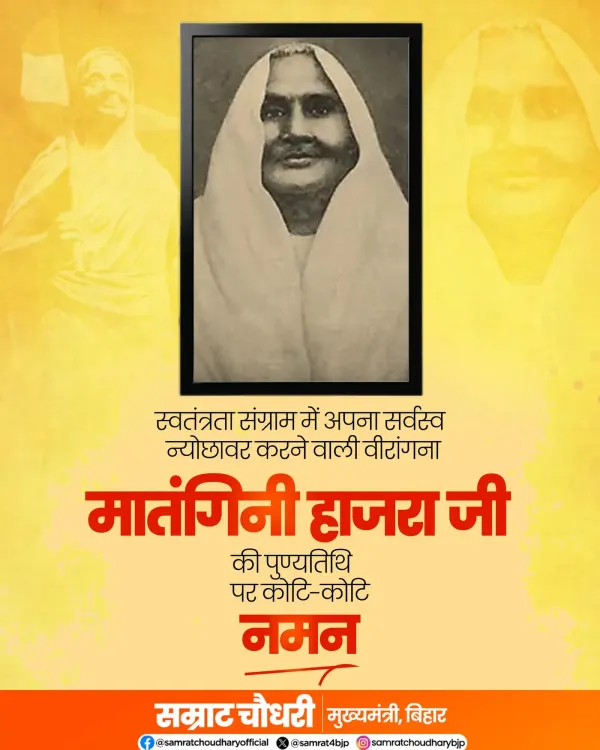
Bihar CM Samrat Choudhary posted a tribute to freedom fighter Matangini Hazra on her death anniversary, 29 September 2026 .
Matangini Hazra was shot dead by British police on 29 September 1942 in Tamluk, West Bengal , during the Quit India Movement — she was 72 years old .
She was struck three times but continued holding the national flag until she fell, becoming one of the most iconic martyrs of the independence struggle.
CM Choudhary's tribute reflects the wider practice of Indian political leaders commemorating freedom fighters from across all states on their death anniversaries.
The post used the hashtag #MatanginiHazra , keeping her memory circulating in national digital discourse.
She walked toward British guns at 72 years of age, the national flag in her hands, and refused to stop. On the death anniversary of freedom fighter Matangini Hazra, Bihar Chief Minister Samrat Choudhary on Tuesday, 29 September 2026, offered a heartfelt tribute to the martyr who gave her life during the Quit India Movement of 1942.
Posting in Hindi on X, CM Choudhary wrote: 'स्वतंत्रता संग्राम में अदम्य साहस और देशभक्ति का परिचय देते हुए अपना सर्वस्व न्योछावर करने वाली वीरांगना मातंगिनी हाजरा जी की पुण्यतिथि पर कोटि-कोटि नमन।' — 'Countless salutes on the death anniversary of the brave Matangini Hazra ji, who demonstrated indomitable courage and patriotism in the freedom struggle and sacrificed everything she had.' He added that 'her sacrifice and martyrdom will forever inspire the people of this nation.'The woman who would not lower the flag
Matangini Hazra, born in 1869 in Tamluk, West Bengal, became one of the most striking figures of the 1942 Quit India Movement. On 29 September 1942 — exactly 84 years ago today — she led a procession of thousands toward the Tamluk police station, defying orders to disperse. British police opened fire, wounding her. Struck three times, she continued holding the tricolour aloft until she fell. She was 72 years old. Her final words, reportedly calling out 'Vande Mataram', have entered the folklore of the independence movement. Her story carries particular resonance because she came not from an elite nationalist household but from a poor, widowed background in rural Bengal — a reminder that the freedom struggle was carried on the shoulders of ordinary people who chose to become extraordinary.A Bihar CM honouring a Bengal martyr
That a Bihar Chief Minister is paying tribute to a martyr from West Bengal reflects a deliberate pattern in Indian political culture — leaders across states and party lines mark the anniversaries of freedom fighters from every corner of the country, framing independence as a shared national inheritance rather than a regional one. For the BJP, invoking figures of selfless mass sacrifice aligns with its broader political messaging around nationalism and historical memory. Such commemorations also keep lesser-known martyrs visible in public discourse — Matangini Hazra, while celebrated in Bengal, does not always receive the same national spotlight as figures like Bhagat Singh or Subhas Chandra Bose. Posts like today's serve a quiet archival function: they remind a scrolling public that the freedom struggle had thousands of faces. Eighty-four years on, the image of an elderly woman refusing to lower a flag under fire remains one of independence history's most quietly devastating moments. Some stories need no embellishment — only remembrance.Point of View
Choudhary subtly projects the party's pan-India cultural reach. More broadly, such commemorations reflect how digital-era politics has made death anniversaries of freedom fighters into low-cost but high-visibility moments of patriotic signalling. The lasting significance, however, belongs to Hazra herself: her story of ordinary courage under fire is precisely the kind of historical detail that risks fading without periodic public recall.
NationPress
29 Sept 2026
Frequently Asked Questions
Who was Matangini Hazra?
Matangini Hazra was an Indian freedom fighter from Tamluk in West Bengal who participated in the Quit India Movement. She was shot dead by British police on 29 September 1942 at the age of 72 while leading a procession and carrying the national flag.
When did Matangini Hazra die?
Matangini Hazra died on 29 September 1942 in Tamluk, West Bengal, after being shot three times by British police during a Quit India Movement procession.
Why is Matangini Hazra remembered?
She is remembered for her extraordinary bravery — despite being shot multiple times, she reportedly continued holding the Indian national flag aloft until she died. Her sacrifice at age 72 made her one of the most iconic martyrs of the 1942 Quit India Movement.
Why did Bihar CM Samrat Choudhary pay tribute to a West Bengal freedom fighter?
Indian political leaders routinely honour freedom fighters from across the country, not just their home states, as part of a broader national commemoration practice. CM Choudhary's post on Matangini Hazra's death anniversary follows this tradition of treating independence as a shared national heritage.
What was the Quit India Movement of 1942?
The Quit India Movement, launched by Mahatma Gandhi in August 1942, was a mass civil disobedience campaign demanding an immediate end to British rule in India. Matangini Hazra was among thousands of ordinary citizens who participated and, in many cases, gave their lives during this movement.