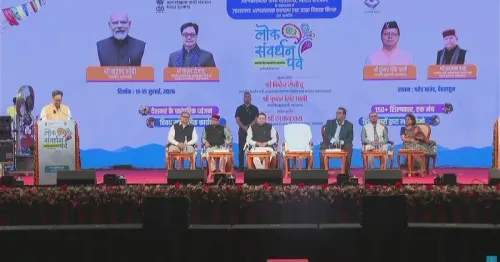
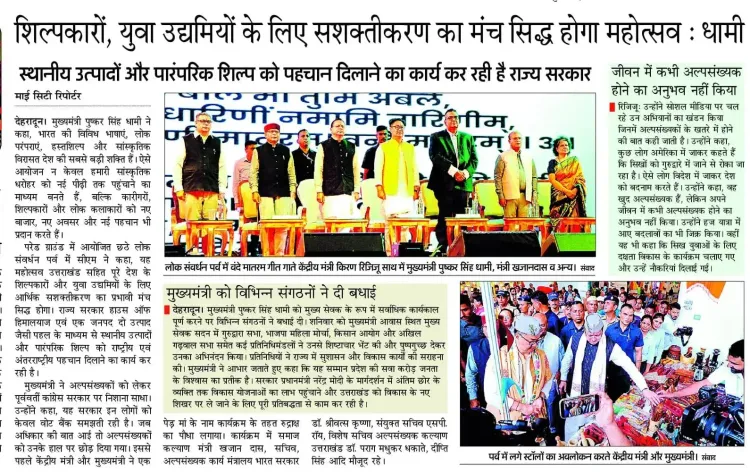
CM Dhami: Lok Sanvardhan Parv a better platform for artisans, youth
Synopsis
Chief Minister Pushkar Singh Dhami has declared the Lok Sanvardhan Parv a superior platform for artisans and young entrepreneurs, linking Uttarakhand's cultural festival directly to livelihood and enterprise goals for hill-district craftspeople.
Key Takeaways
CM Pushkar Singh Dhami publicly described the Lok Sanvardhan Parv as a 'better platform' for artisans and young entrepreneurs on 12 July 2026 .
The festival is a state-organised event in Uttarakhand that showcases folk arts and traditional crafts from the state's hill districts.
The remarks align with the Uttarakhand MSME Policy 2022 , which prioritised market linkages and skill support for artisans and first-generation entrepreneurs.
Key beneficiaries include craftspeople working in ringal bamboo, Aipan folk art, woollen textiles, and wood carving, as well as young brand-builders in the craft sector.
Operational details — vendor registration, stall allocation, and any linked credit or skill schemes — are the next milestones to watch.
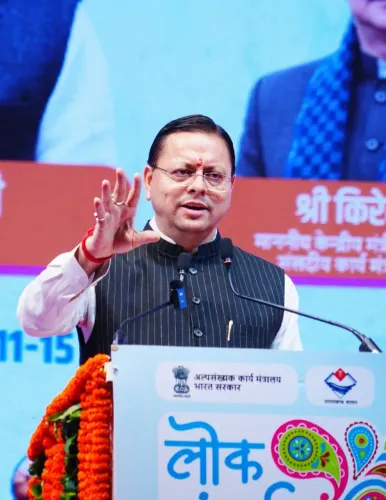
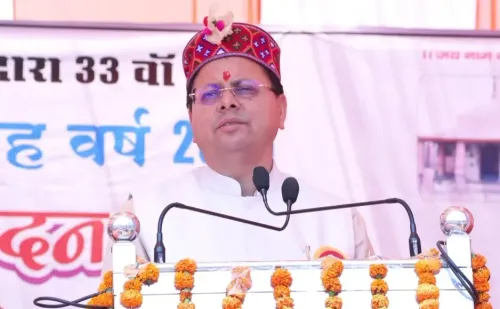
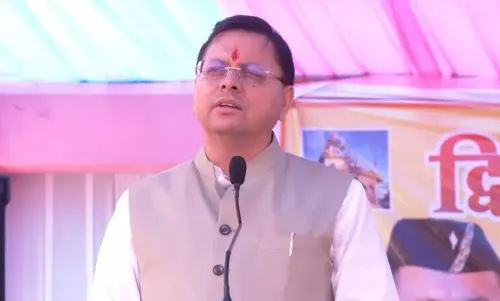
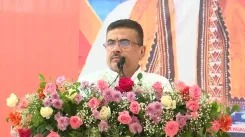
The Chief Minister's Office of Uttarakhand announced on Sunday, 12 July 2026 that Chief Minister Pushkar Singh Dhami has described the Lok Sanvardhan Parv as a superior platform for artisans and young entrepreneurs in the state, signalling the government's intent to deepen the festival's role as an economic bridge for hill-district craftspeople.
Addressing the occasion, CM Dhami stated — 'shilpkar, yuva udyamiyon ke liye behtar manch siddh hoga Lok Sanvardhan Parv ka manch' ('The stage of Lok Sanvardhan Parv will prove to be a better platform for artisans and young entrepreneurs') — framing the cultural festival explicitly as an instrument of livelihood promotion, not merely ceremonial celebration.
Context
The Lok Sanvardhan Parv is a state-organised cultural festival in Uttarakhand designed to showcase folk arts, traditional crafts, and indigenous talent from the state's hill districts. Governments in the state have consistently used such festivals to create direct market access for local craftspeople, recognising that remote geography limits artisans' reach to mainstream commercial channels. CM Dhami's remarks position the current edition as a step beyond cultural preservation toward tangible entrepreneurial opportunity.
Policy Backdrop
The statement aligns closely with the Uttarakhand MSME Policy 2022, which prioritised support for artisans and first-generation entrepreneurs through market linkages and skill development programmes. That policy framework acknowledged that hill-district craftspeople face structural disadvantages — thin local markets, high logistics costs, and limited digital access — that state-sponsored platforms can partially offset. The Lok Sanvardhan Parv fits into this continuum as a physical marketplace with official backing, offering stall space, visibility, and potential buyer connections that artisans cannot easily arrange independently.
Uttarakhand's broader economic strategy has increasingly sought to link cultural identity with commercial outcomes, particularly as the state competes to retain young talent that might otherwise migrate to plains cities for work. By framing the festival as a 'better platform' for young entrepreneurs, CM Dhami is signalling that the event is being reconfigured — or at least repositioned — to serve startup and micro-enterprise goals alongside its traditional folk-arts mandate.
Stakeholders and Impact
Artisans working in traditional crafts such as ringal bamboo products, Aipan folk art, woollen textiles, and wood carving stand to gain the most direct benefit if the festival delivers on its market-access promise. For many, a state-organised venue with curated footfall represents one of the few occasions in the year when urban and tourist buyers come to them, rather than the reverse. Young entrepreneurs — particularly those building brands around Uttarakhand's craft heritage — could use the platform to test products, network with buyers, and access government scheme information in one place.
Tourism, which remains a pillar of the state's economy, also benefits when cultural festivals are well-attended: visitors who engage with artisan stalls tend to extend stays and increase per-capita spending in local economies.
What's Next
Attention will now turn to the operational details of the Lok Sanvardhan Parv — specifically vendor registration processes, stall allocation criteria, and whether any linked credit or skill-development schemes will be announced alongside the festival in the state budget cycle. If the government follows the pattern of previous editions, announcements on participating districts and artisan categories are likely in the coming weeks. The Chief Minister's public endorsement raises the event's profile and may draw greater participation from both craftspeople and institutional buyers this year.
Point of View
Enterprise-oriented audience. This fits a pattern visible across several BJP-governed hill states: repositioning heritage events as startup-friendly ecosystems to counter youth out-migration. The move also gives the festival a sharper policy identity that can be tied to MSME and budget allocations, making it easier to justify state expenditure on cultural programming. Whether the operational reality matches the political framing will depend on how seriously the government pursues buyer linkages and financial support schemes at the ground level.
NationPress
10 Oct 2026
Frequently Asked Questions
What is Lok Sanvardhan Parv in Uttarakhand?
Lok Sanvardhan Parv is a state-organised cultural festival in Uttarakhand that showcases folk arts, traditional crafts, and indigenous talent from the state's hill districts, and is used to create direct market access for local artisans.
What did CM Pushkar Singh Dhami say about Lok Sanvardhan Parv?
CM Pushkar Singh Dhami said the stage of Lok Sanvardhan Parv will prove to be a better platform for artisans and young entrepreneurs, signalling the government's intent to use the festival as an economic tool alongside its cultural role.
How does Lok Sanvardhan Parv help artisans in Uttarakhand?
The festival provides artisans with a state-backed venue where urban and tourist buyers come to them, helping craftspeople in remote hill districts overcome geographic and logistical barriers to market access.
What is the Uttarakhand MSME Policy 2022?
The Uttarakhand MSME Policy 2022 prioritised support for artisans and first-generation entrepreneurs through market linkages and skill development programmes, forming the policy backbone for initiatives like the Lok Sanvardhan Parv.
Which crafts are promoted at Uttarakhand cultural festivals?
Traditional crafts promoted at Uttarakhand's state festivals typically include ringal bamboo products, Aipan folk art, woollen textiles, and wood carving, all of which are indigenous to the state's hill districts.