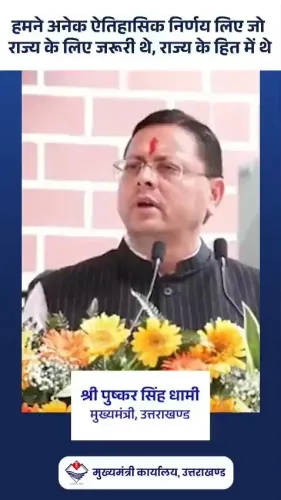
CM Dhami: Climate Change Now a Daily Reality for Uttarakhand

Synopsis
Chief Minister Pushkar Singh Dhami has publicly declared climate change a daily lived reality for Uttarakhand, moving beyond scientific framing. The statement, posted on 6 June 2026, signals the state government's intent to deepen adaptation planning for hill communities, farmers, and tourism operators in the Himalayan region.
Key Takeaways
CM Pushkar Singh Dhami stated on 6 June 2026 that climate change is no longer a scientific abstraction but an everyday reality for Uttarakhand's residents.
Uttarakhand is among India's most climate-vulnerable states, facing glacial melt, erratic monsoons, and flash floods.
India's National Action Plan on Climate Change (2008) includes a dedicated mission for sustaining the Himalayan Ecosystem , under which states maintain their own action plans.
Key affected stakeholders include hill farmers, tourism operators , and flood-prone valley communities .
The statement aligns with a broader pattern of Himalayan state governments framing climate change as a lived crisis to support adaptation budgets and SDG integration.
The next policy milestone to watch is Uttarakhand's updated State Action Plan on Climate Change and new adaptation infrastructure budget lines.
Chief Minister Pushkar Singh Dhami of Uttarakhand declared on Saturday, 6 June 2026 that climate change has moved beyond scientific debate to become a lived reality in everyday life, signalling the state government's intent to anchor adaptation planning in ground-level experience.
Context
Speaking through the official Chief Minister's Office account, CM Dhami stated — 'जलवायु परिवर्तन अब केवल वैज्ञानिकों की चर्चा का विषय नहीं रह गया है, बल्कि यह हमारे रोजमर्रा के जीवन की वास्तविकता बन गया है' — ('Climate change is no longer merely a subject of discussion among scientists; it has become the reality of our everyday lives'). The remark, shared under the hashtags #ClimateChange and #SustainableDevelopment, was accompanied by a video, indicating a formal address or event setting.
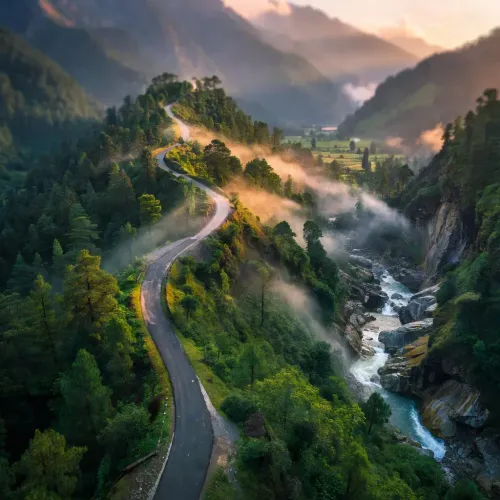
Uttarakhand sits at the frontline of Himalayan climate stress, experiencing accelerating glacial melt, erratic monsoon behaviour, and increasingly frequent flash floods. The statement positions the state's leadership as directly acknowledging this vulnerability in public terms.
Policy Backdrop
India launched its National Action Plan on Climate Change (NAPCC) in 2008, which includes the National Mission for Sustaining the Himalayan Ecosystem — a framework specifically designed to address the vulnerabilities of mountain states like Uttarakhand. Sub-national governments are expected to translate this into State Action Plans on Climate Change (SAPCCs), which guide local adaptation spending and infrastructure priorities.
Himalayan states have increasingly framed climate change as a lived crisis rather than a distant projection, using such messaging to build public and political support for adaptation budgets. CM Dhami's statement follows this pattern, aligning with the national integration of Sustainable Development Goals (SDGs) into state-level policy, particularly after a series of extreme weather events have tested the region's resilience in recent years.
Stakeholders and Impact
The communities most directly affected by this framing include hill farmers whose crop cycles have been disrupted by shifting precipitation patterns, tourism operators dependent on predictable snowfall and stable terrain, and residents of flood-prone valleys who face seasonal displacement. For these groups, a Chief Minister's public acknowledgement of climate change as an everyday reality carries implications for how state resources may be allocated.
Broader civil society groups and environmental advocates have long called for Himalayan state governments to move from rhetorical acknowledgement to concrete adaptation infrastructure — including early-warning systems, slope stabilisation, and climate-resilient agriculture support. Dhami's statement could serve as a political signal ahead of updated policy announcements.
What's Next
Attention will now turn to whether this statement is followed by substantive policy action — specifically, the rollout of Uttarakhand's updated State Action Plan on Climate Change and any new budget allocations for adaptation infrastructure in the state's hill districts. The video accompanying the post may contain further programmatic detail that could clarify the immediate intent behind the declaration.
As India approaches its next cycle of climate commitment reviews under international frameworks, statements from frontline Himalayan states carry added weight in shaping the national narrative on sub-national adaptation readiness.
Point of View
This kind of top-level political acknowledgement is a precondition for sustained budget prioritisation. The statement also positions Uttarakhand within a growing coalition of Himalayan state governments that are pressing the Centre for greater devolution of climate finance. Whether the rhetoric translates into measurable policy — updated SAPCCs, ring-fenced adaptation funds, early-warning infrastructure — will be the real test of its significance.
NationPress
21 Oct 2026
Frequently Asked Questions
What did CM Pushkar Singh Dhami say about climate change?
CM Dhami stated on 6 June 2026 that climate change is no longer just a topic of scientific discussion but has become a reality of everyday life, particularly for the people of Uttarakhand.
Why is Uttarakhand especially vulnerable to climate change?
Uttarakhand is a Himalayan state facing accelerating glacial melt, increasingly erratic monsoon patterns, and frequent flash floods — making it one of India's most climate-exposed regions.
What is India's National Action Plan on Climate Change?
Launched in 2008, the National Action Plan on Climate Change (NAPCC) outlines India's framework for addressing climate risks, including a dedicated National Mission for Sustaining the Himalayan Ecosystem relevant to states like Uttarakhand.
What is Uttarakhand's State Action Plan on Climate Change?
It is a state-level policy document that translates India's national climate framework into local adaptation priorities, covering infrastructure, agriculture, and disaster resilience specific to Uttarakhand's geography.
Who are the most affected communities by climate change in Uttarakhand?
Hill farmers, tourism operators dependent on stable mountain conditions, and residents of flood-prone valleys are among the most directly impacted communities in Uttarakhand.