CM Dhami: Employees Key to Building Viksit Uttarakhand
Synopsis
Chief Minister Pushkar Singh Dhami has publicly recognised the pivotal role of government employees in building a developed Uttarakhand, aligning state governance messaging with the national Viksit Bharat 2047 framework and signalling a focus on administrative accountability.
Key Takeaways
CM Pushkar Singh Dhami stated on 18 June 2026 that employees are crucial to building a developed Uttarakhand.
The statement aligns Uttarakhand's governance narrative with the national Viksit Bharat 2047 framework.
The Dhami government has prioritised bureaucratic performance and good governance since taking office in March 2021 .
Uttarakhand faces unique governance challenges due to its Himalayan terrain, migration trends, and tourism dependence.
Analysts will watch for follow-up policy action such as performance-linked incentives or administrative reform orders.
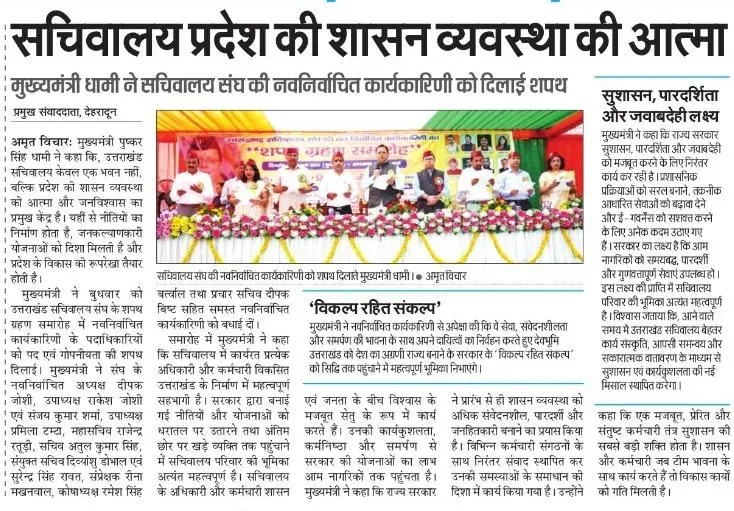
The Chief Minister's Office of Uttarakhand, on behalf of Chief Minister Pushkar Singh Dhami, on Thursday, 18 June 2026, underscored the central role of government employees in realising the vision of a developed Uttarakhand, framing their contribution as indispensable to the state's growth trajectory.
Context
The post, shared via the official Chief Minister's Office account, carries the message: 'Viksit Uttarakhand ke nirman mein karmachariyon ki bhumika aham' — ('The role of employees is crucial in building a developed Uttarakhand'). The statement is a direct acknowledgement by CM Dhami of the bureaucracy's place in translating policy intent into ground-level outcomes across the state.
Uttarakhand, a Himalayan state formed in 2000, faces distinctive governance challenges including difficult terrain, seasonal migration, and a heavy dependence on tourism. In this context, a motivated and accountable civil service is widely regarded as critical to delivering public services effectively.
Policy Backdrop
Since assuming office in March 2021, the Dhami government has consistently positioned good governance and bureaucratic performance as cornerstones of state development. The BJP's 2022 assembly election manifesto for Uttarakhand explicitly linked employee welfare with targets for self-reliant growth and employment generation.
The messaging also fits squarely within the national Viksit Bharat 2047 framework, which calls on every tier of government — including state administrations — to align civil service capacity with long-term development goals. Chief ministers across BJP-ruled states have increasingly made public gestures to boost morale and reinforce accountability within the permanent bureaucracy.
Stakeholders and Impact
Government employees across Uttarakhand's departments are the primary audience for this signal. Public recognition from the Chief Minister carries weight in shaping administrative culture, particularly in a state where postings in remote hill districts can be demanding and under-recognised.
For citizens, the statement implies a governance compact: that the administration views its workforce not merely as a procedural apparatus but as active partners in the state's development. This framing can influence how departments prioritise service delivery and responsiveness in the months ahead.
What's Next
Observers will watch for follow-through in the form of concrete administrative reform orders, performance-linked incentive structures, or training modules tied to departmental key performance indicators. The next state budget cycle will be a key indicator of whether this public acknowledgement translates into measurable policy support for the workforce.
If the Dhami administration moves to institutionalise employee recognition or introduce accountability frameworks, Uttarakhand could offer a model for other hill states navigating similar governance constraints under the broader Viksit Bharat umbrella.
Point of View
Not merely a ceremonial remark. By tying the civil service's role to the 'Viksit Uttarakhand' vision, the Chief Minister is building a governance narrative that mirrors the Centre's Viksit Bharat 2047 ambition — a pattern common across BJP-ruled states seeking to project developmental momentum. The statement also serves a morale function in a state where remote postings and difficult terrain make employee retention and motivation a real administrative challenge. Whether it yields structural reforms — such as performance incentives or accountability frameworks — will determine if the message carries policy weight beyond optics.
NationPress
18 Sept 2026
Frequently Asked Questions
What did CM Pushkar Singh Dhami say about government employees?
CM Pushkar Singh Dhami stated on 18 June 2026 that government employees play a crucial role in building a developed Uttarakhand, publicly recognising their contribution to the state's growth.
What is the Viksit Uttarakhand vision?
'Viksit Uttarakhand' refers to the Dhami government's goal of achieving sustainable, all-round development in Uttarakhand, aligned with the national Viksit Bharat 2047 framework that aims to make India a developed nation by its centenary of independence.
Why are government employees important for Uttarakhand's development?
Uttarakhand's Himalayan terrain, dispersed population, and dependence on tourism make effective public service delivery especially challenging, placing a premium on a motivated and accountable civil service.
Has CM Dhami introduced any employee welfare policies in Uttarakhand?
Since taking office in March 2021, the Dhami government has emphasised good governance and bureaucratic performance. The BJP's 2022 manifesto also highlighted employee welfare alongside self-reliant growth targets, though specific new schemes tied to this June 2026 statement are yet to be announced.
What should we watch for after CM Dhami's statement on employees?
Key things to watch include administrative reform orders, performance-linked incentive schemes, training modules for government staff, and signals in the next state budget that translate this public acknowledgement into concrete policy support.