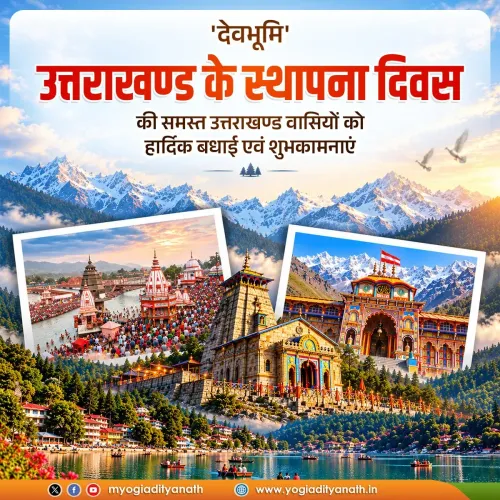
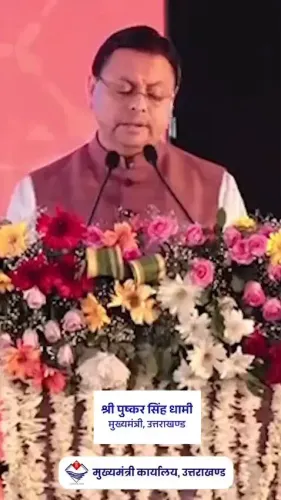
CM Dhami Marks Uttarakhand's 26th Foundation Day
Synopsis
On Uttarakhand's 26th Foundation Day, CM Pushkar Singh Dhami saluted statehood movement activists, credited former PM Atal Bihari Vajpayee for the 2000 carve-out, and pledged inclusive, heritage-rooted development for youth, women, farmers, and border-district residents.
Key Takeaways
Uttarakhand Foundation Day falls on 9 November , marking statehood achieved in 2000 under PM Atal Bihari Vajpayee's NDA government.
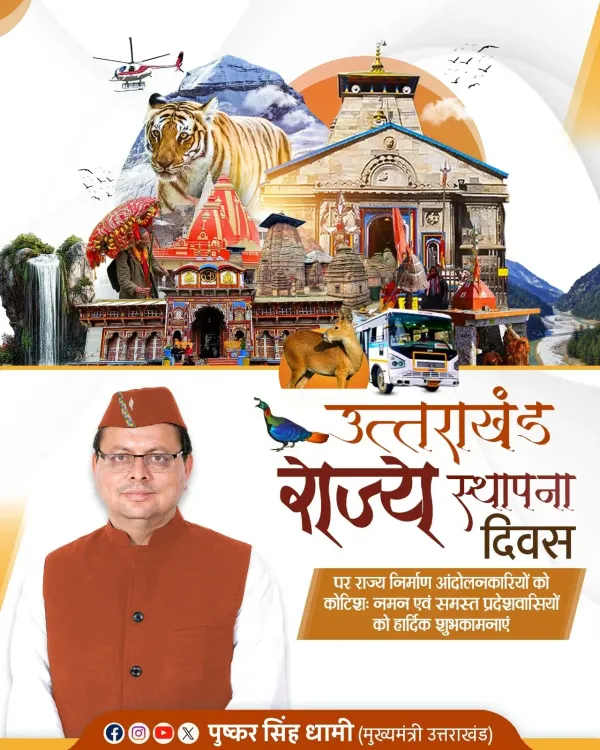
CM Dhami offered tribute to statehood movement activists and extended wishes to all residents of the state.
Vajpayee's Uttar Pradesh Reorganisation Act simultaneously created Uttarakhand, Jharkhand, and Chhattisgarh — three new states in one move.
Dhami's development focus targets youth employment, women's self-reliance, farmer welfare, and border-district livelihoods .
The CM framed the state's identity around cultural heritage, spiritual consciousness, natural wealth, and human capability .
The overarching goal stated is an Uttarakhand that is economically strong, socially inclusive, environmentally balanced, and culturally rooted.
Twenty-six years after a decades-long agitation finally carved a new state out of the Himalayan foothills, Uttarakhand Chief Minister Pushkar Singh Dhami marked Uttarakhand Foundation Day on 9 November 2026 with a sweeping tribute to the movement's martyrs and a vision statement for the state's next chapter.
Posting on X, CM Dhami offered koti-koti naman — 'a salute a million times over' — to every activist who gave their all to the statehood cause, while extending warm wishes to the people of Uttarakhand. He credited the state's very existence to the 'far-sighted leadership, sensitive outlook, and firm political will' of former Prime Minister and Bharat Ratna awardee Atal Bihari Vajpayee, whose government enacted the legislation that made Uttarakhand India's 27th state on 9 November 2000.
From Agitation to Statehood: The Vajpayee Legacy
The road to statehood was long and, at points, bloody. The Uttarakhand movement stretched across decades, with activists demanding separation from Uttar Pradesh on grounds of geographical, cultural, and administrative distinctiveness. It was the NDA government under Vajpayee that finally delivered — the Uttar Pradesh Reorganisation Act of 2000 simultaneously created Uttarakhand, Jharkhand, and Chhattisgarh, one of independent India's most significant federal reorganisations in a single stroke.
Dhami's decision to anchor the anniversary message so explicitly in Vajpayee's name is both tribute and political continuity — a BJP chief minister invoking a BJP prime minister to frame the state's founding myth. That lineage matters in a state where the statehood movement's memory remains a living part of civic identity.
Dhami's Four Pillars: Youth, Women, Farmers, Border Districts
Beyond the salute to history, the CM outlined the development agenda his government intends to pursue. He said the goal is not merely to expand basic infrastructure but to build an Uttarakhand that is 'economically strong, socially inclusive, environmentally balanced, and culturally rooted.' He listed four specific beneficiary groups: youth seeking expanded opportunities, women working toward self-reliance, farmers seeking prosperity, and residents of border districts in need of new livelihood avenues.
The Himalayan state has long grappled with out-migration — young people leaving hill districts for the plains in search of jobs — making the youth employment and border-area development pledges particularly pointed. The CM invoked the guidance of Prime Minister Narendra Modi as the broader framework within which 'development and heritage' would be harmonised.
A State That Sells Itself to the World
Dhami noted that over 26 years, Uttarakhand has established a distinct national and international identity built on four assets: its rich cultural heritage, spiritual consciousness, natural wealth, and human capability. That identity is no accident — the state has steadily leveraged its Himalayan pilgrimage circuit (Char Dham, Rishikesh, Haridwar) and adventure-tourism potential into economic activity, even as it manages the ecological pressures of a fragile mountain ecosystem.
The closing note of the CM's message was aspirational but grounded: 'With the collective strength of the people, their participation, and an unbreakable resolve, we will realise the dreams of the state movement's activists and build a developed Uttarakhand for future generations.' That sentence is at once a promise to the living and an accountability marker for every budget and policy session that follows.
Point of View
Women, farmers, border residents — the statement reads less like a ceremonial address and more like a pre-budget policy signal, suggesting targeted schemes may be in the pipeline. The emphasis on 'environmentally balanced' development is notable in a state where infrastructure ambitions have repeatedly clashed with ecological vulnerability. As Uttarakhand enters its 27th year, the gap between aspiration and out-migration statistics will be the sharpest test of these pledges.
NationPress
9 Nov 2026
Frequently Asked Questions
When was Uttarakhand founded as a separate state?
Uttarakhand was founded on 9 November 2000 , carved out of Uttar Pradesh under the Uttar Pradesh Reorganisation Act passed during PM Atal Bihari Vajpayee's NDA government. It became India's 27th state.
Who is credited with granting Uttarakhand statehood?
Former Prime Minister Atal Bihari Vajpayee , a Bharat Ratna awardee, is widely credited with the political will to create Uttarakhand. CM Dhami explicitly honoured his 'far-sighted leadership and firm political resolve' in his Foundation Day message.
What is the Uttarakhand statehood movement?
The Uttarakhand statehood movement was a decades-long agitation by activists demanding a separate state from Uttar Pradesh, citing the region's distinct Himalayan geography, culture, and administrative needs. The movement succeeded in 2000 .
What are CM Dhami's development priorities for Uttarakhand?
CM Dhami has outlined four key focus areas: expanding opportunities for youth , achieving self-reliance for women , ensuring prosperity for farmers , and creating new livelihood avenues in border districts of the state.
Which three states were created together with Uttarakhand in 2000?
The Uttar Pradesh Reorganisation Act of 2000 created Uttarakhand , while separate legislation in the same parliamentary session also established Jharkhand (from Bihar) and Chhattisgarh (from Madhya Pradesh), making it one of India's largest federal reorganisations.