CM Dhami Pays Tribute to RSS Chief Balasaheb Deoras on Death Anniversary
Synopsis
Uttarakhand Chief Minister Pushkar Singh Dhami on 17 June 2026 honoured RSS's third Sarsanghchalak Balasaheb Deoras on his death anniversary, citing his legacy of nation-building, social harmony, and organisational expansion as an enduring source of inspiration.
Key Takeaways
Uttarakhand CM Pushkar Singh Dhami posted a tribute to Balasaheb Deoras on 17 June 2026 , his death anniversary.
Balasaheb Deoras was the third Sarsanghchalak of the RSS , serving from 1973 to 1994 .
Dhami highlighted Deoras's contributions to nation-building, social harmony (samarasta), and RSS organisational expansion .
The tribute tagged @RSSorg , publicly affirming the BJP-Sangh ideological link.
Deoras steered the RSS through the Emergency period (1975–77) and is credited with significant grassroots expansion.
Such tributes by BJP leaders to past RSS chiefs form a recurring pattern that underscores shared ideological roots.
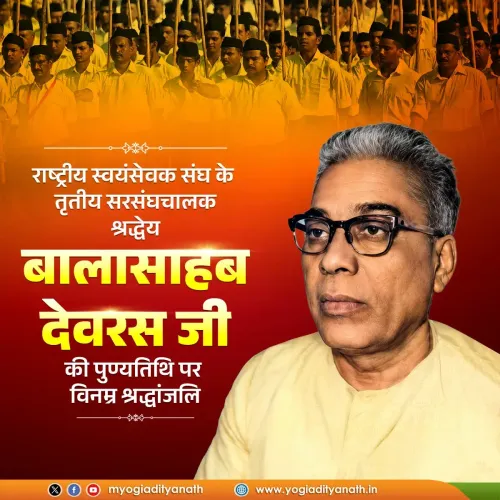
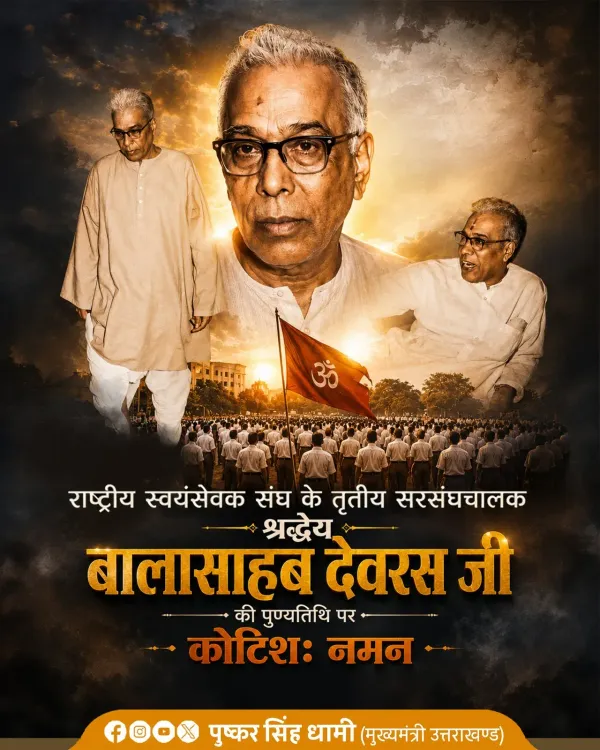
Uttarakhand Chief Minister Pushkar Singh Dhami on Wednesday, 17 June 2026, paid tribute to Balasaheb Deoras, the third Sarsanghchalak of the Rashtriya Swayamsevak Sangh (RSS), on his death anniversary, honouring his legacy of nation-building, social harmony, and organisational expansion.
Posting on X and tagging @RSSorg, Dhami wrote: 'Rashtriya Swayamsevak Sangh ke tritiya Sarsanghchalak shraddheya Balasahab Deoras ji ki punyatithi par kotishaha naman' — offering crores of salutations to the revered third Sarsanghchalak on his death anniversary. He described Deoras's life as a source of inspiration for all, dedicated to nation-building (rashtra nirman), social harmony (samajik samarasta), and organisational growth.
Context
Balasaheb Deoras, born Madhukar Dattatraya Deoras, served as the RSS's third Sarsanghchalak from 1973 to 1994, succeeding M.S. Golwalkar. His tenure was among the most consequential in the organisation's history, spanning the Emergency period (1975–77) and years of significant ideological and structural consolidation. He is credited with expanding the RSS's grassroots network and placing a strong emphasis on samarasta — the principle of social harmony across caste lines.
Dhami's tribute specifically cited Deoras's 'far-sighted leadership and tireless dedication' (doordarshi netritva aur athak tapasya) as having taken the Sangh to new heights. The post concluded that Deoras's thoughts and ideals 'will always guide us.'
Policy Backdrop
The RSS, founded in 1925, functions as the ideological parent of the BJP and a wider constellation of affiliated organisations collectively known as the Sangh Parivar. Leaders who rise through RSS-affiliated structures frequently invoke the organisation's foundational figures as touchstones for governance philosophy, particularly on themes of national integration and social cohesion.
Tributes by BJP chief ministers and central leaders to past RSS Sarsanghchalaks on their death anniversaries form a recurring and institutionalised pattern. These public acknowledgements serve to reinforce the ideological continuum between elected governance and the Sangh's volunteer tradition — themes Dhami has consistently underscored during his tenure in Dehradun.
Stakeholders and Impact
The tribute carries resonance for RSS swayamsevaks across the country, for whom Deoras remains a revered figure who steered the organisation through one of India's most turbulent political periods. For the broader BJP ecosystem, such statements publicly affirm shared ideological roots ahead of organisational and electoral cycles.
Deoras's emphasis on samarasta — outreach to communities historically marginalised within Hindu society — continues to inform both RSS programming and BJP social policy framing. Dhami's invocation of this legacy signals continuity with that tradition at the state level.
What's Next
Similar commemorative messages from other BJP chief ministers and central leaders are expected around 17 June each year, reflecting the calendar of Sangh observances that party leaders publicly mark. Observers will watch whether references to Deoras's samarasta legacy translate into specific cultural or social policy announcements in Uttarakhand's upcoming legislative or budgetary calendar. The consistency of such tributes also signals the Sangh-BJP relationship as a live political force, not merely a historical one.
Point of View
Dhami aligns his governance identity with the Sangh's social outreach legacy, which has electoral salience in a diverse state like Uttarakhand. The tagging of @RSSorg amplifies the message beyond a personal tribute into an institutional affirmation. At a broader level, this pattern illustrates how the BJP-RSS relationship is actively maintained through symbolic communication, not only through policy or organisational channels.
NationPress
15 Sept 2026
Frequently Asked Questions
Who was Balasaheb Deoras of RSS?
Balasaheb Deoras, born Madhukar Dattatraya Deoras, was the third Sarsanghchalak (chief) of the Rashtriya Swayamsevak Sangh, serving from 1973 to 1994. He is remembered for expanding the RSS's organisational network and championing 'samarasta' — social harmony across caste lines.
When did Balasaheb Deoras die?
Balasaheb Deoras passed away on 17 June 1996, and his death anniversary is observed annually by RSS and BJP leaders with tributes and commemorations.
Why did CM Dhami pay tribute to Balasaheb Deoras?
Uttarakhand Chief Minister Pushkar Singh Dhami posted the tribute on 17 June 2026, the death anniversary of Balasaheb Deoras, honouring his legacy of nation-building, social harmony, and RSS organisational growth.
What is samarasta in the context of RSS?
Samarasta, meaning social harmony, is a principle championed by Balasaheb Deoras within the RSS that emphasises unity and equal dignity across all sections of Hindu society, particularly reaching out to communities historically marginalised by caste discrimination.
What is the relationship between BJP and RSS?
The BJP and the RSS share deep ideological roots; the RSS is widely regarded as the ideological parent organisation of the BJP. Many BJP leaders, including chief ministers, have backgrounds in RSS activities, and public tributes to RSS figures are a regular feature of BJP political culture.