CM Dhami: Other States Now Follow Uttarakhand's Policy Model
Synopsis
Chief Minister Pushkar Singh Dhami has stated that multiple policy decisions taken by Uttarakhand in the state's interest are now being replicated by other states, describing this as evidence of the success of Uttarakhand's good governance model.
Key Takeaways
The Chief Minister's Office of Uttarakhand quoted CM Pushkar Singh Dhami on July 23, 2026 , claiming other states are following the state's policy decisions.
CM Dhami described the development as proof of the success of Uttarakhand's good governance model .
Uttarakhand was formed in 2000 and has focused on sustainable development, tourism, and administrative modernisation.
India's federal system has a documented history of policy diffusion between states, facilitated partly by platforms such as NITI Aayog .
No specific policies or named states adopting them were cited in the post; these details remain to be officially documented.
The Chief Minister's Office of Uttarakhand, on Thursday, July 23, 2026, quoted Chief Minister Pushkar Singh Dhami asserting that several policy decisions taken in the state's interest are now being adopted by other states — citing this as proof of the success of Uttarakhand's good governance model.
Context
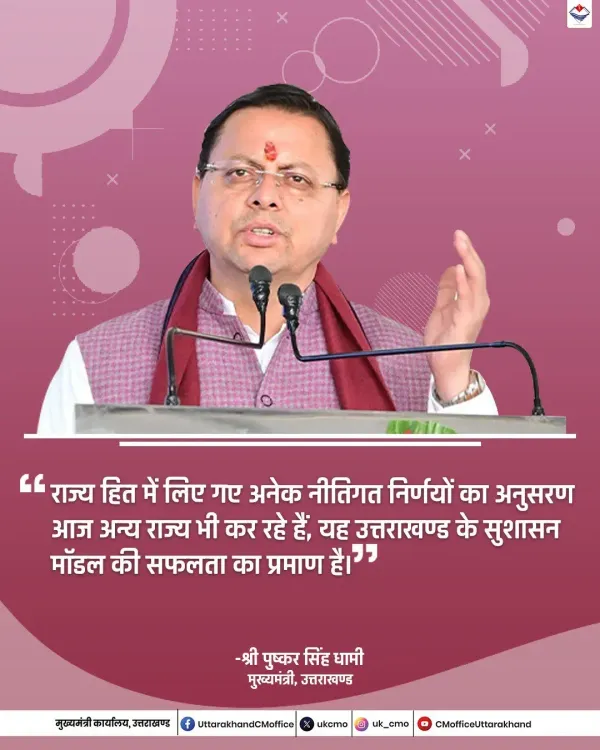
The official post from the Chief Minister's Office carries a direct quote from CM Dhami: 'राज्य हित में लिए गए अनेक नीतिगत निर्णयों का अनुसरण आज अन्य राज्य भी कर रहे हैं, यह उत्तराखण्ड के सुशासन मॉडल की सफलता का प्रमाण है।' ('Many policy decisions taken in the interest of the state are today being followed by other states as well — this is proof of the success of Uttarakhand's good governance model.')
The statement positions Uttarakhand as a governance template within India's federal structure, with CM Dhami framing policy diffusion from the state as a marker of administrative achievement since he assumed office in 2021.
Policy Backdrop
India's federal architecture has historically enabled a form of competitive federalism, where states observe, adapt, and replicate successful administrative or welfare measures from peers. This phenomenon has been documented across domains — from land reforms and digital governance tools to anti-corruption mechanisms — particularly since the early 2000s.
Uttarakhand, carved out as a separate state in 2000, has positioned itself around themes of sustainable development, Himalayan tourism, and administrative modernisation. Platforms such as NITI Aayog have institutionalised knowledge-sharing across states, providing a formal channel through which governance innovations travel between state capitals.
Stakeholders and Impact
The primary beneficiaries of any successful policy diffusion from Uttarakhand would be residents of states that adopt its administrative frameworks, as well as Uttarakhand's own citizens, for whom the state's governance record is a point of civic pride and political accountability. Other state governments, regardless of political affiliation, stand as the key actors in this dynamic.
For CM Dhami and the ruling dispensation in Dehradun, the narrative of being a model state carries significant political weight — particularly as it reinforces the administration's self-assessment ahead of any future electoral cycle in the state.
What's Next
Observers will watch for specific policy citations from other state governments or formal references in legislative sessions and governors' conferences that corroborate the claim of Uttarakhand's model being replicated. Any documentation from NITI Aayog or inter-state forums identifying Uttarakhand as a source of best practices would lend institutional weight to CM Dhami's assertion.
If the governance model claim is backed by verifiable examples in the coming weeks, it could sharpen Uttarakhand's profile in national policy discourse and strengthen the state's standing in federal grant and resource allocation conversations.
Point of View
The statement functions more as political positioning than verifiable record, though it could gain traction if substantiated by inter-governmental citations. The broader significance lies in how competitive federalism is increasingly being weaponised as a soft-power instrument within India's domestic political arena.
NationPress
21 Oct 2026
Frequently Asked Questions
What did CM Pushkar Singh Dhami say about Uttarakhand's governance model?
CM Pushkar Singh Dhami stated that many policy decisions taken in Uttarakhand's interest are now being followed by other states, calling it proof of the success of Uttarakhand's good governance model.
Which states are following Uttarakhand's policies?
The Chief Minister's Office post did not name specific states. The claim that other states are adopting Uttarakhand's policies has not been corroborated by official documentation as of the date of the post.
When did Pushkar Singh Dhami become Chief Minister of Uttarakhand?
Pushkar Singh Dhami became Chief Minister of Uttarakhand in 2021 and has since led the state's governance and policy agenda.
What is Uttarakhand's good governance model?
Uttarakhand's governance model broadly refers to the state's administrative reforms, sustainable development initiatives, and welfare policies pursued since its formation in 2000, with recent emphasis under CM Dhami on digital governance and state development.
What is competitive federalism in India?
Competitive federalism in India refers to the dynamic where states adopt, adapt, and replicate successful policies from peer states, often facilitated by bodies like NITI Aayog, to improve governance and attract investment.