CM Dhami: Uttarakhand economy grew 1.5x, per capita income up 41%
Synopsis
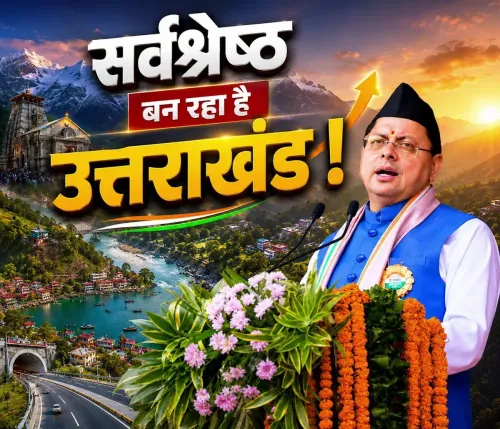
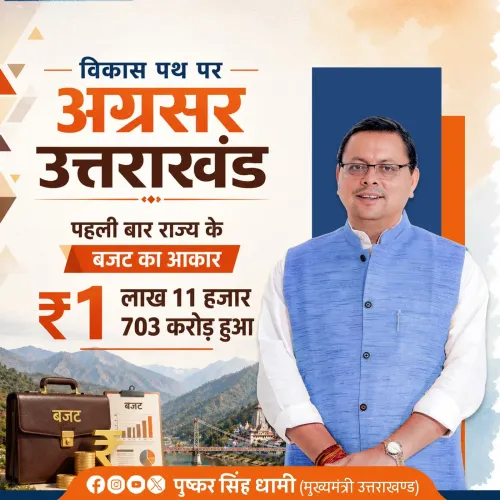
Chief Minister Pushkar Singh Dhami on 12 July 2026 declared that Uttarakhand's economy has grown one-and-a-half times and per capita income has risen 41 per cent, citing the figures as evidence of his government's development record.
Key Takeaways
CM Pushkar Singh Dhami on 12 July 2026 stated that Uttarakhand's economy has grown to one-and-a-half times its previous size.
Per capita income in the state has risen by 41 per cent , according to the Chief Minister's remarks.
The statement was shared via video by the Chief Minister's Office of Uttarakhand's official X account.
Uttarakhand , formed in 2000 , relies on tourism, hydropower, agriculture , and emerging manufacturing as economic pillars.
The government's figures are expected to be verified against the next official Uttarakhand Economic Survey and state budget.
The claims align with the broader pattern of Indian states using economic indicators to build both investor confidence and political narratives.
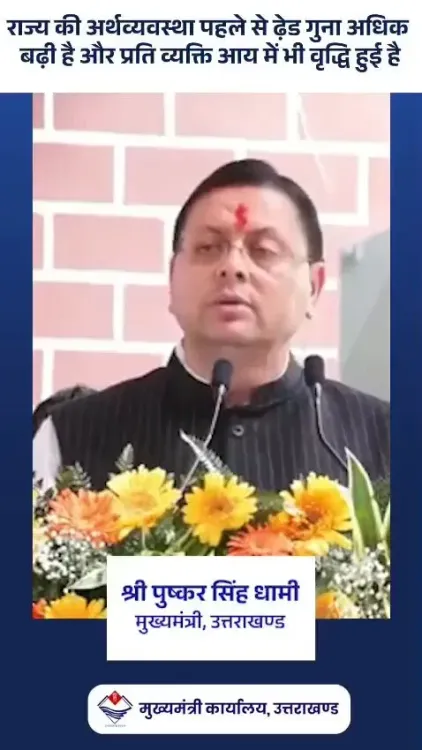
Chief Minister Pushkar Singh Dhami on Sunday, 12 July 2026 stated that Uttarakhand's economy has grown to one-and-a-half times its earlier size and that per capita income in the state has risen by 41 per cent, citing these figures as markers of the state government's development record.
Context
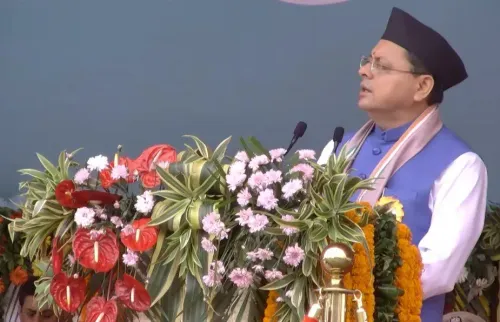
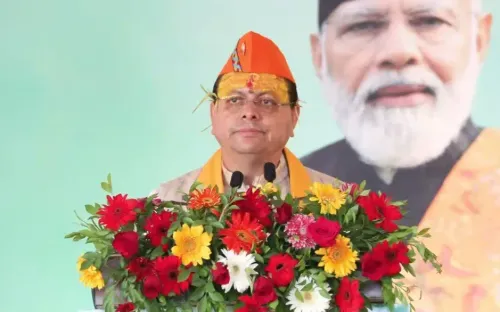
Speaking in remarks shared by the Chief Minister's Office of Uttarakhand on its official X account, CM Dhami said: 'Aaj rajya ki arthavyavastha pahle se dedh guna adhik badhi hai aur prati vyakti aay mein bhi 41% ki vriddhi hui hai' — ('Today the state's economy has grown one-and-a-half times more than before and per capita income has also increased by 41 per cent'). The statement was accompanied by a video, suggesting it was drawn from a public address or event.
The claim places Uttarakhand among the faster-growing hill states in India. The government has not specified the baseline year for the comparison in this post, though the figures are being presented as a measure of progress under the current administration.
Policy Backdrop
Uttarakhand, carved out as a separate state in November 2000, has historically relied on tourism, hydropower, agriculture, and more recently, pharmaceuticals and light manufacturing as economic pillars. The state's industrial policy framework, including the Uttarakhand Industrial Policy 2017, was designed to attract investment and diversify growth beyond terrain-constrained sectors.
CM Dhami, who has led the BJP government in the state since March 2021, has repeatedly positioned investment attraction and infrastructure development as central to his administration's agenda. The state has hosted investment summits aimed at channelling private capital into manufacturing and services.
Indian state governments regularly publicise gross state domestic product growth and per capita income gains as part of competitive federalism, benchmarking themselves against national averages and neighbouring states. For a hill state managing environmental sensitivities and tourism dependence, sustaining above-average growth is considered a significant policy achievement.
Stakeholders and Impact
The figures, if borne out by official economic surveys, would have direct implications for Uttarakhand's approximately 1.1 crore residents, particularly those in rural and semi-urban areas where income gains have historically lagged behind urban centres like Dehradun and Haridwar. Rising per capita income is typically associated with improved purchasing power, better access to credit, and greater household spending on education and health.
Local businesses across the tourism corridor — from Rishikesh to Kedarnath — as well as emerging industrial clusters in the Haridwar-Roorkee belt, stand to benefit if the economic expansion is broad-based. Labour migration out of the hills, a persistent structural challenge for the state, could moderate if income growth is sustained in interior districts.
What's Next
The government's claims will be tested against the next state budget presentation and the official Uttarakhand Economic Survey, which typically provides independently compiled gross state domestic product and income data with baseline comparisons. Any forthcoming investment summit or policy announcement is expected to use these figures as a launchpad for further capital mobilisation.
For CM Dhami, these economic benchmarks are likely to feature prominently in the political narrative ahead of future electoral cycles, as the BJP seeks to consolidate its position in the state on a development platform.
Point of View
Where state governments use GSDP and income metrics to build electoral and investor narratives simultaneously. For a hill state like Uttarakhand — constrained by geography, migration pressure, and environmental regulations — a 1.5-times economy expansion would represent a meaningful structural shift, not merely cyclical growth. CM Dhami's public emphasis on these numbers suggests the BJP intends to anchor its state-level political identity firmly on economic delivery. The credibility of the claims will ultimately rest on the granular data released in the next economic survey.
NationPress
11 Oct 2026
Frequently Asked Questions
How much has Uttarakhand's economy grown under CM Dhami?
CM Pushkar Singh Dhami stated on 12 July 2026 that Uttarakhand's economy has grown to one-and-a-half times its earlier size, though the specific baseline year was not mentioned in the post.
By how much has per capita income increased in Uttarakhand?
According to CM Dhami's statement, per capita income in Uttarakhand has risen by 41 per cent, a figure he cited as a key indicator of the state's economic progress.
What is Uttarakhand's economy based on?
Uttarakhand's economy is primarily based on tourism, hydropower, agriculture, and a growing pharmaceutical and light manufacturing sector, with industrial corridors concentrated around Haridwar and Roorkee.
Who is the Chief Minister of Uttarakhand in 2026?
Pushkar Singh Dhami of the BJP has been Chief Minister of Uttarakhand since March 2021 and continues to lead the state government.
Where can I find official Uttarakhand economic data?
Official economic figures for Uttarakhand are published in the state's annual Economic Survey and budget documents released by the Uttarakhand government, which provide verified GSDP and per capita income data with baseline comparisons.