CM Dhami: Developed Uttarakhand needs every section of society
Synopsis
Chief Minister Pushkar Singh Dhami has declared that a developed Uttarakhand is achievable only when every section of society participates in the state's growth journey, reinforcing the government's inclusive-development mandate amid persistent challenges of hill out-migration and uneven economic gains.
Key Takeaways
CM Pushkar Singh Dhami stated on 13 July 2026 that the vision of a developed Uttarakhand requires participation from every section of society.
The statement aligns with the national 'Sabka Saath, Sabka Vikas' framework and the state BJP's 'double-engine' development model.
Uttarakhand faces structural challenges including out-migration from hill districts and uneven distribution of gains from tourism and hydropower.
Primary intended beneficiaries include SC/ST communities, women , and residents of remote hill areas in Garhwal and Kumaon divisions.
Policy observers are watching for concrete budget allocations and scheme launches that translate this rhetoric into targeted action for migration-affected districts.
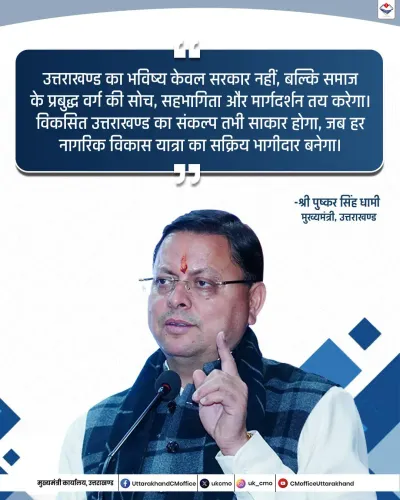
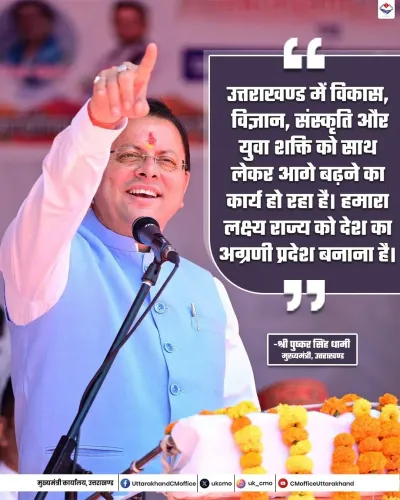
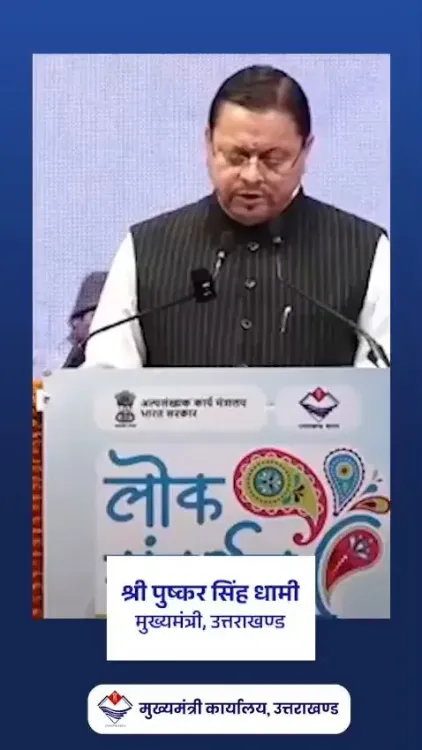
The Chief Minister's Office of Uttarakhand on Monday, 13 July 2026 shared a statement by Chief Minister Pushkar Singh Dhami reaffirming that the vision of a developed Uttarakhand can only be realised when every section of society is part of the journey of progress.
In the post, CM Dhami was quoted as saying: 'Hamari sarkar ka spasht vishwas hai ki viksit Uttarakhand ka sapna tabhi sakar hoga jab samaj ka har varg vikas ki is yatra mein shamil hoga' — ('Our government firmly believes that the dream of a developed Uttarakhand will be realised only when every section of society is part of this journey of development.')
Context
Pushkar Singh Dhami has served as Chief Minister of Uttarakhand since March 2021, leading a BJP government that has consistently positioned itself around a dual mandate: aligning state-level schemes with central government programmes and addressing the Himalayan state's structural development challenges. The statement underscores that inclusive growth — not merely aggregate economic expansion — is the administration's stated benchmark for success.
Uttarakhand faces distinct pressures that make the 'every section of society' framing particularly resonant. Persistent out-migration from hill districts has hollowed out rural communities, while economic gains from tourism and hydropower have been unevenly distributed across regions and demographics.
Policy Backdrop
The sentiment expressed by CM Dhami closely mirrors the national 'Sabka Saath, Sabka Vikas' (Together with all, development for all) framework that has anchored central government messaging since 2014. At the state level, this philosophy has translated into efforts to bring Scheduled Caste, Scheduled Tribe, women and residents of remote hill areas into the mainstream of welfare delivery and economic opportunity.
The Uttarakhand BJP government's emphasis on a 'double-engine' development model — whereby state schemes are designed to complement and amplify centrally sponsored programmes — has been a recurring feature of its budgetary and administrative communications since 2017.
Stakeholders and Impact
The constituencies most directly addressed by this framing are marginalised communities and rural hill populations, who have historically been the last to benefit from growth driven by the state's tourism corridors and energy infrastructure. For these groups, inclusive-development rhetoric carries weight only when accompanied by targeted budget allocations and on-ground scheme implementation.
Women entrepreneurs, SC/ST communities, and residents of migration-affected districts in the Garhwal and Kumaon divisions stand to be the primary intended beneficiaries of any policy measures that follow from such stated commitments. Civil society groups and opposition parties in the state are likely to scrutinise upcoming budget sessions and scheme announcements against this benchmark.
What's Next
Statements of this nature from the Chief Minister's Office have historically preceded or accompanied budget presentations, welfare scheme launches, or major administrative reviews. Observers will watch for concrete allocations targeting migration-affected districts and underserved demographics in upcoming state government announcements.
The degree to which the Dhami government translates this inclusive-development commitment into measurable outcomes — particularly for remote hill communities — will shape the political narrative in Uttarakhand as the state moves further into its current legislative term.
Point of View
Calibrated for a state where geographic and demographic fault lines make such messaging politically essential. By invoking 'every section of society,' the Chief Minister signals awareness that Uttarakhand's development story cannot be credibly told through aggregate numbers alone — hill out-migration and tourism-sector concentration demand a more granular equity argument. The statement fits a broader pattern in which state BJP governments use the 'Sabka Saath' framework to pre-empt opposition critiques ahead of budget cycles or scheme rollouts. Its real political weight will be determined by the specificity and scale of welfare measures that follow in the coming legislative calendar.
NationPress
12 Oct 2026
Frequently Asked Questions
What did CM Pushkar Singh Dhami say about Uttarakhand's development?
CM Dhami stated that the dream of a developed Uttarakhand will be realised only when every section of society is included in the journey of progress, as quoted by the Chief Minister's Office on 13 July 2026.
What is the 'double-engine' development model in Uttarakhand?
The double-engine model refers to the Uttarakhand BJP government's approach of aligning state-level schemes with centrally sponsored programmes, aiming to amplify development outcomes by synchronising both engines of governance.
Why is inclusive development a challenge in Uttarakhand?
Uttarakhand faces persistent out-migration from hill districts and uneven distribution of economic gains from tourism and hydropower, leaving marginalised communities and remote hill populations behind despite overall growth.
Who are the main beneficiaries of Uttarakhand's inclusive development push?
The primary intended beneficiaries are SC/ST communities, women, and residents of remote hill areas in the Garhwal and Kumaon divisions, who have historically been underserved by growth concentrated in tourism corridors.
How does CM Dhami's statement connect to national policy?
The statement mirrors the national 'Sabka Saath, Sabka Vikas' framework promoted since 2014, reflecting a consistent alignment between the Uttarakhand state government's messaging and the central BJP government's inclusive-development philosophy.