CM Dhami: Women's Trust Is Uttarakhand's Greatest Strength
Synopsis
Uttarakhand Chief Minister Pushkar Singh Dhami declares that the trust and smiles of mothers and sisters are his government's greatest asset, tying women's goodwill directly to the state's self-reliance and development mission.
Key Takeaways
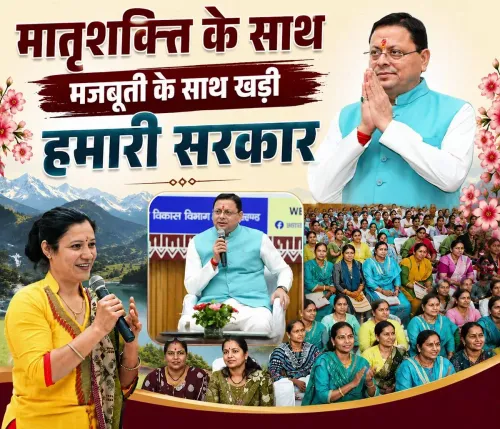
CM Pushkar Singh Dhami described the smiles and trust of mothers and sisters as Uttarakhand's 'greatest capital' in a post on October 17, 2026 .
He framed women's affection not as mere sentiment but as a reinforcement of his government's resolve to develop and make Uttarakhand self-reliant.
The message invokes the Atmanirbhar Bharat framework announced in 2020 , applying the self-reliance goal explicitly at the state level.
In Uttarakhand , a high out-migration hill state, women are primary recipients of welfare delivery and a key political constituency.
BJP -led state governments have consistently used women's endorsement as a governance barometer, signalling ground-level welfare reach.
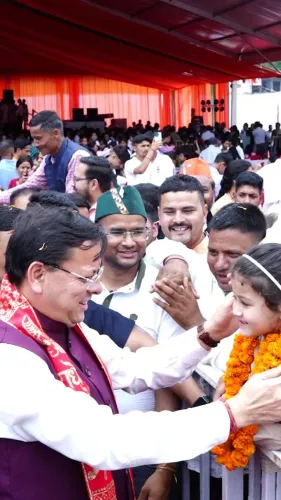
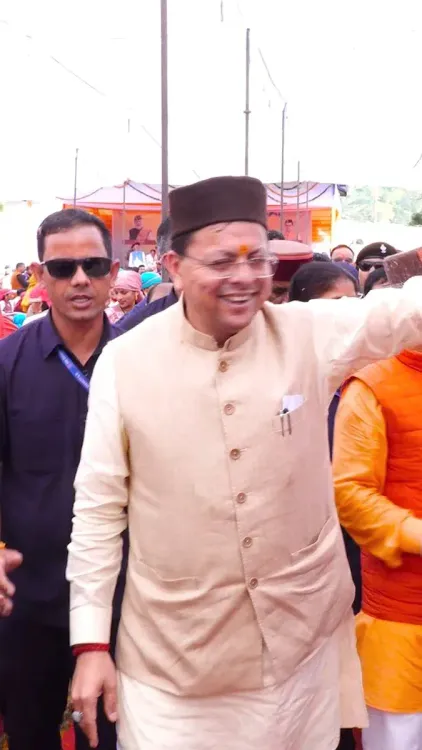
The smiles of mothers and sisters, Uttarakhand Chief Minister Pushkar Singh Dhami wrote on Saturday, October 17, are not just emotional warmth — they are the fuel that hardens his government's resolve to build a developed, self-reliant Devbhoomi.
In a post on X, CM Dhami wrote: 'Maataon-bahnon ke chehron par muskaan aur aankhon mein dikhaai dene wala vishwas hamari sabse badi punji hai' — 'The smiles on the faces of mothers and sisters, and the trust visible in their eyes, is our greatest capital.' He went further, calling that affection not merely an emotional support but a force that strengthens the government's commitment to serving the state and making Uttarakhand developed and self-reliant.
Women at the Centre of Dhami's Governance Narrative
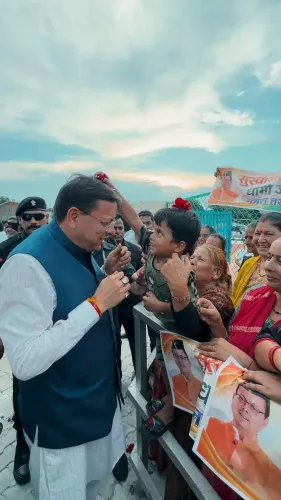
The framing is deliberate. BJP-led state governments have consistently positioned women's goodwill as a barometer of effective governance — a signal that welfare delivery is reaching the last household. For a hill state like Uttarakhand, where male out-migration to cities is historically high, women are disproportionately both the administrators of daily life and the primary recipients of state-run welfare schemes.
Invoking their trust, then, is not ceremonial language. It is a political and administrative report card — an assertion that ground-level delivery is working.
Self-Reliant Uttarakhand and the Atmanirbhar Thread
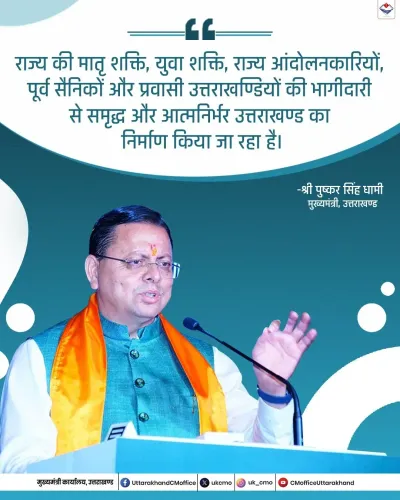
Dhami's explicit use of 'aatmanirbhar' (self-reliant) echoes the national Atmanirbhar Bharat framework announced in 2020, which called on states to reduce dependence on central transfers and build local economic capacity. Applied to Uttarakhand — a state whose economy leans heavily on tourism, remittances, and central grants — self-reliance carries particular urgency. Women-led self-help groups, rural livelihoods missions, and hill-agriculture programmes are among the state-level instruments through which that goal is pursued.
The Chief Minister's message ties women's emotional endorsement directly to that larger economic ambition: their trust is cast as both the motivation and the measure of progress.
What the Signal Means Going Forward
Statements of this kind from state chief ministers typically precede or accompany announcements of expanded social schemes, ground-level outreach drives, or review meetings on women-focused programmes. Whether a concrete policy move follows this affirmation in the coming days will determine whether it lands as a governing signal or a rhetorical one. Either way, Dhami has placed women's welfare — and women's verdict on his government — squarely at the centre of Uttarakhand's development story.
In hill politics, that is rarely an accident.
Point of View
He stitches Uttarakhand's local development agenda onto the national self-reliance narrative, lending it ideological coherence. For a hill state chronically dependent on central flows and facing demographic stress from out-migration, placing women at the narrative centre is also a tacit acknowledgement of where real administrative and social weight lies. Whether this reaffirmation translates into specific scheme announcements will be the telling indicator.
NationPress
17 Oct 2026
Frequently Asked Questions
What did CM Pushkar Singh Dhami say about women in his October 2026 post?
CM Dhami said the smiles and trust of mothers and sisters are his government's greatest capital, and that their affection strengthens his resolve to develop and make Uttarakhand self-reliant.
What does 'Devbhoomi' mean in the context of Uttarakhand?
'Devbhoomi' means 'Land of the Gods' and is a revered name for Uttarakhand, reflecting its religious and cultural significance as home to major Hindu pilgrimage sites.
What is the Atmanirbhar Bharat initiative and how does it relate to Uttarakhand?
Atmanirbhar Bharat is a national self-reliance framework launched in 2020. CM Dhami's vision of an 'aatmanirbhar' Uttarakhand applies this goal at the state level, aiming to reduce dependence on external transfers and boost local economic capacity.
Why do BJP-led state governments emphasise women's support in governance messaging?
BJP-led state governments use women's endorsement as a signal of effective welfare delivery at the household level, reflecting a broader political strategy of positioning women as both beneficiaries and validators of inclusive governance.
What welfare programmes target women in Uttarakhand?
Uttarakhand runs several women-focused schemes including self-help group missions, rural livelihoods programmes, and hill-agriculture initiatives, aligned with national frameworks for women's economic empowerment.