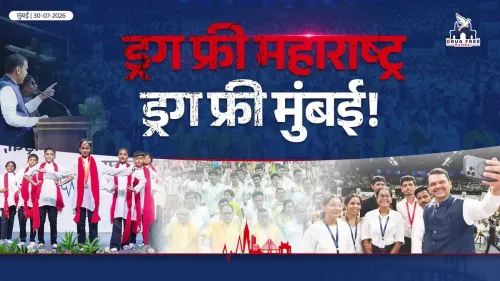
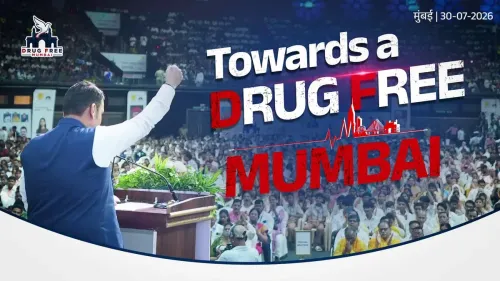
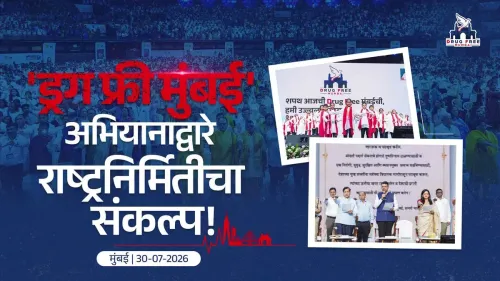
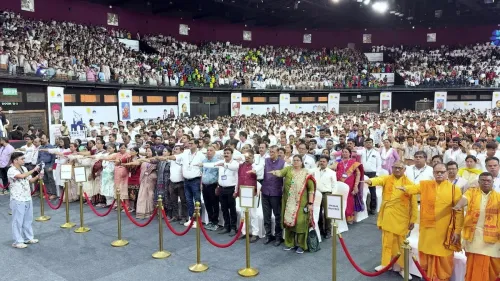
CM Fadnavis Calls for Drug-Free Mumbai
Synopsis
Chief Minister Devendra Fadnavis on 31 July 2026 called for a drug-free Mumbai, with the CMO amplifying the pledge on X. The statement invokes Maharashtra's NDPS Act enforcement framework and signals potential inter-agency action in India's financial capital.
Key Takeaways
The Chief Minister's Office of Maharashtra on 31 July 2026 posted a call by CM Devendra Fadnavis for a drug-free Mumbai.
Devendra Fadnavis has served as Maharashtra's Chief Minister since 2022 , previously holding the post from 2014 to 2019 .
Mumbai 's port geography and dense population make it a persistent hub for narcotics trafficking networks.
State enforcement operates under the Narcotic Drugs and Psychotropic Substances (NDPS) Act, 1985 , in coordination with the central Narcotics Control Bureau .
Specific follow-up measures — enforcement operations, awareness programmes, or inter-agency meetings — are yet to be announced.
Mumbai — India's financial capital and a city of 21 million — has a narcotics problem that no amount of skyline glamour can obscure. On Friday, 31 July 2026, the Chief Minister's Office of Maharashtra amplified a call from Chief Minister Devendra Fadnavis for a drug-free Mumbai, putting the issue squarely on the state's governance agenda.
Fadnavis and the weight of Mumbai's drug challenge
Devendra Fadnavis, who first served as Maharashtra's Chief Minister from 2014 to 2019 and returned to the post in 2022, has made urban governance a centrepiece of his political identity. Mumbai's geography — a dense port city with layered informal economies — has long made it a persistent node in India's narcotics trafficking networks. The city's vulnerabilities are structural: port access, transient populations, and the sheer scale of its informal economy all create openings that enforcement agencies have repeatedly flagged.
Maharashtra operates within the framework of the Narcotic Drugs and Psychotropic Substances (NDPS) Act, 1985, which governs both state police action and coordination with central agencies such as the Narcotics Control Bureau (NCB). Periodic state-level enforcement drives under this framework have targeted trafficking routes and street-level distribution, though sustained outcomes have proved elusive across successive administrations.
A recurring pledge — and what makes it stick
Drug-free city campaigns are not new to Indian urban governance. Major metros have cycled through them, combining police crackdowns with awareness drives in schools and housing societies. What distinguishes a campaign that shifts numbers from one that generates headlines is the depth of coordination — between state police, the NCB, customs, and local municipal bodies — and whether enforcement is paired with rehabilitation infrastructure for users.
For Mumbai residents and law enforcement alike, the Chief Minister's public call is now on record. The pressure it creates — on police commissioners, district officials, and central agency liaisons — is real, even before a single specific measure is announced. In Indian governance, a CM-level statement of intent typically precedes an inter-agency coordination meeting or a formal action plan rollout.
The next test is specifics: which enforcement operations follow, what awareness programmes are deployed in vulnerable neighbourhoods, and whether the state allocates fresh resources to the NCB's Mumbai zone. A call without a calendar is a headline. A call with a plan is a policy.
Point of View
The statement raises the bar for his own administration — any visible backsliding on enforcement will now be measured against this moment. The broader arc here is the tension between Maharashtra's periodic enforcement surges and the structural factors — port access, informal economies — that keep Mumbai's narcotics networks resilient. Whether this call seeds a durable policy framework or fades into the cycle of recurring announcements will define its legacy.
NationPress
31 Jul 2026
Frequently Asked Questions
What did CM Devendra Fadnavis say about drugs in Mumbai?
On 31 July 2026 , CM Devendra Fadnavis called for a drug-free Mumbai, a statement amplified by the official Chief Minister's Office of Maharashtra on X. Specific measures accompanying the call had not been publicly detailed at the time of the post.
What is the drug situation in Mumbai?
Mumbai 's status as India's largest port city and financial hub makes it a persistent node in narcotics trafficking networks. Dense populations, port access, and layered informal economies create structural vulnerabilities that enforcement agencies have flagged repeatedly.
Which law governs anti-drug action in Maharashtra?
Maharashtra's anti-narcotics enforcement operates primarily under the Narcotic Drugs and Psychotropic Substances (NDPS) Act, 1985 , with state police working in coordination with the central Narcotics Control Bureau (NCB) .
How long has Devendra Fadnavis been Chief Minister of Maharashtra?
Devendra Fadnavis first served as Chief Minister from 2014 to 2019 and returned to the office in 2022 , making him one of Maharashtra's most experienced chief ministers in recent decades.
What should we watch for after Fadnavis's drug-free Mumbai call?
Key indicators will include specific enforcement operations announced by Mumbai Police or the NCB, inter-agency coordination meetings convened by the state, awareness programmes in high-risk neighbourhoods, and any fresh budget allocation for rehabilitation infrastructure.