CM Fadnavis Calls for Mass Participation in Drug-Free Maharashtra Drive
Synopsis
The Chief Minister's Office of Maharashtra on 17 July 2026 amplified CM Devendra Fadnavis's appeal for universal public participation in the Drug-Free Maharashtra movement, framing collective action as essential to building a stronger state.
Key Takeaways
The Chief Minister's Office of Maharashtra posted on 17 July 2026 calling for mass participation in an anti-addiction movement under the banner #DrugFreeMaharashtra .
Chief Minister Devendra Fadnavis is personally associated with the campaign, lending it significant political and administrative weight.
Maharashtra has over 112 million residents and has historically run substance-abuse awareness and rehabilitation programmes in urban centres and educational institutions.
The campaign operates within India's NDPS Act framework , amended in 2014 to strengthen both penalties and treatment provisions.
Key stakeholders include youth and families affected by addiction , with community organisations and local bodies expected to play a central role in outreach.
Upcoming district-level awareness camps and potential expansions of rehabilitation centres are the key developments to watch from the state health department.
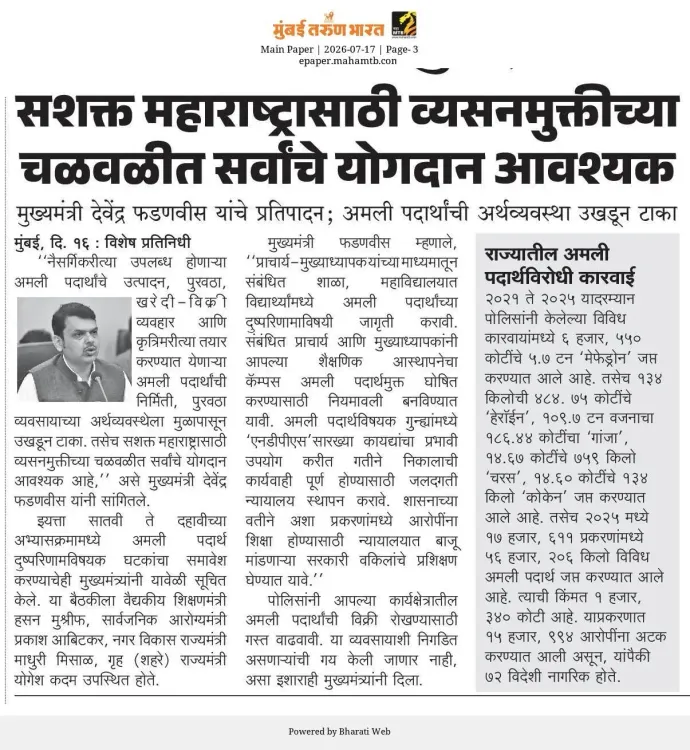
The Chief Minister's Office of Maharashtra posted on Friday, 17 July 2026, amplifying a call by Chief Minister Devendra Fadnavis for collective public participation in the state's anti-addiction movement, framing it as essential to building a stronger Maharashtra.
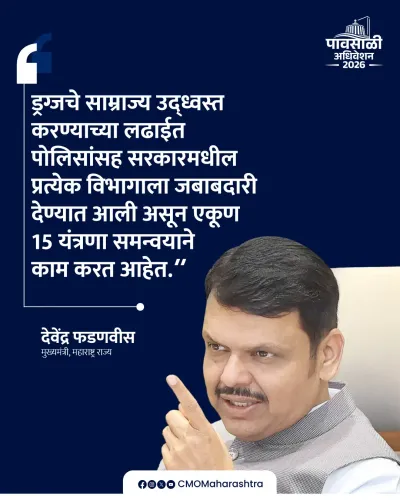
The post, shared via the official CMO handle in response to @CMOMaharashtra, carried the message: 'सशक्त महाराष्ट्रासाठी व्यसनमुक्तीच्या चळवळीत सर्वांचे योगदान आवश्यक' — 'Everyone's contribution is necessary in the movement for addiction-free Maharashtra, for a stronger Maharashtra.' The hashtags #DrugFreeMaharashtra and #DevendraFadnavis accompanied the post, signalling an active public mobilisation push.
Context
Maharashtra, home to over 112 million residents, has long grappled with substance abuse challenges across its urban centres and rural districts. The state government has periodically run awareness campaigns and rehabilitation programmes targeting youth and families affected by addiction. This latest communication positions the anti-addiction drive not merely as a law-enforcement exercise but as a broad social movement requiring citizen involvement at every level.
Chief Minister Devendra Fadnavis, who has served multiple terms at the helm of Maharashtra, has previously championed state-level social campaigns alongside administrative reforms. His direct association with the #DrugFreeMaharashtra hashtag signals that the campaign carries the Chief Minister's personal political weight.
Policy Backdrop
India's legal framework against narcotics rests on the Narcotic Drugs and Psychotropic Substances (NDPS) Act, which was significantly amended in 2014 to tighten penalties and expand treatment and rehabilitation provisions for drug-dependent individuals. Maharashtra's state-level programmes operate within this national framework, complementing enforcement with awareness and counselling outreach.
State governments across India have increasingly recognised that enforcement alone is insufficient, and that community-driven participation — through schools, local bodies, and civil society — is critical to reducing substance abuse rates. The CMO's post squarely reflects this approach, emphasising collective responsibility over top-down action alone.
Stakeholders and Impact
The primary beneficiaries of a sustained #DrugFreeMaharashtra campaign are youth and families affected by addiction, groups that bear the heaviest social and economic burden of substance abuse. Educational institutions, community organisations, and local government bodies are expected to serve as key delivery channels for any expanded outreach under this drive.
For families in both urban neighbourhoods and smaller towns, effective rehabilitation infrastructure and awareness camps can translate into reduced household distress and improved economic participation. The CMO's call for 'everyone's contribution' suggests the campaign intends to draw in non-governmental actors, resident welfare associations, and volunteers alongside official machinery.
What's Next
Observers will watch for concrete follow-through from the Maharashtra state health department, including announcements of district-level awareness camps, expansions of rehabilitation centre capacity, or formal partnerships with civil society groups. The public mobilisation tone of the CMO's post suggests that community-facing events and outreach drives may be forthcoming in the weeks ahead.
If the government translates this social-media push into a structured programme with measurable targets — such as the number of counselling centres opened or beneficiaries reached — it could set a template for other Indian states seeking to scale up anti-addiction work within the NDPS framework.
Point of View
' the Fadnavis administration is connecting public health to its wider development narrative ahead of any potential electoral or policy cycle. The emphasis on 'everyone's contribution' is also a signal to civil society and local bodies that the state expects co-delivery, not just passive compliance. Whether this momentum translates into measurable programme expansion will determine if the campaign is a lasting policy push or a high-visibility moment.
NationPress
15 Oct 2026
Frequently Asked Questions
What is the Drug-Free Maharashtra campaign?
The Drug-Free Maharashtra campaign is a public mobilisation drive by the Maharashtra state government, backed by Chief Minister Devendra Fadnavis, aimed at reducing substance abuse through community awareness, rehabilitation, and citizen participation alongside law enforcement.
What did CM Devendra Fadnavis say about the anti-addiction drive?
The Chief Minister's Office shared a message on 17 July 2026 stating that 'everyone's contribution is necessary in the movement for addiction-free Maharashtra, for a stronger Maharashtra,' calling for broad public involvement in the campaign.
What is the NDPS Act and how does it relate to Maharashtra's drug policy?
The Narcotic Drugs and Psychotropic Substances Act is India's primary legislation governing narcotics control. Amended in 2014 to tighten penalties and expand treatment provisions, it forms the legal backbone within which Maharashtra runs its anti-addiction enforcement and rehabilitation programmes.
Who are the main beneficiaries of Maharashtra's anti-addiction programmes?
Youth and families affected by addiction are the primary beneficiaries. Outreach is typically delivered through educational institutions, community organisations, local government bodies, and state-run rehabilitation centres.
What should we expect next from the Maharashtra government on this campaign?
Watch for announcements from the Maharashtra state health department on district-level awareness camps, rehabilitation centre expansions, and formal partnerships with civil society groups as the government moves to operationalise the public mobilisation push.