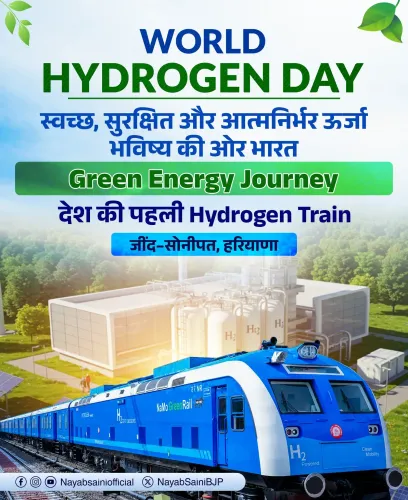
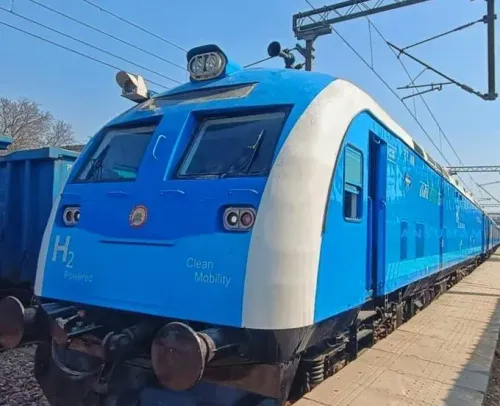
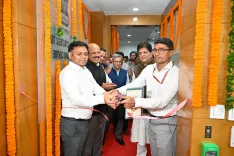
CM Samrat Choudhary hails India's first hydrogen train launch

Synopsis
Bihar Chief Minister Samrat Choudhary on July 17, 2026 hailed the launch of India's first hydrogen-powered train as a historic milestone, crediting PM Modi's leadership for advancing Indian Railways toward indigenous green technology and the Atmanirbhar Bharat vision.
Key Takeaways
Bihar CM Samrat Choudhary publicly welcomed the launch of India's first hydrogen-powered train on July 17, 2026 .
He credited Prime Minister Narendra Modi for steering Indian Railways toward modern technology and green energy.
The launch aligns with the National Green Hydrogen Mission approved in 2023 and the Hydrogen for Heritage railway scheme.
India has committed to achieving net-zero emissions by 2070 , with railways central to that goal.
Hydrogen trains emit only water vapour, offering a zero-carbon alternative on deployed routes.
Further route expansions and integration with state renewable projects are the key milestones to watch.
Bihar Chief Minister Samrat Choudhary on Friday, July 17, 2026 welcomed the launch of India's first hydrogen-powered train, calling it a historic step that gives fresh momentum to the vision of a developed India. The senior BJP leader praised Prime Minister Narendra Modi for steering Indian Railways toward modern technology, indigenous innovation, and green energy.
Context
Choudhary's post, written in Hindi, describes the launch as 'ek aitihasik kadam' — a historic step — that strengthens both environmental protection and the self-reliance mission. He wrote that the achievement is 'not merely technological progress, but also empowers the resolve for environmental conservation and an Atmanirbhar Bharat [self-reliant India].' He added that this new beginning toward 'clean, safe and sustainable transport is a matter of pride for the entire country.'
The post was accompanied by a video and carried the hashtag #भारत_की_पहली_हाइड्रोजन_ट्रेन (India's first hydrogen train), signalling coordinated political messaging around the milestone.
Policy Backdrop
The launch sits at the intersection of two flagship policy frameworks. The National Green Hydrogen Mission, approved in 2023, set out to position hydrogen as a clean fuel across transport and heavy industry. In the same year, Indian Railways announced the Hydrogen for Heritage scheme, which earmarked hydrogen-powered trains for deployment on heritage and hill routes as a first phase.
Successive Union Budgets have linked the Atmanirbhar Bharat self-reliance agenda with clean technology adoption in public transport, making the hydrogen train a symbolic convergence of industrial policy and climate commitments. India has also pledged to reach net-zero emissions by 2070, with the rail sector — one of the country's largest energy consumers — seen as central to that transition.
Stakeholders and Impact
Railway passengers stand to benefit from quieter, emission-free travel, while the domestic renewable energy and fuel-cell manufacturing industries gain a high-profile use case to accelerate investment. Hydrogen trains emit only water vapour, eliminating particulate and carbon emissions on the routes they serve.
For Bihar, a state with significant rail connectivity needs and a growing push for industrial investment, the CM's endorsement also carries a political signal: that the BJP-led government at the Centre is delivering tangible infrastructure modernisation beyond traditional freight and passenger upgrades.
What's Next
Attention will now turn to the pace of further route deployments and whether hydrogen train operations are integrated with state-level renewable energy projects in upcoming railway budget allocations. The success of initial runs will be critical to determining whether the technology scales beyond heritage and hill routes to mainstream corridors. Broader adoption could reshape India's rail decarbonisation timeline well ahead of the 2070 net-zero target.
Point of View
The CM positions himself as aligned with the Modi government's modernisation narrative while signalling to Bihar's electorate that the alliance is delivering tangible progress. The hydrogen train launch is also significant as a policy proof-of-concept: it tests whether India's green hydrogen ambitions can move from mission documents to operational rail infrastructure. How quickly subsequent deployments follow will determine whether this remains a symbolic moment or the start of a genuine decarbonisation shift in Indian Railways.
NationPress
15 Oct 2026
Frequently Asked Questions
What is India's first hydrogen-powered train?
India's first hydrogen-powered train is a fuel-cell-based locomotive developed under Indian Railways' push for green technology, running on hydrogen that emits only water vapour instead of carbon emissions.
What did Bihar CM Samrat Choudhary say about the hydrogen train?
Samrat Choudhary called the launch a historic step that gives new momentum to the vision of a developed India, praising PM Modi for advancing Indian Railways with indigenous innovation and clean energy.
What is the National Green Hydrogen Mission?
The National Green Hydrogen Mission, approved in 2023, is India's policy framework to promote hydrogen as a clean fuel in transport, industry, and energy storage to reduce fossil fuel dependence.
What is the Hydrogen for Heritage scheme?
The Hydrogen for Heritage scheme, announced by Indian Railways in 2023, plans to deploy hydrogen-powered trains on heritage and hill routes as the first step toward broader green rail operations.
How does the hydrogen train connect to India's net-zero target?
India has committed to net-zero emissions by 2070, and decarbonising Indian Railways — one of the country's largest energy consumers — through hydrogen and renewable energy is a key part of that strategy.