CM Fadnavis Launches State-Wide Anti-Drug Campaign in Maharashtra
Synopsis
The Chief Minister's Office of Maharashtra announced a statewide anti-narcotics campaign on 8 June 2026, with CM Devendra Fadnavis leading a broad enforcement and awareness drive targeting drug use and trafficking across the state.
Key Takeaways
The Chief Minister's Office of Maharashtra announced a statewide anti-drug campaign on 8 June 2026 .
Chief Minister Devendra Fadnavis is personally associated with the initiative, as indicated by his tagging in the official post.
The campaign operates under the central Narcotic Drugs and Psychotropic Substances (NDPS) Act framework.
Maharashtra's urban centres — including Mumbai , Pune , and Nashik — are key focus areas given their role as transit hubs for narcotics.
Youth and urban police forces are the primary stakeholders in the initiative.
Possible coordination with the Narcotics Control Bureau (NCB) and legislative follow-up in the state assembly are being watched.
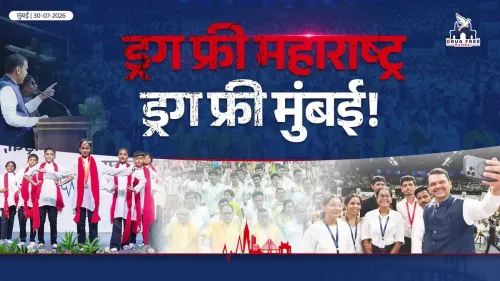
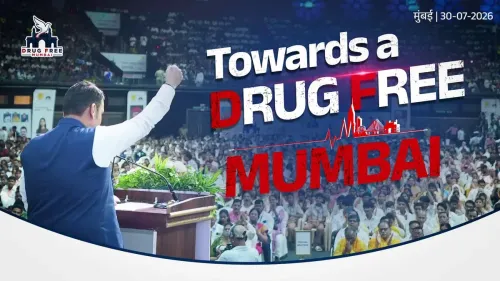
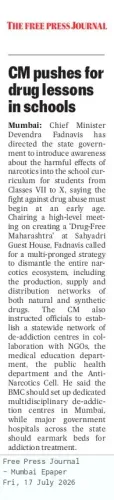
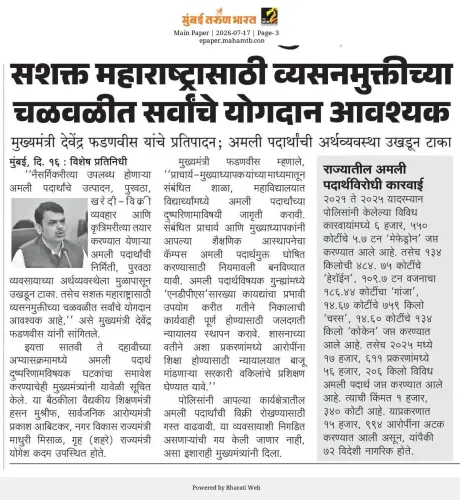
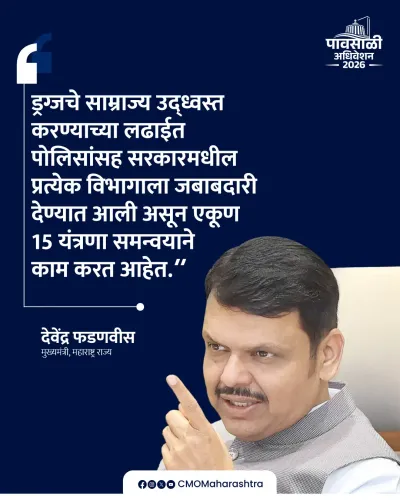
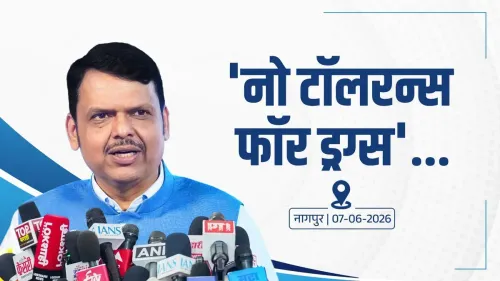
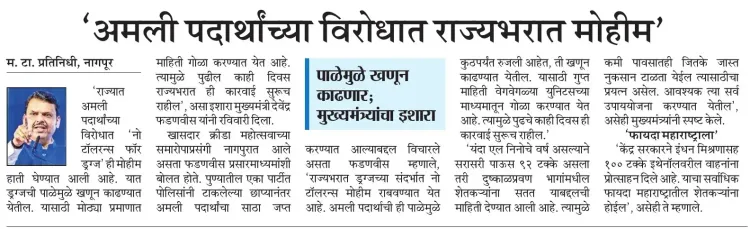
The Chief Minister's Office of Maharashtra announced on Monday, 8 June 2026 that the state government has launched a comprehensive anti-drug campaign across Maharashtra, with Chief Minister Devendra Fadnavis at the helm of the initiative aimed at curbing narcotics use and trafficking statewide.
The official post, shared in Marathi, declared: 'अमली पदार्थांच्या विरोधात राज्यभरात मोहीम' — 'A campaign across the state against narcotics' — signalling a broad-based mobilisation of state resources to tackle drug-related challenges.
Context
Maharashtra has long been on the frontlines of India's anti-narcotics effort, given its position as a major commercial and transit hub in western India. Urban centres such as Mumbai, Pune, and Nashik have periodically witnessed surges in synthetic drug availability, prompting state-level enforcement responses. The current campaign appears to extend this tradition of periodic, coordinated crackdowns.
Chief Minister Devendra Fadnavis, a senior BJP leader who previously served as Chief Minister from 2014 to 2019, has consistently positioned law-and-order and enforcement as central planks of his governance agenda. His tagging in the official post underscores his personal association with the drive.
Policy Backdrop
Anti-narcotics campaigns in Maharashtra operate within the framework of the central Narcotic Drugs and Psychotropic Substances (NDPS) Act, which has governed India's drug enforcement architecture since the 1980s. State police forces, in coordination with agencies such as the Narcotics Control Bureau (NCB), typically lead both enforcement raids and public awareness drives under this framework.
Indian states have increasingly intensified such campaigns ahead of examination seasons and major festivals, responding to documented concerns about the spread of synthetic drugs among youth. Maharashtra's state police and health departments have historically run parallel tracks — enforcement on one hand and school and college awareness programmes on the other — as part of a dual-pronged strategy.
Stakeholders and Impact
The campaign's primary beneficiaries are expected to be Maharashtra's youth population, who remain the most vulnerable demographic in drug-related public health assessments. Urban police forces across the state's districts are the key operational arm, tasked with translating the political directive into ground-level action.
Community organisations, educational institutions, and local self-government bodies are also likely to play a supporting role, as past drives in the state have relied on grassroots networks to amplify awareness messaging. The statewide scope of the campaign suggests district-level coordination is already underway or imminent.
What's Next
Observers will watch for the rollout of district-level enforcement actions and any formal coordination announcements with central agencies like the Narcotics Control Bureau. Legislative or budgetary follow-up in the Maharashtra state assembly — including potential allocation of dedicated funds or a formal policy resolution — would signal the campaign's long-term institutional ambition beyond the immediate announcement.
If the initiative sustains momentum, it could set a template for other states grappling with similar challenges, reinforcing Maharashtra's role as a policy bellwether in India's federal governance landscape.
Point of View
The communication strategy blurs the line between state action and political positioning — a pattern common in India's competitive federal politics. The initiative also fits into a broader national arc where state governments are under pressure to demonstrate proactive responses to rising synthetic drug concerns among youth. Whether this translates into sustained institutional reform or remains a high-visibility enforcement burst will be the defining test of its policy seriousness.
NationPress
20 Sept 2026
Frequently Asked Questions
What is the Maharashtra anti-drug campaign announced in June 2026?
The Chief Minister's Office of Maharashtra announced a statewide campaign against narcotics on 8 June 2026, led by CM Devendra Fadnavis, aimed at curbing drug use and trafficking across the state through enforcement and awareness measures.
What is DrugFreeMaharashtra?
'DrugFreeMaharashtra' is the official hashtag and stated goal of Maharashtra's anti-narcotics initiative, representing the state government's objective of eliminating drug abuse through coordinated police action and public awareness drives.
What law governs anti-drug campaigns in Maharashtra?
Anti-drug operations in Maharashtra are primarily governed by the central Narcotic Drugs and Psychotropic Substances (NDPS) Act, under which state police and agencies like the Narcotics Control Bureau conduct enforcement and awareness activities.
Who is Devendra Fadnavis?
Devendra Fadnavis is a senior BJP leader and the Chief Minister of Maharashtra. He previously served as Chief Minister from 2014 to 2019 and has made law-and-order enforcement a key part of his governance agenda.
Which areas in Maharashtra are most affected by drug trafficking?
Urban centres such as Mumbai, Pune, and Nashik are considered key areas of concern in Maharashtra due to their roles as major commercial and transit hubs, making them focal points for anti-narcotics enforcement drives.