Cabinet Clears VISTAR: India's AI-Ready Stats Overhaul
Synopsis
The Modi Cabinet has approved VISTAR, a new scheme to transform India's official statistical system into a real-time, AI-compatible architecture. The move advances the Viksit Bharat 2047 agenda by targeting data latency, granularity gaps, and poor inter-ministerial interoperability in existing government datasets.
Key Takeaways
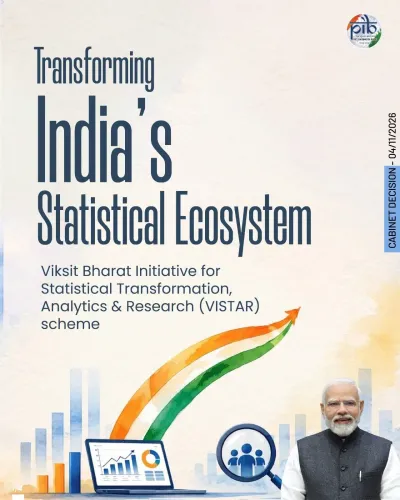
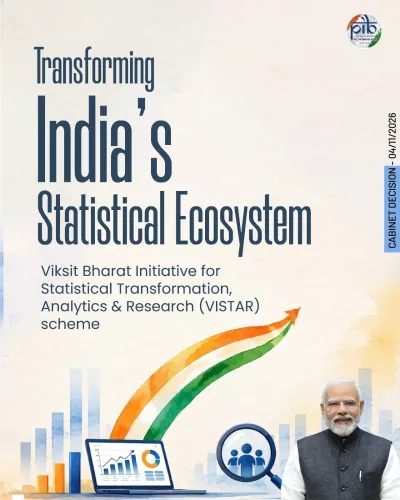
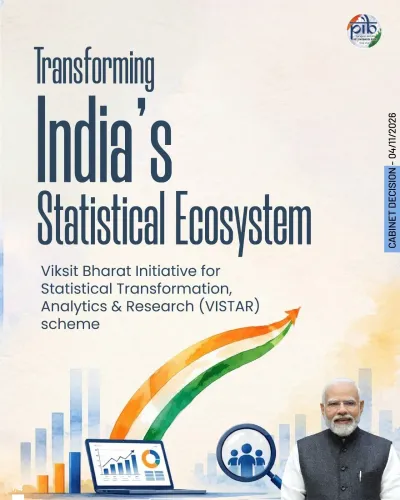
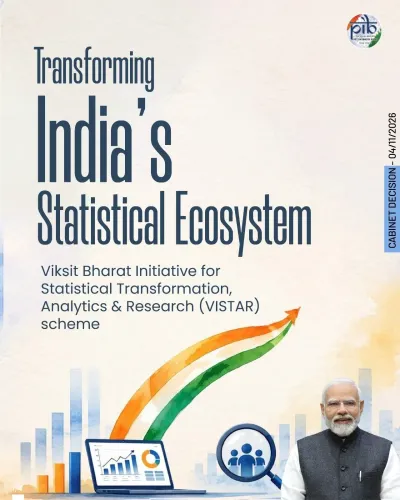
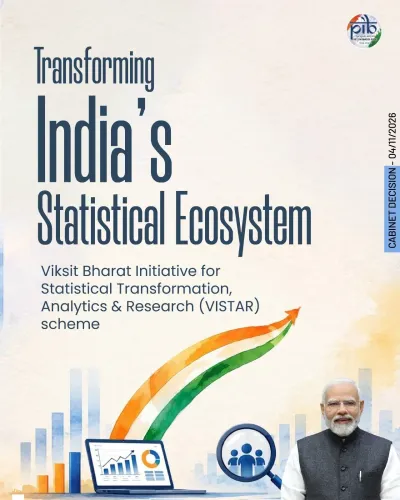
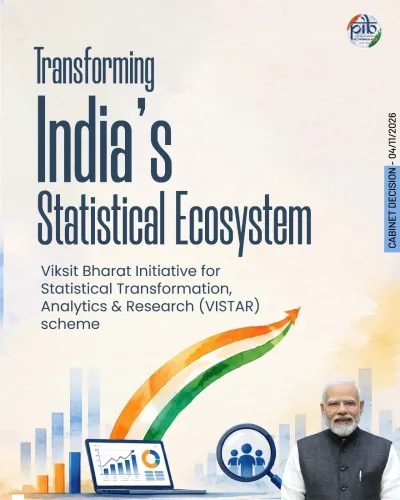
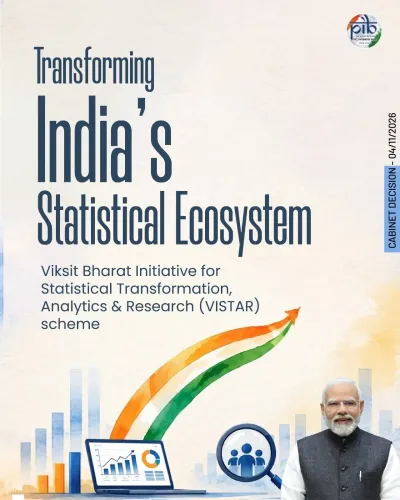
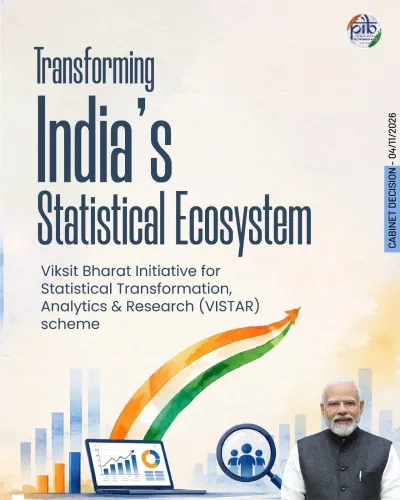
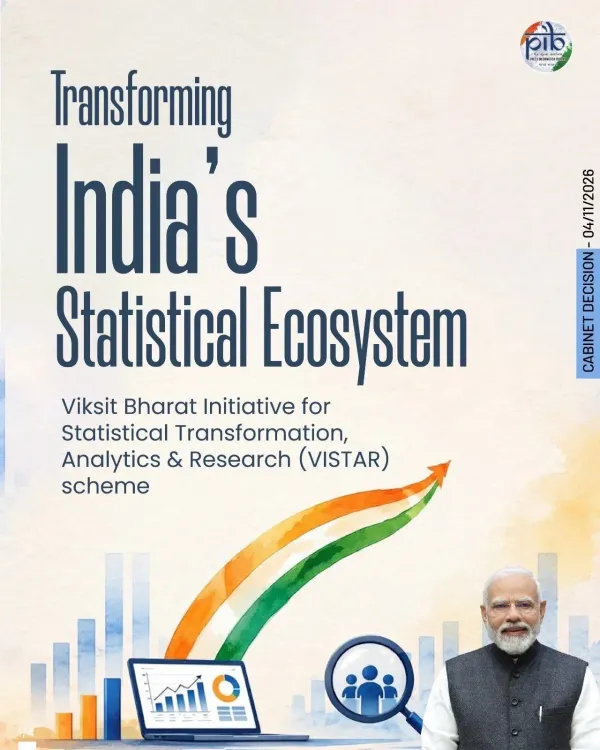
The Union Cabinet approved the VISTAR (Viksit Bharat Initiative for Statistical Transformation, Analytics and Research) scheme on November 4, 2026 .
The scheme aims to build a real-time, future-ready official statistical architecture for India.
Key goals include greater data timeliness and granularity , improved interoperability across ministries, and harmonised, AI-ready datasets .
VISTAR is explicitly aligned with the Viksit Bharat 2047 vision of transforming India into a developed economy by its centenary of independence.
It builds on the Digital India programme launched in 2015, extending its digital infrastructure into the statistical layer.
Budgetary allocation and a phased rollout timeline are expected in subsequent Cabinet or Union Budget announcements.
India's official data backbone is getting a 21st-century refit. The Union Cabinet, led by Prime Minister Narendra Modi, has approved the Viksit Bharat Initiative for Statistical Transformation, Analytics and Research (VISTAR) scheme — a sweeping upgrade to the country's official statistical architecture designed to deliver real-time, AI-compatible data for governance and policy-making.
What VISTAR Sets Out to Fix
Union Environment Minister Bhupender Yadav announced the Cabinet decision on Wednesday, November 4, 2026, framing VISTAR as central to the Viksit Bharat 2047 vision — India's blueprint to become a fully developed economy by its centenary of independence. The scheme targets four structural weaknesses that have long dogged official statistics: data latency, coarse granularity, poor interoperability between ministries, and datasets that cannot be plugged directly into machine-learning or AI pipelines.
In practice, that means moving away from periodic, siloed survey releases toward a dynamic system where data flows continuously, can be sliced at district or block level, and talks seamlessly to other government databases. The difference matters enormously to planners — a welfare scheme calibrated on two-year-old district data is a very different beast from one recalibrated on last month's figures.
A Decade of Groundwork, Now Accelerated
VISTAR does not arrive from nowhere. The Digital India programme, launched in 2015, laid the foundational infrastructure — digitised records, national broadband, common government portals — that makes a real-time statistical layer technically plausible today. What VISTAR adds is the intelligence layer: harmonised, AI-ready datasets that different agencies can query without bespoke data-cleaning on every use. The Ministry of Statistics and Programme Implementation (MoSPI) is widely expected to anchor the rollout, though a formal phased timeline and budgetary allocation are anticipated in subsequent Cabinet or Union Budget announcements.
The broader pattern is one of compounding investment. Each administrative reform cycle has pushed official data closer to real-time utility — VISTAR is the most explicit statement yet that India intends to run its development apparatus on live evidence, not historical snapshots.
Why AI-Ready Datasets Are the Headline Detail
'Harmonised, AI-ready datasets' is the phrase in the approval that carries the most policy weight. Government statistical agencies globally are grappling with the same problem: decades of data collected in incompatible formats, different base years, and inconsistent geographies that make large-scale modelling unreliable. VISTAR's mandate to harmonise across ministries signals an ambition to solve that at the source — building datasets that do not need to be cleaned before they can be analysed. For researchers, think-tanks, and policymakers designing everything from crop-insurance triggers to urban infrastructure spending, that is a qualitative leap.
The question now is execution speed. India has approved statistical modernisation frameworks before; the test of VISTAR will be whether the inter-ministerial coordination it demands actually materialises, and whether the funding allocated matches the scope of the ambition.
Point of View
Not an administrative afterthought. By mandating AI-ready, harmonised datasets, the scheme implicitly acknowledges that the quality of India's development spending is constrained by the quality of its data — a candid admission with real policy consequences. The scheme's success will hinge on whether MoSPI can enforce cross-ministry data standards, an exercise that has historically stalled on turf and legacy-system resistance. If it delivers, VISTAR could become the evidence backbone for the Viksit Bharat 2047 planning cycle; if it doesn't, it joins a long list of well-designed frameworks awaiting execution.
NationPress
4 Nov 2026
Frequently Asked Questions
What is the VISTAR scheme approved by the Cabinet?
VISTAR stands for Viksit Bharat Initiative for Statistical Transformation, Analytics and Research. It is a newly approved central scheme to upgrade India's official statistical system, aiming to deliver real-time data, greater granularity, inter-ministerial interoperability, and harmonised, AI-ready datasets for government planning and policy-making.
What is the connection between VISTAR and Viksit Bharat 2047?
VISTAR is directly framed as part of the Viksit Bharat 2047 vision — Prime Minister Modi's blueprint to transform India into a fully developed economy by 2047, the 100th anniversary of independence. Better statistical infrastructure is seen as essential to evidence-based policymaking required for that goal.
Which ministry will implement the VISTAR scheme?
The Ministry of Statistics and Programme Implementation (MoSPI) is widely expected to anchor the rollout of VISTAR, though a formal implementing framework and phased timeline are anticipated in subsequent Cabinet or Union Budget announcements.
What does 'AI-ready datasets' mean in the context of VISTAR?
AI-ready datasets refer to government data that is harmonised across ministries, standardised in format, and structured so it can be directly used in machine-learning and AI models without requiring extensive pre-processing or cleaning — a significant departure from India's current fragmented, format-inconsistent data systems.
How does VISTAR relate to the Digital India programme?
Digital India, launched in 2015, built the foundational digital infrastructure — digitised records, broadband connectivity, and common government portals — that makes a real-time statistical system technically feasible. VISTAR is designed to build an intelligence and analytics layer on top of that existing digital foundation.