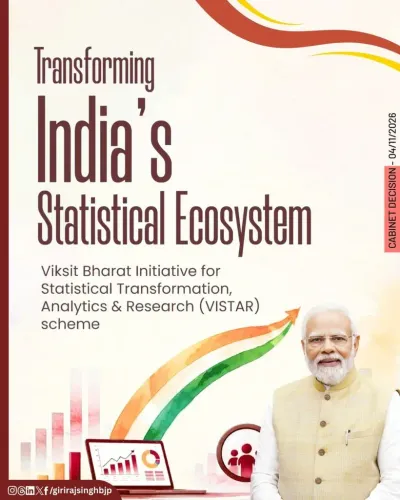
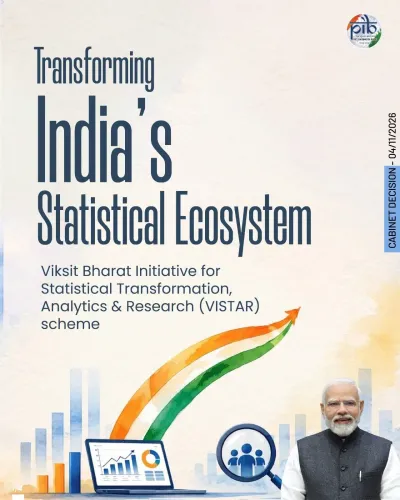
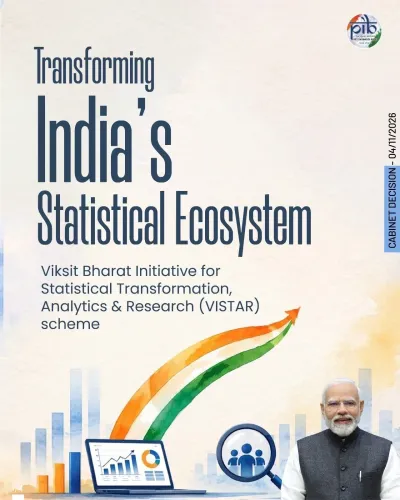
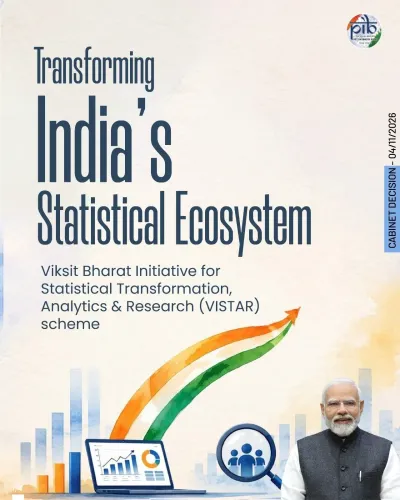
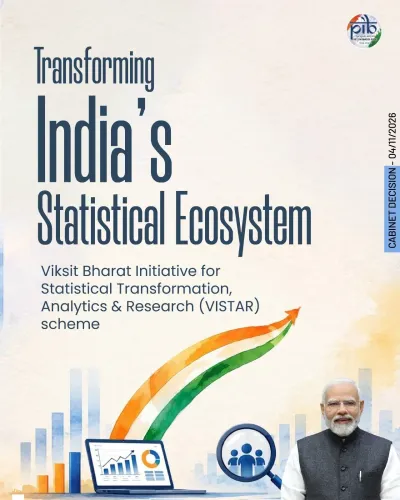
Cabinet Clears ₹4,371-Crore VISTAR Scheme for Statistical Overhaul
Synopsis
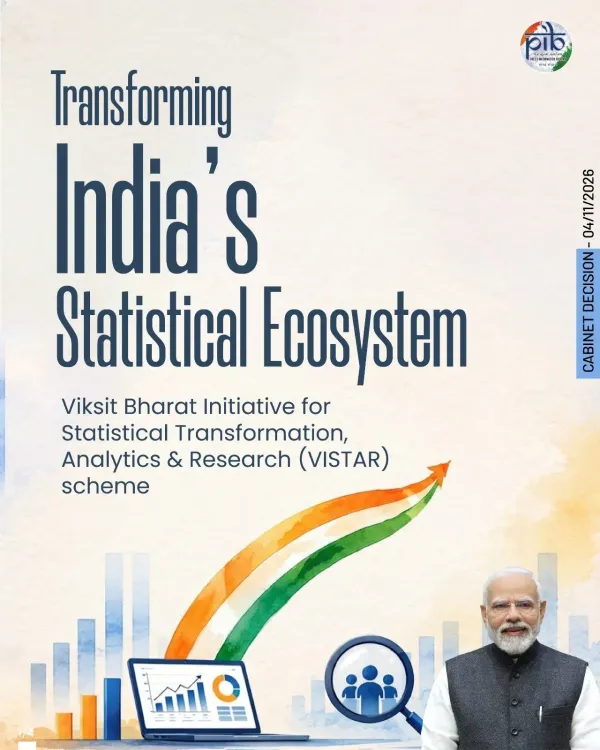
The Union Cabinet on November 4, 2026 approved VISTAR, a ₹4,371.10-crore five-year scheme to build a real-time, AI-enabled statistical system for India — including 59 major surveys and the 8th Economic Census down to gram panchayat level.
Key Takeaways
₹4,371.10 crore approved for the VISTAR scheme covering FY 2026-27 to 2030-31 .
Scheme targets real-time, AI-enabled data management and faster dissemination of official statistics.
59 major surveys will be conducted under the scheme across the five-year period.
The 8th Economic Census will map economic activity down to gram panchayat and ward level — a first at this resolution.
Statistical capabilities will be strengthened in all States and Union Territories , expanding district-level data availability.
The initiative directly supports the Viksit Bharat 2047 framework for evidence-based policymaking.
India's statistical backbone is about to get a generational upgrade. The Union Cabinet, chaired by Prime Minister Narendra Modi, on Wednesday, November 4, 2026, approved the Viksit Bharat Initiative for Statistical Transformation, Analytics and Research (VISTAR) — a ₹4,371.10-crore Central Sector Scheme designed to rebuild India's data infrastructure from the gram panchayat up, with a five-year run from FY 2026-27 to 2030-31. Union Coal and Mines Minister G. Kishan Reddy announced the decision on X, calling it 'an important step towards strengthening evidence-based policymaking.'
What VISTAR actually sets out to do
The scheme's ambitions are concrete and wide-ranging. At its core, VISTAR mandates real-time, AI-enabled data management, faster dissemination of official statistics, harmonised datasets across ministries and significantly finer granularity — meaning data broken down to the district, ward, and gram panchayat level, not just states and districts as has largely been the norm. The push for local-level numbers is not cosmetic: welfare schemes, infrastructure allocations, and even health interventions increasingly depend on hyper-local demand mapping. Blunt, aggregated data leaves gaps that VISTAR explicitly targets.
Critically, the scheme commits to strengthening statistical capabilities in States and Union Territories — recognising that India's data weaknesses are not just federal but deeply structural at the sub-national level, where collection machinery is often thin and inconsistently resourced.
59 surveys and the long-awaited 8th Economic Census
The headline operational deliverable is the launch of 59 major surveys and, most significantly, the 8th Economic Census. The 7th Economic Census, conducted in 2019 under the Ministry of Statistics and Programme Implementation, was the last nationwide exercise mapping economic establishments — shops, factories, service units — at the village and ward level. That census is now seven years old, predating the COVID-19 disruptions that reshaped India's economic landscape dramatically. The 8th Census, funded under VISTAR, is expected to generate a fresh baseline down to individual gram panchayats and wards, giving planners a live picture of economic activity at resolution India has never had in real time.
India's National Statistical Commission had flagged the need for improved data quality and coverage as far back as 2011. Successive governments have moved in this direction incrementally — the 2010s saw the first wave of real-time monitoring dashboards for central schemes — but the integration of AI-driven analytics into the core official statistics architecture represents a step-change rather than an iteration.
VISTAR in the Viksit Bharat 2047 arc
The timing and framing are deliberate. The Viksit Bharat 2047 vision — Prime Minister Modi's target of developed-nation status by India's centenary of independence — is premised on evidence-led governance at scale. You cannot plan a ₹100-lakh-crore infrastructure decade, or calibrate social welfare to 1.4 billion people, on five-year-old district averages. VISTAR is essentially the data plumbing that the broader development agenda depends on. Without it, the flagship schemes downstream are flying partially blind.
The scheme's approval arrives as India actively positions itself as a data-governance leader in the Global South — a credibility play that requires demonstrable statistical rigour at home before it can be exported as a model.
When the 8th Economic Census begins rolling out and the first district-level VISTAR datasets are published, the real test of this ₹4,371-crore bet will be legible to anyone with an internet connection — and that accountability is precisely the point.
Point of View
Calibrate economic policy, and attract credible development investment all rest on the quality of its official data. By anchoring the scheme in AI-enabled analytics and committing to gram-panchayat-level granularity, the Cabinet is signalling that the Viksit Bharat agenda will be evidence-led rather than slogan-driven. The 8th Economic Census will be the earliest and most visible test: if district and ward-level data begin flowing within the scheme's first two years, it validates the investment; if delivery slips, the gap between ambition and execution will be impossible to mask.
NationPress
5 Nov 2026
Frequently Asked Questions
What is the VISTAR scheme approved by the Union Cabinet?
VISTAR stands for Viksit Bharat Initiative for Statistical Transformation, Analytics and Research. It is a Central Sector Scheme approved with an outlay of ₹4,371.10 crore for FY 2026-27 to 2030-31, aimed at building a real-time, AI-enabled statistical system for India.
What is the 8th Economic Census and when will it be conducted?
The 8th Economic Census is a nationwide exercise that will map economic establishments — shops, factories, service units — down to gram panchayat and ward levels. It is to be undertaken under the VISTAR scheme from FY 2026-27 onward; the last such census, the 7th, was conducted in 2019.
How much money has the government allocated for the VISTAR scheme?
The Union Cabinet has approved ₹4,371.10 crore for the VISTAR scheme, to be spent over five financial years from 2026-27 to 2030-31.
How is VISTAR connected to Viksit Bharat 2047?
VISTAR is explicitly framed as a building block for the Viksit Bharat 2047 vision — Prime Minister Modi's goal of developed-nation status by India's centenary. The scheme provides the granular, real-time data needed to plan and monitor the large-scale development programmes that underpin that goal.
How many surveys will be conducted under the VISTAR scheme?
VISTAR mandates 59 major surveys across its five-year tenure, in addition to the 8th Economic Census, to expand and update India's official statistical datasets at national, state, district, and local levels.