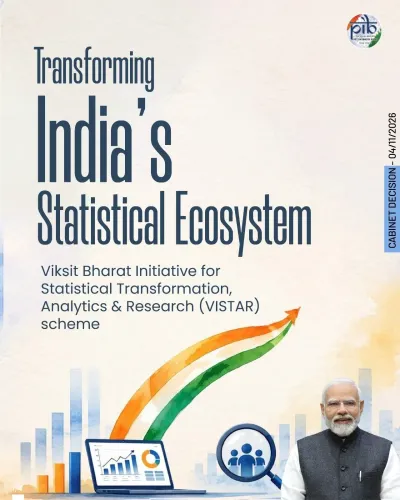
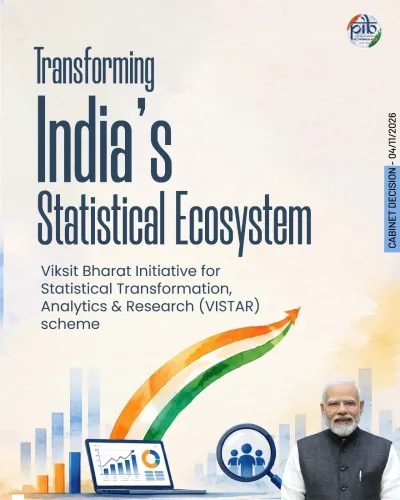
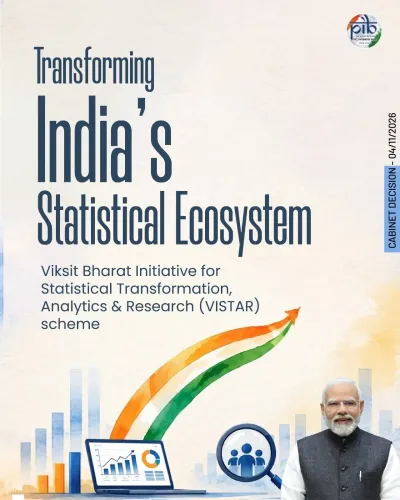
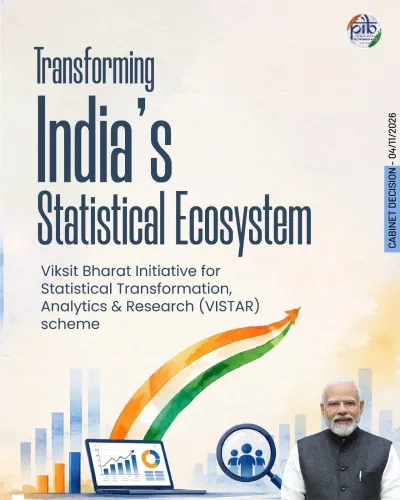
Gadkari: Cabinet clears VISTAR scheme, ₹4,371 cr for data overhaul
Synopsis
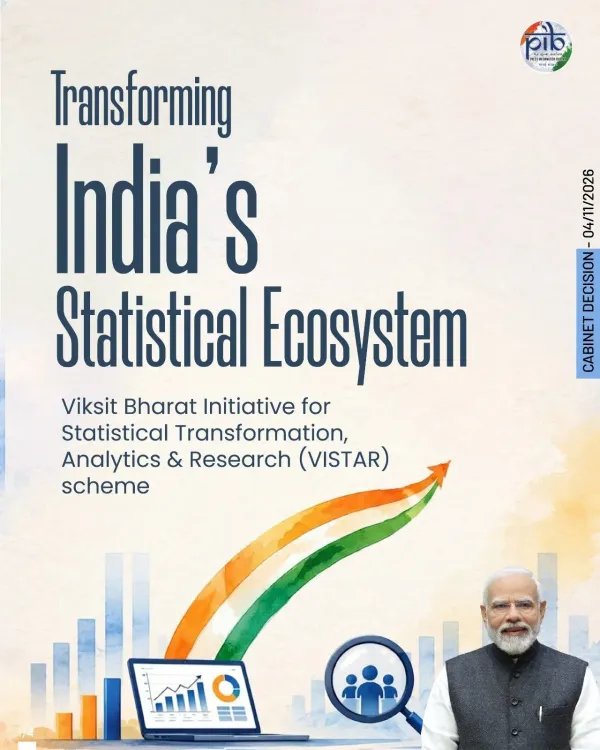
The Union Cabinet has approved the VISTAR scheme with a ₹4,371.10 crore outlay for FY 2026–31, aiming to build a real-time, AI-ready statistical architecture to strengthen evidence-based governance under the Viksit Bharat 2047 vision.
Key Takeaways
The Union Cabinet, chaired by PM Narendra Modi , approved the VISTAR scheme on 4 November 2026 .
Total outlay: ₹4,371.10 crore across FY 2026–27 to FY 2030–31 .
VISTAR targets real-time, AI-ready, interoperable official datasets to replace legacy fragmented systems.
The scheme is explicitly aligned with the Viksit Bharat 2047 national development vision.
Key expected outcomes include greater data timeliness, finer granularity, and harmonised cross-ministry datasets.
Implementation watch: detailed guidelines from MoSPI and potential integration with the National Data Governance Framework.
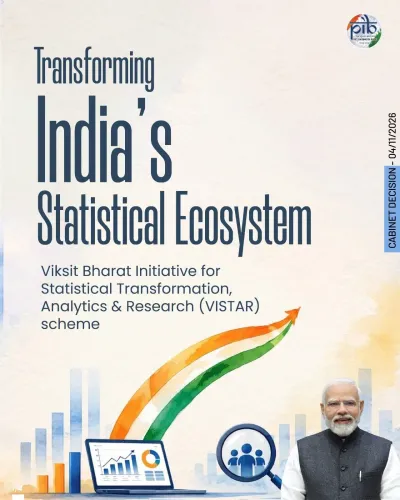
India's statistical backbone is about to get a serious upgrade. Union Road Transport and Highways Minister Nitin Gadkari announced on Wednesday, 4 November 2026 that the Union Cabinet, chaired by Prime Minister Narendra Modi, has approved the Viksit Bharat Initiative for Statistical Transformation, Analytics and Research (VISTAR) scheme — a ₹4,371.10 crore overhaul of India's official data architecture spanning FY 2026–27 to FY 2030–31.
What VISTAR sets out to build
The scheme's mandate is specific and ambitious: a dynamic, real-time, future-ready statistical infrastructure with tighter data timeliness, finer granularity, and harmonised datasets engineered to be AI-ready. Put plainly, the government wants its data pipelines to stop lagging behind the speed at which policy decisions must now be made. Greater interoperability across ministries — long a friction point in Indian governance — is an explicit target.
The Cabinet decision frames VISTAR as the statistical pillar of the broader Viksit Bharat 2047 vision, the Modi government's long-horizon roadmap to transform India into a fully developed economy by the centenary of independence. That vision has already seeded dozens of cross-sectoral programmes; VISTAR makes the data infrastructure itself a first-class deliverable, not an afterthought.
Why India's official statistics needed this push
Successive Indian governments have chipped away at the country's statistical systems — incremental digitisation, survey modernisation, the slow migration away from paper-based enumeration. But real-time, interoperable, AI-ready datasets have remained out of reach, partly because legacy systems across the Ministry of Statistics and Programme Implementation (MoSPI) and line ministries were never designed to talk to each other. VISTAR's five-year window and dedicated outlay signal a structural fix rather than another patch.
The timing matters. As India accelerates infrastructure investment, social-scheme targeting, and economic planning, the quality of the data feeding those decisions determines whether money reaches the right places at the right time. Poor data granularity has historically blunted the precision of welfare delivery and development spending. A modernised statistical architecture directly raises the return on every rupee the government deploys elsewhere.
The road to 2030 — and 2047 beyond it
What to watch now: detailed implementation guidelines from MoSPI, the disbursement schedule across the five years, and whether VISTAR will formally integrate with the National Data Governance Framework that has been in development. If those integration announcements arrive, India could move from a patchwork of departmental databases to something genuinely unified — a statistical operating system for a 1.4 billion-person democracy.
Five years to build it. Twenty-one years to prove it matters. The Cabinet has just made the opening bet.
Point of View
371.10 crore allocation signals that data quality is finally being treated as upstream to policy quality, not downstream. If implementation keeps pace with ambition, this could close the feedback loop between scheme design and on-ground outcomes that has long hampered India's welfare delivery. The harder test will be interoperability: whether competing ministerial data silos will actually harmonise, or whether VISTAR becomes another well-funded island.
NationPress
4 Nov 2026
Frequently Asked Questions
What is the VISTAR scheme approved by the Cabinet?
VISTAR stands for Viksit Bharat Initiative for Statistical Transformation, Analytics and Research. It is a government scheme approved in November 2026 with an outlay of ₹4,371.10 crore for FY 2026–27 to FY 2030–31, aimed at building a real-time, AI-ready, and interoperable official statistical infrastructure for India.
How much money has been allocated for the VISTAR scheme?
The Union Cabinet has approved an outlay of ₹4,371.10 crore for the VISTAR scheme, to be spent over five financial years from 2026–27 to 2030–31.
What is the connection between VISTAR and Viksit Bharat 2047?
VISTAR is designed as the statistical pillar of the Viksit Bharat 2047 vision — Prime Minister Modi's long-term roadmap to make India a fully developed nation by 2047. It aims to equip India with the data quality and infrastructure needed to support evidence-based policymaking over the coming decades.
Which ministry will implement the VISTAR scheme?
The Ministry of Statistics and Programme Implementation (MoSPI) is the primary agency expected to oversee VISTAR's implementation, including disbursement of funds and setting up the new statistical architecture.
What problem does VISTAR solve for Indian governance?
India's official statistical systems have historically been fragmented, slow, and non-interoperable across ministries. VISTAR aims to fix this by creating harmonised, AI-ready, real-time datasets — directly improving the quality of welfare targeting, infrastructure planning, and economic policymaking.