Giriraj Singh meets Jaipur Rugs chief to discuss carpet exports
Synopsis
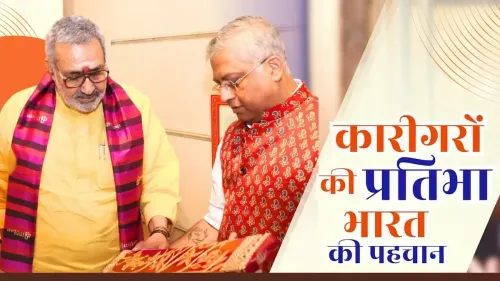
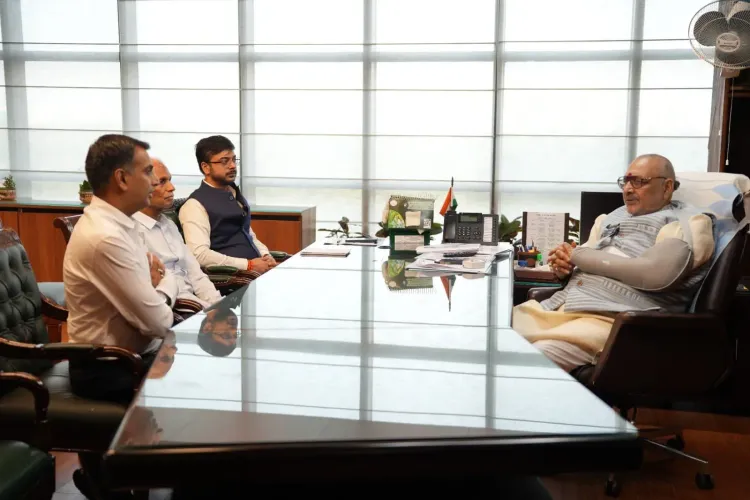
Union Textiles Minister Giriraj Singh held a focused discussion with Jaipur Rugs founder Nand Kishore Chaudhary in New Delhi on 4 November 2026, covering India's carpet heritage, artisan skill, and rising global export opportunities.
Key Takeaways
Union Textiles Minister Giriraj Singh met Jaipur Rugs founder Nand Kishore Chaudhary at his New Delhi office on 4 November 2026 .
Discussions centred on India's carpet-weaving heritage, artisan craftsmanship, and growth potential in international markets.
Jaipur Rugs is known for its direct artisan-engagement model, connecting village weavers to global premium buyers.
The Carpet Export Promotion Council , set up in 1982 , is the key institutional body linking Indian weavers to overseas markets under the Ministry of Textiles.
No specific policy announcement was made public immediately after the meeting.
The meeting signals active private-sector engagement with the Ministry on export strategy for traditional craft.
India's hand-knotted carpet industry — a centuries-old craft that sustains millions of rural artisans — landed at the centre of a high-level conversation in New Delhi on Wednesday, 4 November 2026, when Union Textiles Minister Giriraj Singh sat down with Nand Kishore Chaudhary, Founder and Chairman of Jaipur Rugs, at the Minister's official office.
Posting about the meeting on X, Minister Singh wrote: 'आज दिल्ली स्थित अपने कार्यालय में जयपुर रग्स के संस्थापक एवं चेयरमैन श्री नंद किशोर चौधरी जी के साथ सार्थक चर्चा हुई।' — 'Today, a meaningful discussion was held with Jaipur Rugs Founder and Chairman Shri Nand Kishore Chaudhary at my Delhi office.' The talks, he said, ranged across the rich heritage of India's carpet industry, the unmatched skill of its artisans, and the growing potential of Indian products in global markets.Jaipur Rugs and the artisan-to-export model
Jaipur Rugs is one of India's most closely-watched success stories in traditional crafts. The company built its identity around direct engagement with weaving clusters — bypassing middlemen to connect village artisans with premium international buyers. That model has drawn attention well beyond the carpet trade as a template for how heritage craft can scale without losing its soul.
Nand Kishore Chaudhary started the venture from modest beginnings and grew it into an internationally recognised name in hand-knotted carpets. His presence at a ministerial meeting signals that industry leaders are actively seeking alignment between private craft-export strategy and government policy levers.
A ministry with deep roots in carpet promotion
The Carpet Export Promotion Council (CEPC), established in 1982, has long been the institutional backbone linking weavers to overseas markets. It operates under the Ministry of Textiles and has historically coordinated India's participation in international trade fairs while channelling incentives to export-oriented artisan clusters.
Indian textile policy has consistently tried to hold two objectives in one hand: preserving traditional weaving clusters — many of them concentrated in Uttar Pradesh, Rajasthan, and Jammu & Kashmir — while simultaneously pushing up India's global carpet market share. Skill-development schemes administered through the Ministry have been a recurring instrument in that effort.
Why this meeting matters for weavers on the ground
The discussion is notable because it brings together a government with the authority to reshape export incentives and a private sector leader who has built direct pipelines to global buyers. For the hundreds of thousands of artisans whose livelihoods depend on carpet orders, the gap between a ministerial conversation and a notified policy scheme can be the difference between a full loom and an idle one.
No formal policy announcement followed the meeting immediately, and specific outcomes remain to be confirmed. But the Minister's decision to publicly highlight the meeting — framing it around artisan skill and global market potential — suggests the dialogue is part of a wider push to sharpen India's hand-crafted textile export story.
The carpet industry is watching. The next move — whether trade-fair participation, an export-incentive revision, or a fresh artisan-skilling push — will tell the full story.
Point of View
The ministry's ability to convert such conversations into concrete export incentives or skilling programmes will be the real test. The Jaipur Rugs model, if amplified through policy, could become a replicable blueprint for other craft verticals.
NationPress
5 Nov 2026
Frequently Asked Questions
Why did Giriraj Singh meet Nand Kishore Chaudhary?
Union Textiles Minister Giriraj Singh met Jaipur Rugs founder Nand Kishore Chaudhary on 4 November 2026 to discuss India's carpet industry heritage, artisan skill development, and opportunities to expand Indian carpet exports in global markets.
What is Jaipur Rugs known for?
Jaipur Rugs is an Indian company known for hand-knotted carpets and a direct artisan-engagement model that connects village weavers to international buyers without middlemen.
What is the Carpet Export Promotion Council?
The Carpet Export Promotion Council (CEPC) is a body established in 1982 under the Ministry of Textiles to promote Indian carpet exports, support artisan clusters, and coordinate participation in international trade fairs.
Who is Nand Kishore Chaudhary?
Nand Kishore Chaudhary is the founder and chairman of Jaipur Rugs, a company he built from modest beginnings into an internationally recognised name in traditional hand-knotted carpets.
What could follow the Giriraj Singh and Jaipur Rugs meeting?
Possible follow-up steps include announcements on carpet export incentives, artisan skill-development schemes, or enhanced Indian participation in international textile and handicraft trade fairs.