Giriraj Singh Spotlights Kutch's Ajrakh Block-Print Legacy
Synopsis
Union Textiles Minister Giriraj Singh spotlighted Kutch's Ajrakh block-printing art on 13 August 2026, describing the GI-protected craft — made with natural dyes and hand-carved wooden blocks — as a defining symbol of India's textile heritage and artisan excellence.
Key Takeaways
Union Textiles Minister Giriraj Singh praised Ajrakh , Kutch's traditional block-printing craft, on 13 August 2026 .
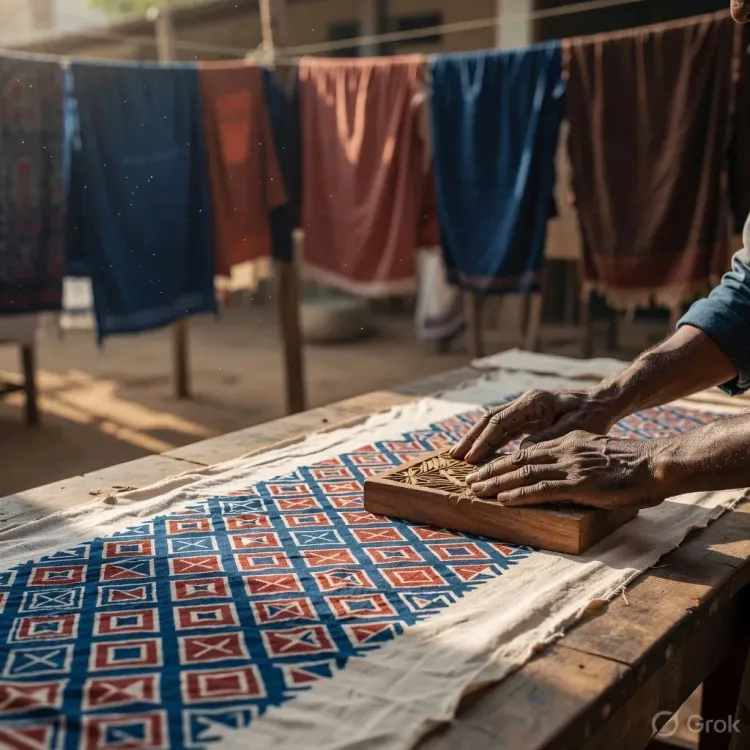
Ajrakh uses natural dyes (indigo, madder, pomegranate rind) and hand-carved wooden blocks in a multi-stage resist-printing process.
The craft is produced primarily in Kutch district, Gujarat , by hereditary artisan communities.
Ajrakh holds protection under India's Geographical Indications of Goods Act, 1999 , shielding it from imitation.
The post is part of a broader Ministry of Textiles outreach pattern linking regional crafts to GI registration, artisan livelihoods, and export promotion.
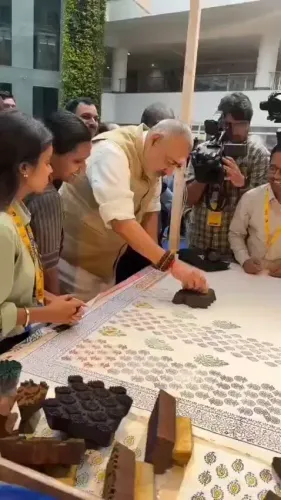
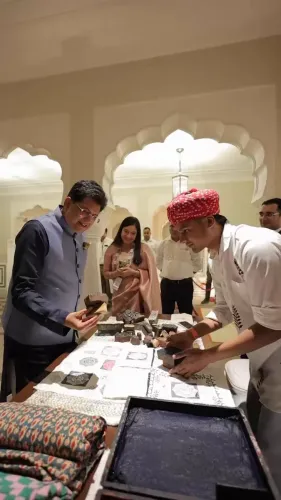
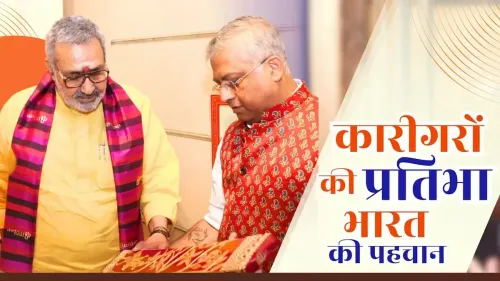
India's textile heritage runs deep, and Union Textiles Minister Giriraj Singh is making sure one of its most distinctive threads stays visible. On Thursday, 13 August 2026, the minister took to X to celebrate Ajrakh — the centuries-old block-printing tradition from Kutch, Gujarat — calling it a 'beautiful identity of our rich craft tradition and the skill of artisans.'
Posting in Hindi, Singh wrote: 'कच्छ की अजरख कला हमारी समृद्ध शिल्प परंपरा और कारीगरों के हुनर की खूबसूरत पहचान है।' ('Kutch's Ajrakh art is the beautiful identity of our rich craft tradition and the skill of artisans.') He added that the craft — defined by natural dyes and intricate block printing — is a marker of India's textile heritage.
What Makes Ajrakh a Living Craft Tradition
Ajrakh is a resist-block-printing technique practised primarily in the Kutch district of Gujarat, where artisan communities have refined it across generations. The process is labour-intensive: natural dyes derived from indigo, madder root, and pomegranate rind are applied through hand-carved wooden blocks onto cotton or silk fabric, with multiple wash-and-dry cycles between each layer of colour. The result is a geometric, deeply saturated textile that has no machine equivalent. The craft earned protection under India's Geographical Indications of Goods (Registration and Protection) Act, 1999, which shields it from imitation and supports its export identity.Ministerial Spotlight as Soft-Power Outreach
Singh's post fits a deliberate pattern in how the Ministry of Textiles communicates. Successive administrations have used ministerial platforms to draw attention to regional craft clusters — linking specific techniques like Ajrakh to goals of GI registration, artisan livelihood support, and export marketing. The audience is both domestic (affirming cultural pride) and international (positioning Indian handloom and handicraft as premium, traceable, and irreplaceable). For the Kutch artisan community, visibility at the ministerial level matters: it signals continued policy attention to a sector where livelihoods are tied directly to craft survival. The craft's story is also one of resilience. Kutch's artisan clusters rebuilt after the devastating 2001 earthquake with support from government and civil society, and Ajrakh emerged from that period with renewed global recognition. Today it sits at the intersection of heritage tourism, sustainable fashion, and rural employment — a convergence that makes ministerial endorsement more than symbolic. For now, the minister's message is clear: Ajrakh is not a relic. It is a living, breathing proof of what Indian hands can do — and the government wants the world to know it.Point of View
Singh reinforces the Ministry of Textiles' dual agenda: domestic cultural pride and international brand-building for GI-tagged Indian textiles. The post also keeps the spotlight on Gujarat's artisan economy, a constituency with both cultural and electoral resonance for the BJP. Sustained ministerial visibility for crafts like Ajrakh typically precedes or accompanies announcements on artisan cluster funding or export facilitation — worth watching in the weeks ahead.
NationPress
28 Sept 2026
Frequently Asked Questions
What is Ajrakh block printing from Kutch?
Ajrakh is a centuries-old resist-block-printing technique from Kutch, Gujarat, in which natural dyes such as indigo and madder are applied through hand-carved wooden blocks onto fabric across multiple wash-and-dry cycles, producing geometric, richly coloured textiles.
Does Ajrakh have a GI tag in India?
Yes. Kutch's block-printing traditions, including Ajrakh, are protected under India's Geographical Indications of Goods (Registration and Protection) Act, 1999, which certifies their regional origin and guards against imitation.
Why did Giriraj Singh post about Ajrakh?
Union Textiles Minister Giriraj Singh posted about Ajrakh on 13 August 2026 to highlight it as a symbol of India's craft heritage and artisan skill, consistent with the Ministry of Textiles' broader outreach on regional handicraft traditions.
Where is Ajrakh made in India?
Ajrakh is made primarily in the Kutch district of Gujarat by hereditary artisan communities who have practised the craft across generations.
How does the Ministry of Textiles support traditional crafts like Ajrakh?
The Ministry of Textiles supports traditional crafts through GI registration, artisan cluster development schemes, and export promotion initiatives, with ministerial social-media outreach forming part of a broader cultural and economic visibility strategy.