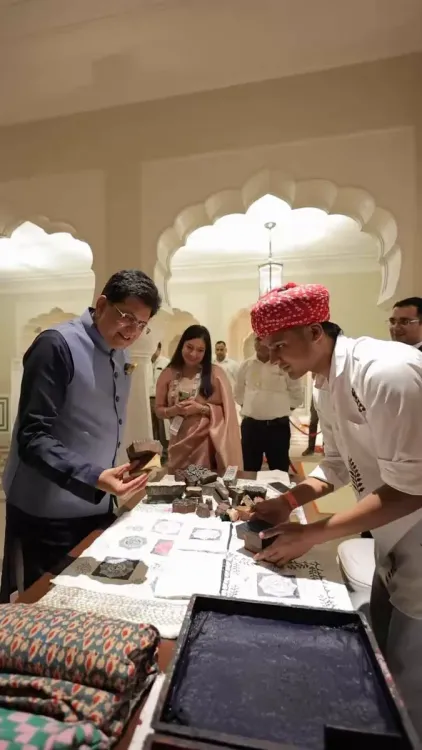
Piyush Goyal tries Bagru Hand Block Printing in Jaipur
Synopsis
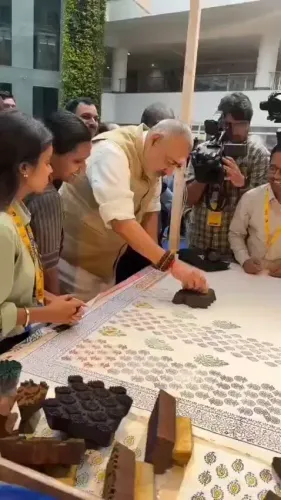
Union Commerce and Industry Minister Piyush Goyal tried Bagru Hand Block Printing in Jaipur, drawing attention to the centuries-old craft rooted in Rajasthan's artisan villages and its place in India's handicraft export story.
Key Takeaways
Piyush Goyal , Union Minister of Commerce and Industry, personally tried Bagru Hand Block Printing in Jaipur .
Bagru is a village near Jaipur, Rajasthan, renowned for natural-dye hand block printing passed down through artisan families.
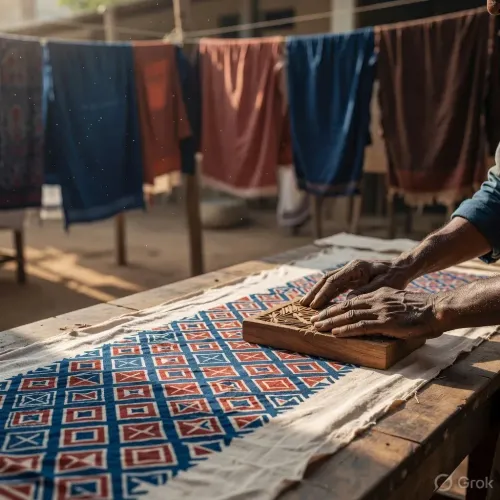
The craft uses mineral and vegetable-based dyes on cotton and silk, with intricately carved wooden blocks.
Rajasthan is a major hub for India's handicraft exports, with Jaipur-region textiles in high international demand.
Goyal called the craft a reflection of 'the skill, creativity, and legacy of our artisans.' The visit signals potential policy attention toward GI-tagged crafts and artisan welfare in Rajasthan.
A cabinet minister's ink-stained hands tell a story older than most government schemes. Union Commerce and Industry Minister Piyush Goyal tried his hand at Bagru Hand Block Printing — one of Jaipur's most storied textile crafts — in a moment that spotlights the artisans quietly keeping a centuries-old tradition alive.
What makes Bagru printing a craft apart
Bagru, a village on the outskirts of Jaipur, Rajasthan, has given its name to a distinctive hand block printing tradition that relies on natural dyes and intricately carved wooden blocks. The craft is characterised by earthy tones — indigo, rust, and black drawn from mineral and vegetable sources — pressed onto cotton and silk with a precision that no machine has convincingly replicated. The technique is passed down through artisan families, many of whom have practised it for generations.
Goyal described the craft as one that 'beautifully reflects the skill, creativity, and legacy of our artisans,' underscoring the human capital embedded in every printed metre of cloth.
Commerce minister, craft sector, and a recurring signal
The engagement is not incidental. As the minister overseeing India's commerce and industry portfolio — including handicraft exports — Goyal's participation carries a policy undertone. Rajasthan is among India's leading states for handicraft exports, and traditional block-printed textiles from the Jaipur region command significant demand in international markets. Indian political leaders periodically participate in regional craft demonstrations to draw attention to artisanal sectors that often operate outside the formal economy's spotlight.
The broader question the visit raises: whether such visibility translates into sustained support — through GI-tag enforcement, artisan welfare schemes, or export facilitation — for the craftspeople who make these traditions viable.
Point of View
And ministerial visibility can accelerate GI-tag recognition and buyer confidence abroad. The gesture fits a broader BJP-era pattern of leaders visually associating with India's artisanal identity, though the real test is whether follow-through policy — artisan credit, digital marketplace access, IP protection — matches the optics. For the craftspeople of Bagru, the camera is welcome; the contract is what counts.
NationPress
21 Sept 2026
Frequently Asked Questions
What is Bagru Hand Block Printing?
Bagru Hand Block Printing is a traditional textile craft from Bagru village near Jaipur, Rajasthan, using natural dyes and hand-carved wooden blocks to create intricate patterns on cotton and silk fabrics.
Where is Bagru located?
Bagru is a village situated on the outskirts of Jaipur, the capital of Rajasthan, and is the geographic and cultural home of this distinctive printing tradition.
Why did Piyush Goyal visit Bagru?
Goyal tried Bagru Hand Block Printing to highlight the skill and legacy of India's traditional artisans; as Commerce and Industry Minister, such engagements also signal policy interest in the handicraft export sector.
Is Bagru Block Printing a GI-tagged craft?
Bagru's hand block printing tradition is part of Rajasthan's recognised craft heritage; any specific GI-tag status should be verified with the official GI registry.
How does Bagru printing relate to India's handicraft exports?
Rajasthan is one of India's top handicraft-exporting states, and Jaipur-region block-printed textiles — including Bagru work — are in significant demand in international markets, making the sector commercially important beyond its cultural value.