Giriraj Singh hails Jaipur sandalwood carver Vinod Kumar
Synopsis
Union Textiles Minister Giriraj Singh has publicly celebrated Vinod Kumar, a fourth-generation sandalwood carver from Jaipur who holds the Shilp Guru and National Awards, urging Indians to appreciate such artisans as the true strength of India's craft heritage.
Key Takeaways
Giriraj Singh , Union Textiles Minister, praised Vinod Kumar of Jaipur on 25 May 2026 via a post on X.
Vinod Kumar is a fourth-generation sandalwood carver known for intricate miniature work.
Kumar has received the Shilp Guru award and the National Award , among the highest honours the Textiles Ministry confers on craftspeople.
The post aligns with the Vocal for Local campaign, mainstreamed in 2020 under the Atmanirbhar Bharat package.
The Ministry of Textiles has run national awards for master craftspersons since the 1960s to preserve traditional skills.
Singh called skilled artisans India's 'real strength' and urged the public to appreciate and feel proud of them.
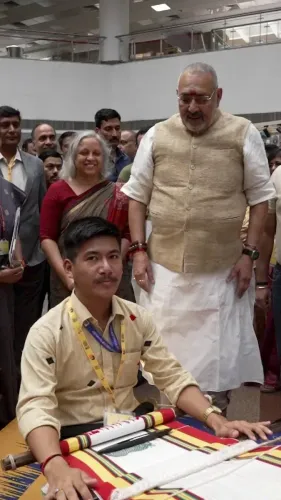
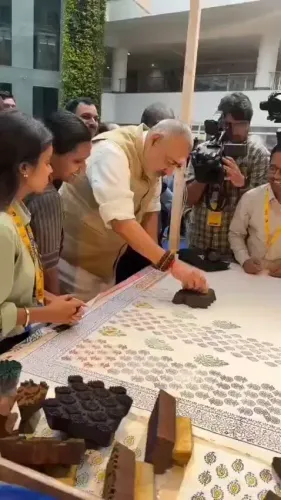
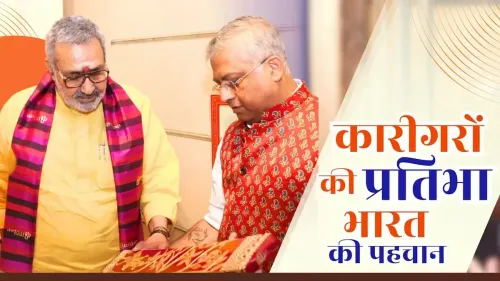
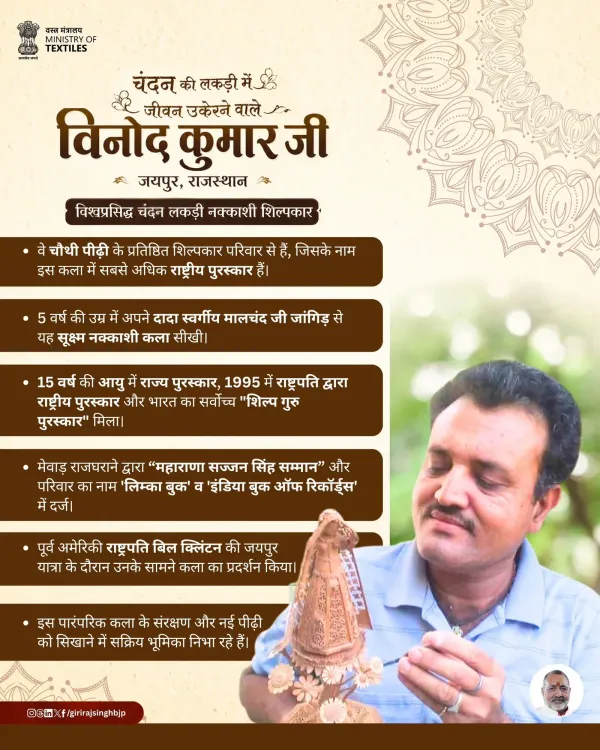
Union Textiles Minister Giriraj Singh on Monday, 25 May 2026, took to X to celebrate Vinod Kumar, a fourth-generation sandalwood carving artisan from Jaipur, calling him a symbol of India's craft heritage and urging citizens to appreciate such skilled artisans.
In his post, the Minister wrote: 'चंदन की लकड़ी पर जीवन उकेरने वाले जयपुर के विश्वप्रसिद्ध शिल्पकार विनोद कुमार जी' ['World-renowned artisan Vinod Kumar of Jaipur, who carves life onto sandalwood'], noting that Kumar has earned the coveted Shilp Guru award and the National Award — among the highest honours the government confers on master craftspeople. Singh added that 'such uniquely skilled individuals are our real strength' and invited the public to appreciate and feel proud of them.
Context
Vinod Kumar represents the fourth generation of a family devoted to intricate sandalwood carving, a tradition rooted in Jaipur, Rajasthan. His work is characterised by micro-level detailing — figures, landscapes and motifs rendered on sandalwood surfaces — a craft that demands years of apprenticeship before mastery. By spotlighting Kumar, Minister Singh frames individual artisans as living custodians of a civilisational legacy rather than peripheral cottage-industry workers.
Policy Backdrop
The Ministry of Textiles has administered national awards for master craftspersons since the 1960s, with the Shilp Guru award standing as one of the most prestigious recognitions available to a practising artisan. These awards are designed not only to honour excellence but to create market visibility and generational continuity for traditional skills. The Vocal for Local campaign, mainstreamed in 2020 under the Atmanirbhar Bharat package, extended this effort by encouraging domestic consumers to actively choose indigenous crafts, reducing dependence on imported decorative and lifestyle goods.
The Textiles Ministry has increasingly used social media to profile individual practitioners from wood, metal and textile clusters — a strategy that links heritage skills with domestic markets, export promotion and cultural tourism in a single narrative.
Stakeholders and Impact
For Jaipur's centuries-old craft cluster — which encompasses wood carving, blue pottery, block printing and gem-cutting — ministerial visibility translates into potential buyer interest, tourism footfall and policy attention. Artisans working in sandalwood and other traditional media often operate in informal setups with limited access to credit and organised markets; government endorsement can open doors to craft fairs, export councils and e-commerce platforms. The broader handicraft sector employs millions of artisans across India, many from communities where the skill is the sole livelihood across generations.
Geographical Indication registrations and export promotion schemes have previously helped clusters in Rajasthan gain international recognition, and consistent ministerial messaging reinforces the case for further institutional support to such artisans.
What's Next
Attention will now turn to the next cycle of Shilp Guru and National Handicraft Award selections, where the Ministry is expected to continue recognising practitioners from underrepresented craft traditions. Any new marketing or financial support announced for sandalwood and wooden craft clusters in Rajasthan would be a concrete follow-through to the kind of public appreciation Singh is encouraging. As India positions its craft heritage as a pillar of cultural soft power, the visibility of artisans like Vinod Kumar may increasingly feed into tourism branding, export strategy and skill-development programmes targeting the next generation of craftspeople.
Point of View
Ministry-led strategy to use social media as a soft-power tool — converting individual artisan stories into a broader political narrative around cultural nationalism and self-reliance. By invoking the Vocal for Local hashtag alongside a decorated craftsperson, the Textiles Ministry reinforces its dual mandate of cultural preservation and economic empowerment of informal workers. The spotlight on a Rajasthan-based artisan also carries regional resonance, given the state's dense craft ecosystem and its importance to BJP's political geography. The consistency of such messaging across ministerial handles suggests a coordinated communications playbook, not a one-off tribute.
NationPress
25 Sept 2026
Frequently Asked Questions
Who is Vinod Kumar the sandalwood carver from Jaipur?
Vinod Kumar is a fourth-generation sandalwood artisan from Jaipur, Rajasthan, celebrated for intricate miniature carving. He has received the Shilp Guru award and the National Award from the Ministry of Textiles, two of the highest honours available to Indian craftspeople.
What is the Shilp Guru award in India?
The Shilp Guru award is one of the most prestigious national honours conferred by India's Ministry of Textiles on master craftspeople who have demonstrated exceptional skill and contributed to preserving traditional craft traditions.
What is the Vocal for Local campaign?
Vocal for Local is a campaign mainstreamed in 2020 as part of the Atmanirbhar Bharat package, encouraging Indian consumers to buy domestically made goods including traditional handicrafts, thereby supporting artisan livelihoods and reducing import dependence.
Why did Giriraj Singh post about Vinod Kumar?
As Union Textiles Minister, Giriraj Singh regularly uses social media to spotlight award-winning artisans, aligning individual recognition with ministry goals of preserving craft heritage and promoting indigenous products under the Vocal for Local initiative.
What support does the government provide to sandalwood carvers in Rajasthan?
The Ministry of Textiles provides support through national awards, Geographical Indication registrations, craft fair participation and export promotion schemes. Jaipur's craft clusters, including wood carvers, benefit from these programmes designed to link traditional skills with domestic and international markets.