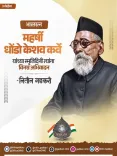
Gadkari pays tribute to Bharat Ratna Dhondo Keshav Karve
Synopsis
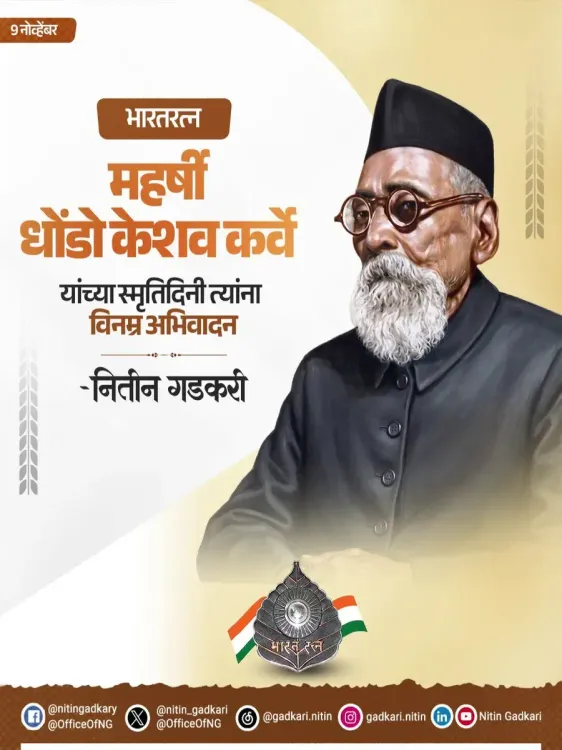
Union Minister Nitin Gadkari marked the death anniversary of Bharat Ratna Maharshi Dhondo Keshav Karve, hailing the 19th-century social reformer who championed widow remarriage and founded SNDT Women's University in 1916 as 'the greatest and most active social reformer of modern India.'
Key Takeaways
Union Minister Nitin Gadkari paid tribute on the death anniversary of Maharshi Dhondo Keshav Karve on 9 November 2026 .
Gadkari described Karve as 'the greatest and most active social reformer of modern India' in a Marathi post on X.
Karve ( 1858–1962 ) championed widow remarriage and women's education across a life spanning 104 years .
He founded SNDT Women's University in 1916 , one of South Asia's earliest universities dedicated to women's higher education.
Karve was awarded the Bharat Ratna in 1958 , India's highest civilian honour, in his centenary year.
On the death anniversary of one of modern India's most consequential social reformers, Union Road Transport and Highways Minister Nitin Gadkari paid his respects to Bharat Ratna Maharshi Dhondo Keshav Karve, honouring the educator and champion of women's rights whose life's work reshaped the possibilities of an entire gender.
Posting in Marathi on Monday, 9 November 2026, Gadkari described Karve as 'आधुनिक भारतातील श्रेष्ठ व कर्ते समाजसुधारक' — 'the greatest and most active social reformer of modern India' — and called his work 'remarkable and all-encompassing.' The tribute reflects a wider tradition among Union ministers of publicly marking the anniversaries of pre-independence social reformers whose legacies cut across party lines.A century of reform: who Dhondo Keshav Karve was
Dhondo Keshav Karve was born in 1858 and lived to the remarkable age of 104, dying in 1962. In a society that widely stigmatised widows, he championed widow remarriage at a personal cost — he himself married a widow — and devoted decades to expanding access to formal education for women. His most enduring institutional legacy is SNDT Women's University, which he founded in 1916, making it one of the earliest universities in South Asia dedicated exclusively to women's higher education. The breadth of that contribution was formally recognised by the Indian state when he was awarded the Bharat Ratna in 1958, the nation's highest civilian honour, in his centenary year — a rare alignment of a life and a milestone.Why tributes to Karve carry particular weight
Karve's story sits at the intersection of social justice and institution-building — two themes that remain live in Indian public discourse. His work predates independence, yet the university he founded continues to function, making him one of the few reformers of his era whose impact is literally still standing. A senior BJP leader invoking Karve in Marathi, on a platform read nationally, signals the enduring cross-ideological prestige of figures who built lasting public institutions rather than merely agitated for change. The tribute is also a reminder that women's access to education, the cause Karve staked his life on, remains a live policy conversation in India more than a century after he first acted on it.Point of View
Invoking Karve reinforces its outreach to reform-era icons who are widely venerated in Maharashtra, a politically critical state. The choice of Marathi signals a regional audience even on a national platform. More broadly, the tribute underscores how institution-builders like Karve — whose SNDT Women's University still operates — hold a distinct place in public memory above purely rhetorical reformers.
NationPress
9 Nov 2026
Frequently Asked Questions
Who was Dhondo Keshav Karve?
Dhondo Keshav Karve (1858–1962) was a pioneering Indian social reformer who championed widow remarriage and women's education. He founded SNDT Women's University in 1916 and was awarded the Bharat Ratna in 1958.
When did Dhondo Keshav Karve die?
Dhondo Keshav Karve died in 1962 at the age of 104, having been born in 1858.
Why is Dhondo Keshav Karve called Maharshi?
The honorific 'Maharshi' — meaning great sage — was bestowed on Karve in recognition of his lifelong selfless service to women's education and social reform, particularly his work for the welfare of widows in 19th and 20th century India.
What did Nitin Gadkari say about Karve?
On Karve's death anniversary, Gadkari described him as 'the greatest and most active social reformer of modern India' and said his work was 'remarkable and all-encompassing,' offering a respectful tribute in Marathi on X.
Which university did Dhondo Keshav Karve found?
Karve founded SNDT Women's University in 1916, one of the earliest universities in South Asia exclusively dedicated to women's higher education. It continues to function today.