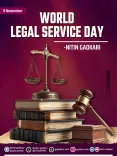
Gadkari calls for equal access to justice on World Legal Services Day
Synopsis
On World Legal Services Day, 9 November 2026, Union Minister Nitin Gadkari called for strengthening access to justice and legal awareness, urging that every Indian — regardless of socio-economic background — be able to exercise their legal rights with dignity and equality.
Key Takeaways
World Legal Services Day is observed on 9 November each year to promote equal access to justice and legal awareness.
Union Minister Nitin Gadkari reaffirmed the commitment to ensuring legal rights for all, irrespective of socio-economic status.
India's legal-aid framework is rooted in Article 39A of the Constitution, which mandates free legal aid as a constitutional obligation.
The National Legal Services Authority (NALSA) , constituted under the Legal Services Authorities Act of 1987 , is the apex statutory body delivering free legal services to weaker sections.
The minister's message emphasises 'dignity and equality' — core constitutional values underpinning India's legal-aid architecture.
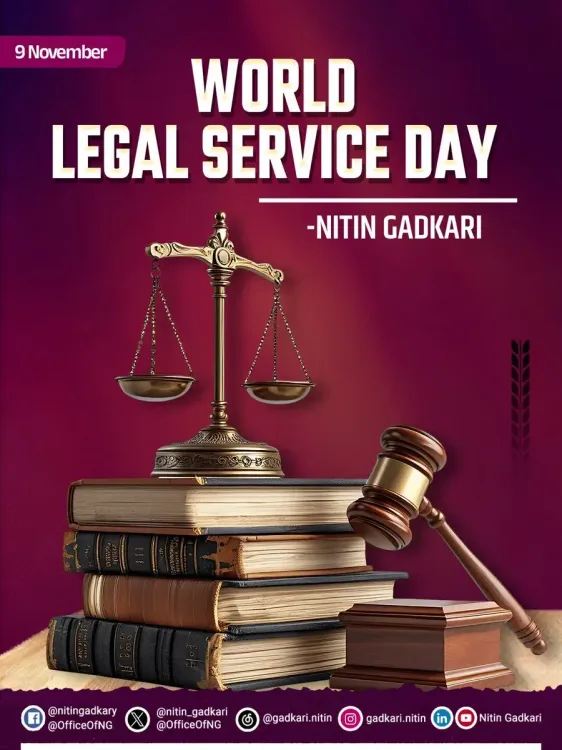
Justice, Union Road Transport and Highways Minister Nitin Gadkari reminded the nation on Monday, 9 November 2026, must be a right available to every Indian — not a privilege rationed by wealth or circumstance. Marking World Legal Services Day, Gadkari called for a renewed commitment to legal awareness and dignity-driven access to justice for all citizens.
Posting on X, Gadkari wrote: 'On World Legal Services Day, let us reaffirm our commitment to strengthening access to justice, promoting legal awareness and ensuring that every individual, irrespective of their socio-economic background, can exercise their legal rights with dignity and equality.'
Why 9 November carries constitutional weight
World Legal Services Day is observed every year on 9 November to spotlight the gap between legal rights on paper and legal relief in practice. The date is closely associated with India's own statutory architecture for bridging that gap — the Legal Services Authorities Act, 1987, which created a national network of legal-aid bodies anchored in Article 39A of the Constitution. That article places free legal aid not in the realm of charity but of constitutional obligation.
NALSA and the architecture of free legal aid
At the apex of this structure sits the National Legal Services Authority (NALSA), the statutory body mandated to deliver free legal services to weaker sections — the poor, women, children, persons with disabilities, and victims of trafficking, among others. NALSA coordinates state and district-level authorities, runs legal literacy camps, and operates tele-law platforms to reach citizens in remote areas. Gadkari's call to 'strengthen access' lands in a context where this infrastructure exists but remains unevenly utilised across India's vast and diverse population.
Equality as the operative word
The minister's framing — 'dignity and equality' — is deliberate constitutional language. India's legal-aid framework is explicitly designed to ensure that an inability to afford a lawyer does not translate into an inability to access justice. The annual observance serves as a reminder that laws and courts alone do not deliver justice; awareness, outreach, and institutional reach are the last mile that matters most for those at the margins.
India has built the scaffolding. Whether every citizen can climb it remains the unfinished work of this generation's legal reformers.
Point of View
While observational rather than policy-announcing, sits within a long-standing BJP-era emphasis on constitutional rights for the marginalised as a governance deliverable rather than a purely civil-society concern. The government has sought to position legal-aid expansion — through digital platforms and tele-law — as part of its broader 'last-mile delivery' governance narrative. Senior ministers joining the annual observance lends political visibility to an institution, NALSA, that often operates outside mainstream public discourse. The real policy watch is whether this vocal commitment translates into enhanced budget allocations or legislative updates in the forthcoming parliamentary session.
NationPress
9 Nov 2026
Frequently Asked Questions
What is World Legal Services Day and when is it observed?
World Legal Services Day is observed every year on 9 November to promote legal awareness and equal access to justice, particularly for disadvantaged and marginalised sections of society.
What did Nitin Gadkari say on World Legal Services Day 2026?
Union Minister Nitin Gadkari called for reaffirming the commitment to strengthening access to justice and legal awareness, emphasising that every individual — regardless of socio-economic background — must be able to exercise their legal rights with dignity and equality.
What is NALSA and what does it do?
The National Legal Services Authority (NALSA) is a statutory body set up under the Legal Services Authorities Act, 1987, to provide free legal aid and services to weaker sections including the poor, women, children, and persons with disabilities across India.
What is Article 39A of the Indian Constitution?
Article 39A of the Indian Constitution directs the state to ensure that the legal system promotes justice on the basis of equal opportunity, and to provide free legal aid to ensure that no citizen is denied justice due to economic or other disabilities.
Who is eligible for free legal aid in India?
Under NALSA's framework, free legal aid is available to socio-economically weaker sections including persons below the poverty line, women, children, persons with disabilities, victims of trafficking, and other marginalised groups as defined under the Legal Services Authorities Act, 1987 .