Giriraj Singh Spotlights Surat Artisan's Ancient Wood Craft
Synopsis
Union Textiles Minister Giriraj Singh highlighted Surat artisan Rakeshkumar G. Patigara and his Sadeli Kashth Shilpkala on 22 October 2026, drawing national attention to a generations-old Gujarat wood-craft tradition the Ministry of Textiles has long sought to preserve.
Key Takeaways
Giriraj Singh , Union Minister of Textiles, praised Rakeshkumar G.
Patigara of Surat, Gujarat on 22 October 2026 .
Patigara practises Sadeli Kashth Shilpkala , a traditional wood-inlay craft form rooted in Gujarat's artisanal heritage.
The Ministry of Textiles has run national artisan-support programmes through the Office of the Development Commissioner for Handicrafts since the 1950s .
Recognition frameworks such as the Shilp Guru award exist to honour master craftspeople sustaining living craft traditions.
Social-media spotlights by senior ministers can translate into market visibility, institutional support, and renewed apprenticeship interest for endangered craft forms.
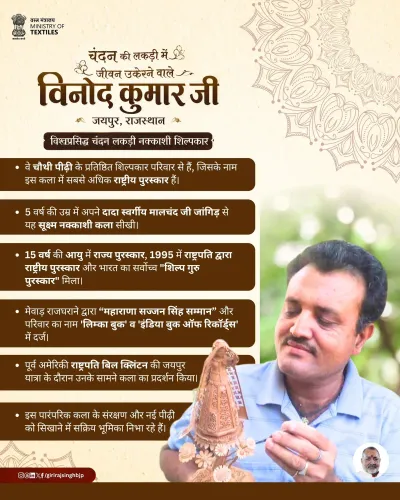
A craftsman from Surat, Gujarat, is keeping a generations-old wood-carving tradition alive — and Union Textiles Minister Giriraj Singh wants the country to know his name. On Thursday, 22 October 2026, the Minister took to X to salute Shri Rakeshkumar G. Patigara, whose mastery of the Sadeli Kashth Shilpkala — an intricate traditional wood-craft form — is drawing fresh attention to India's deep artisanal heritage.
In his post, Minister Singh wrote: 'Gujarat ke Surat ke shilpkar Shri Rakeshkumar ji G. Patigara apni Sadeli Kashth Shilpkala se Bharat ki samridh shilp virasat ko nayi pehchaan de rahe hain.' ('Artisan Shri Rakeshkumar G. Patigara of Surat, Gujarat, is giving a new identity to India's rich craft heritage through his Sadeli wood-craft. His skill plays a vital role in keeping this generations-old art alive.')
What Is Sadeli Kashth Shilpkala — and Why It Matters
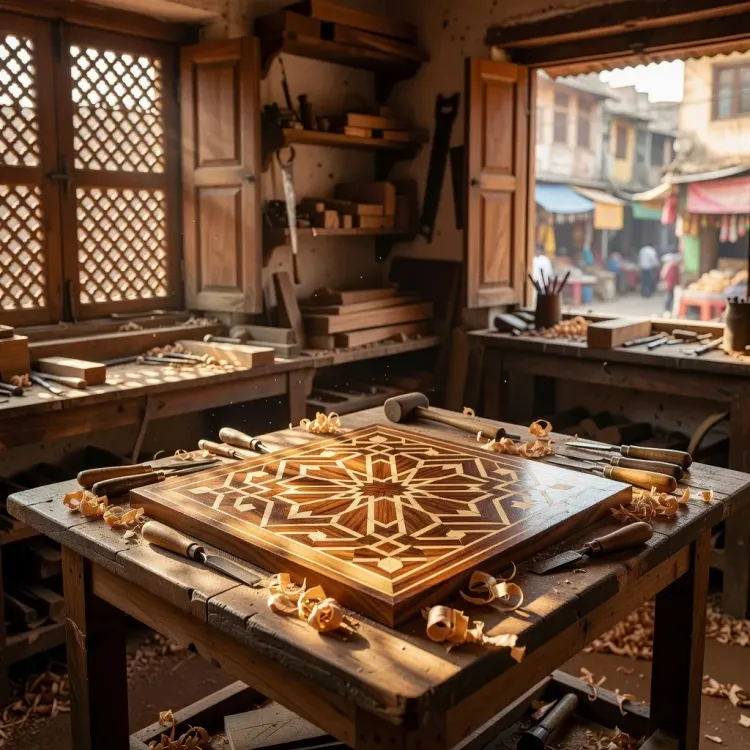
Surat is best known as India's diamond-polishing capital and a powerhouse of the textile trade — but the city also sits inside a Gujarat that holds one of the subcontinent's most layered handicraft traditions. The Sadeli craft is a form of precision wood inlay work, in which thin rods of different materials are assembled and sliced cross-sectionally to produce intricate geometric patterns. The technique demands extraordinary patience and years of apprenticeship — skills that rarely survive the pull of industrial employment.
That generational pull is exactly what makes practitioners like Patigara significant. When a single artisan sustains a craft form through personal dedication, they become a living archive of technique, vocabulary, and aesthetic sensibility that no government catalogue can fully replace.
The Ministry's Long-Running Artisan Mandate
The Ministry of Textiles, through its Office of the Development Commissioner for Handicrafts, has run support programmes for traditional artisans since the 1950s — covering cluster development, market access, design intervention, and direct financial assistance. National recognition frameworks such as the Shilp Guru award exist specifically to honour master craftspeople whose work represents the highest expression of a living craft tradition.
Minister Singh's social-media tribute fits a broader pattern: senior ministers periodically use their platforms to amplify individual artisans, functioning as a bridge between a practitioner working in a workshop in Surat and a national audience that might never otherwise encounter their work. The gesture carries soft policy weight — it signals which craft forms the Ministry considers worthy of preservation attention.
For India's handicraft sector, visibility is not a small thing. It can translate into orders, institutional support, and the confidence younger members of a community need to choose craft over migration. One minister's post, in that sense, is also a message to every apprentice watching.
Point of View
A tension that has shaped handicraft policy since independence. By naming a specific practitioner and a specific craft form, the gesture nudges the cultural economy in the direction of individual recognition rather than anonymous cluster statistics. It also arrives at a moment when India's handicraft exports face pressure from machine-made substitutes, making the soft-power value of a minister's endorsement unusually tangible. Whether it translates into formal recognition — a Shilp Guru nomination, a craft-fair slot, an export-promotion tie-up — will be the real measure of its weight.
NationPress
22 Oct 2026
Frequently Asked Questions
Who is Rakeshkumar G. Patigara?
Rakeshkumar G. Patigara is a traditional artisan from Surat, Gujarat, recognised by Union Textiles Minister Giriraj Singh for practising Sadeli Kashth Shilpkala, a generations-old wood-inlay craft form.
What is Sadeli Kashth Shilpkala?
Sadeli Kashth Shilpkala is a traditional Indian wood-craft technique involving precision inlay work, historically associated with Gujarat, in which thin rods of different materials are assembled and sliced to create intricate geometric patterns.
Why did Giriraj Singh post about a Surat artisan?
As Union Textiles Minister, Giriraj Singh periodically uses social media to spotlight individual craftspeople, reflecting the Ministry's mandate to preserve traditional handicraft skills alongside promoting the broader textile sector.
What schemes support traditional artisans in India?
The Ministry of Textiles, through its Office of the Development Commissioner for Handicrafts, has operated artisan-support programmes since the 1950s, covering cluster development, market access, and awards such as the Shilp Guru for master craftspeople.
Is Surat known for traditional crafts beyond textiles?
Yes. While Surat is globally known for diamond polishing and textile trade, it sits within Gujarat — a state with a rich tradition of handicrafts including wood inlay, embroidery, and block printing — making it home to practitioners of several traditional art forms.