Giriraj Singh credits Modi for 50 crore exiting extreme poverty
Synopsis
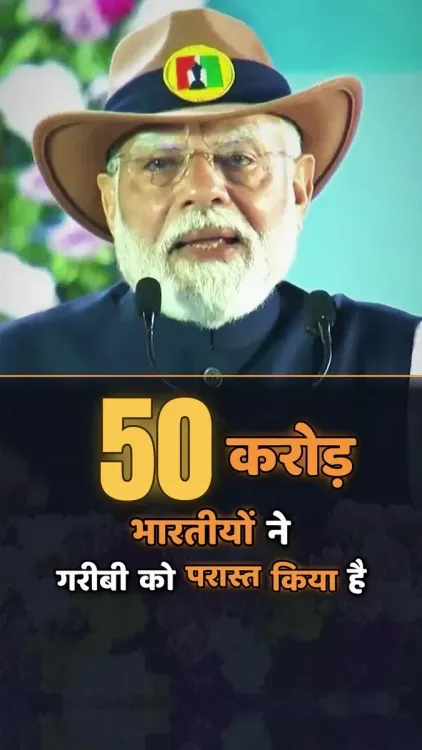
Union Textiles Minister Giriraj Singh posted on X claiming 50 crore Indians have exited extreme poverty under PM Modi, anchoring the assertion in India's multidimensional poverty index narrative and the government's decade-long welfare architecture.
Key Takeaways
Giriraj Singh claimed on 4 November 2026 that 50 crore people have exited extreme poverty in India under PM Narendra Modi's leadership.
The claim draws on the official National Multidimensional Poverty Index narrative maintained by NITI Aayog , which measures deprivation across health, education, and living standards.
NITI Aayog's baseline MPI report was released in 2021 ; successive updates have shown declines in multidimensional poverty.
The specific 50 crore figure is Singh's political framing and has not been independently verified against publicly released MPI data.
Key central schemes — Pradhan Mantri Awas Yojana, Ujjwala, Ayushman Bharat , and free foodgrain entitlements — form the policy backbone behind the government's poverty-reduction claims.
Singh is a Lok Sabha MP from Begusarai, Bihar , a state where welfare delivery metrics carry significant electoral weight.
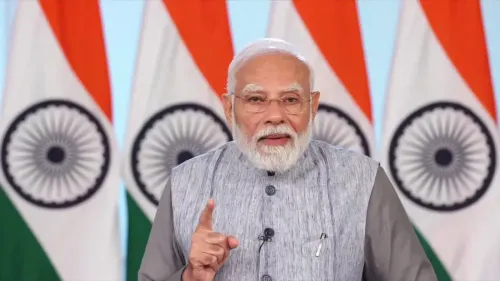
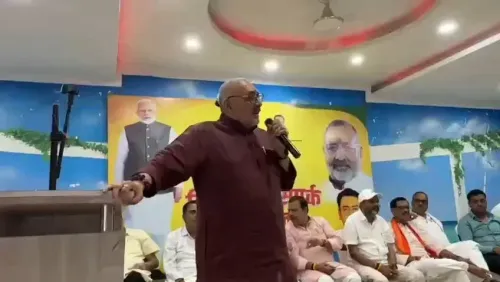
Fifty crore people lifting themselves out of extreme poverty is not a statistic — it is a civilisational shift. Union Textiles Minister Giriraj Singh made that claim on Wednesday, 4 November 2026, in a pointed post on X that framed India's development record as a sweeping transformation driven by Prime Minister Narendra Modi's leadership.
Posting in Hindi, Singh wrote: '50 करोड़ लोगों का अत्यंत गरीबी से बाहर आना, भारत में हो रहे व्यापक बदलाव की एक बड़ी तस्वीर है' — 'The exit of 50 crore people from extreme poverty is a large picture of the sweeping change taking place in India.' He added that under Prime Minister Narendra Modi's leadership, the benefits of development are now reaching the last person in society.
What the 50-crore claim rests on
The figure Singh invokes sits within a broader official narrative built around India's National Multidimensional Poverty Index (MPI), published by government policy think tank NITI Aayog. The MPI tracks simultaneous deprivation across three dimensions — health, education, and living standards — using indicators ranging from nutrition and sanitation to housing quality and household assets. NITI Aayog released its baseline MPI report in 2021, with subsequent updates reporting measurable declines in the share of Indians experiencing overlapping deprivations. The specific figure of 50 crore cited by Singh, however, has not been independently cross-referenced against publicly released MPI data, and must be treated as the minister's own political framing of the trend rather than a verified official number.
The policy scaffolding behind the numbers
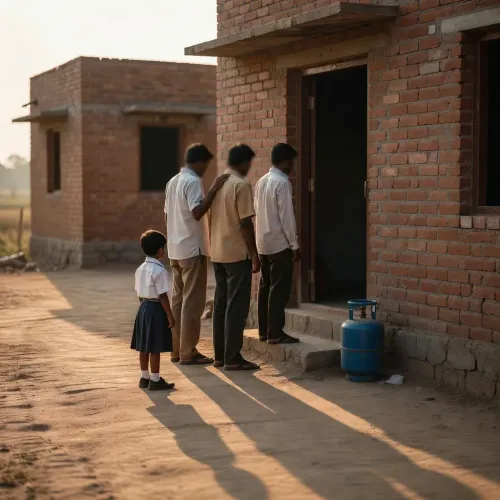
Since 2014, successive central budgets have channelled significant resources into direct benefit transfers, subsidised housing under Pradhan Mantri Awas Yojana, free cooking gas via Ujjwala, universal health cover under Ayushman Bharat, and free foodgrain entitlements — a cluster of schemes collectively aimed at reducing multidimensional deprivation among rural and poor urban households. Each programme targets a specific node of the MPI framework: a family with a pucca home, a gas connection, and an Ayushman card is, in MPI terms, no longer deprived across those indicators.
That architecture gives the government a credible argument that welfare spending has structurally moved people out of measured poverty. The debate, as economists and opposition voices have consistently pressed, is whether income poverty and consumption poverty have moved at the same pace — a question the next NITI Aayog MPI update and any forthcoming parliamentary scrutiny will sharpen considerably.
Singh's signal and its political timing
Singh, a senior BJP leader and Lok Sabha MP from Begusarai, Bihar — a state where welfare delivery metrics carry enormous electoral weight — has consistently been among the most vocal champions of the Modi government's development record. His post arrives as the government seeks to consolidate its welfare narrative ahead of the cycle of state assembly elections and periodic economic reviews. The framing — development reaching 'samaj ke antim vyakti', the last person in society — echoes a Gandhian idiom the BJP has deliberately embedded in its outreach vocabulary.
When the next official poverty data lands, 50 crore will either be the number that defined a generation — or the one that defined a debate.
Point of View
Morally resonant number like 50 crore, the minister is doing political work ahead of forthcoming data cycles, pre-empting opposition critiques with a headline figure. The unverified status of the specific number is itself the story — if official MPI data confirms a figure in that range, it becomes one of the most significant development achievements in modern Indian history; if it falls short, it invites scrutiny of the gap between political rhetoric and measurement. The release of the next NITI Aayog MPI report will be a decisive moment for how this claim ages.
NationPress
5 Nov 2026
Frequently Asked Questions
How many people has India lifted out of extreme poverty according to Giriraj Singh?
Union Textiles Minister Giriraj Singh claimed that 50 crore (500 million) people have exited extreme poverty in India under PM Narendra Modi's leadership, though this specific figure has not been independently verified against publicly released official data.
What is India's National Multidimensional Poverty Index?
India's National Multidimensional Poverty Index (MPI) is published by NITI Aayog and measures simultaneous deprivation across health, education, and living standards. It was first released as a baseline report in 2021 and has since been updated to track changes in poverty indicators.
Which government schemes are credited with reducing poverty in India?
Key schemes include Pradhan Mantri Awas Yojana (subsidised housing), Ujjwala Yojana (free cooking gas), Ayushman Bharat (universal health cover), and free foodgrain entitlements — each targeting a specific deprivation indicator tracked by the MPI.
Who is Giriraj Singh and why did he post about poverty reduction?
Giriraj Singh is India's Union Textiles Minister, a senior BJP leader and Lok Sabha MP from Begusarai, Bihar . His post amplifies the ruling government's development record narrative, particularly significant given Bihar's large rural and poor population.
Is the 50 crore poverty reduction figure officially confirmed?
The specific figure of 50 crore people exiting extreme poverty has not been independently verified against publicly released NITI Aayog MPI data. It represents the minister's political framing of a broader poverty-reduction trend that official indices have documented.