Cabinet clears ₹4,371 crore VISTAR scheme for AI-ready statistical system

Synopsis
India's statistical backbone is getting a ₹4,371 crore overhaul. The Cabinet-approved VISTAR scheme will embed AI into government data workflows, expand MoSPI surveys from 43 to 59, and conduct the 8th Economic Census down to the Gram Panchayat level — with the explicit goal of finally measuring the unorganised sector's true contribution to GDP.
Key Takeaways
The Union Cabinet approved the VISTAR scheme on 4 November 2026 with an outlay of ₹4,371.10 crore for FY 2026-27 to FY 2030-31 .
MoSPI will conduct 59 surveys in the 16th FC cycle, up from 43 previously.
The scheme embeds AI and ML into statistical workflows covering data processing, validation, and analysis.
The 8th Economic Census will capture data down to Gram Panchayat and ward level , forming the basis for a National Statistical Business Register .
New metrics — including a Headline Index of Services Production — will improve visibility into underrepresented sectors of the economy.
State governments will receive funding under a redesigned SSS 2.0 framework tied to deliverable outcomes.
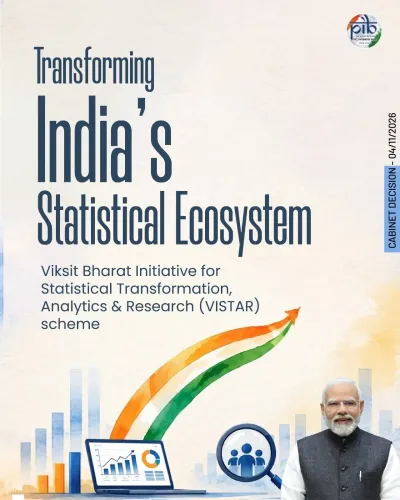
The Union Cabinet, chaired by Prime Minister Narendra Modi, on 4 November 2026 approved the Viksit Bharat Initiative for Statistical Transformation, Analytics and Research (VISTAR) scheme, with an outlay of ₹4,371.10 crore covering the period FY 2026-27 to FY 2030-31. The scheme is designed to overhaul India's official statistical architecture, making it real-time, AI-ready, and interoperable across government data systems.
What VISTAR Aims to Deliver
Aligned with the Viksit Bharat 2047 vision, the scheme will oversee all statistical and data management activities of the Ministry of Statistics and Programme Implementation (MoSPI). It is structured around three components: Comprehensive Statistical Operations and Strengthening of Ecosystem, Support for Statistical Strengthening (SSS), and the Economic Census (EC).
A core ambition is end-to-end digitalisation of statistical processes, embedding Artificial Intelligence (AI) and Machine Learning (ML) into routine workflows — primarily for data processing, validation, and analysis. The scheme also proposes mainstreaming alternative data sources such as mobile phones, scanner data, and e-commerce records to complement traditional surveys and reduce respondent burden.
More Surveys, New Metrics
Under the first component, MoSPI plans to conduct 59 surveys during the 16th Finance Commission (FC) cycle, up from 43 major surveys conducted previously — a significant expansion aimed at plugging critical data gaps across sectors. The ministry will also introduce new metrics, including a Headline Index of Services Production and an Index of Unincorporated Sector Enterprises, providing sharper visibility into parts of the economy that have historically been difficult to measure.
Notably, the scheme builds on foundational pillars of data harmonisation — cataloguing, machine readability, interoperability, sharing protocols, and privacy-by-design — to dismantle information silos and improve programme targeting at multiple levels of government.
Strengthening States and the Economic Census
The Support for Statistical Strengthening (SSS 2.0) component will channel funds to state and Union Territory governments through a redesigned, deliverable-linked framework, aiming to transform statistical capabilities sub-nationally. This marks an upgrade from earlier SSS iterations by tying disbursements to measurable outcomes.
The 8th Economic Census, to be conducted in collaboration with states and UTs, will capture granular data on all non-farm establishments and workers hired — right down to the Gram Panchayat and ward level. This census will serve as the baseline for a National Statistical Business Register (SBR), and will, according to the official statement, pave the way for estimating the contribution of the unorganised sector to GDP — a longstanding gap in India's national accounts.
Capacity Building and Research
Beyond data infrastructure, VISTAR includes provisions for capacity building, with an Internship Scheme for students and a window for research proposals from academic and research institutions. Officials say this component is intended to widen the pipeline of statistical talent available to government agencies over the five-year cycle.
What Comes Next
With Cabinet approval now in place, MoSPI is expected to begin operationalising the scheme from FY 2026-27. The rollout of the 8th Economic Census and the launch of new indices will be among the earliest deliverables to watch. The success of VISTAR will ultimately be judged by whether India's official data ecosystem can keep pace with the policy demands of a rapidly evolving, $3.5 trillion economy.
Point of View
Skew welfare targeting, and blunt monetary policy. The VISTAR scheme's most consequential promise is measuring the unorganised sector's contribution to GDP, something India has struggled with for decades despite that sector accounting for the bulk of employment. The jump from 43 to 59 surveys and the AI integration are directionally sound, but the scheme's credibility will hinge on SSS 2.0's deliverable-linkage actually working — previous state-level statistical strengthening efforts have had patchy compliance. The 8th Economic Census, if executed with the granularity promised, could become the most valuable government dataset of the decade.
NationPress
4 Nov 2026
Frequently Asked Questions
What is the VISTAR scheme approved by the Cabinet?
The VISTAR (Viksit Bharat Initiative for Statistical Transformation, Analytics and Research) scheme is a five-year plan approved on 4 November 2026 with an outlay of ₹4,371.10 crore, running from FY 2026-27 to FY 2030-31. It aims to build an AI-ready, real-time official statistical architecture for India under MoSPI.
What are the three components of the VISTAR scheme?
VISTAR comprises three components: Comprehensive Statistical Operations and Strengthening of Ecosystem (covering surveys, digitalisation, and AI integration), Support for Statistical Strengthening (SSS 2.0) for state and UT governments, and the Economic Census (8th edition). Together, they cover the full spectrum of India's official data infrastructure.
What is the 8th Economic Census and why does it matter?
The 8th Economic Census will collect granular data on all non-farm establishments and hired workers down to the Gram Panchayat and ward level across India. It will serve as the foundation for a National Statistical Business Register and is expected to help estimate the unorganised sector's contribution to GDP — a critical data gap in India's national accounts.
How does VISTAR use AI and new data sources?
Under VISTAR, MoSPI will embed Artificial Intelligence and Machine Learning into regular workflows for data processing, validation, and analysis. The scheme also plans to mainstream alternative data sources — including mobile phone data, scanner data, and e-commerce records — to complement traditional surveys and reduce respondent burden.
How does VISTAR benefit state governments?
The Support for Statistical Strengthening (SSS 2.0) component channels funds directly to state and Union Territory governments through a redesigned, deliverable-linked framework. Unlike earlier versions, disbursements are tied to measurable outcomes, aiming to build statistical capacity at the sub-national level.