Cabinet Clears ₹2,814 Cr Scheme to Build Critical Mineral Processing Power
Synopsis
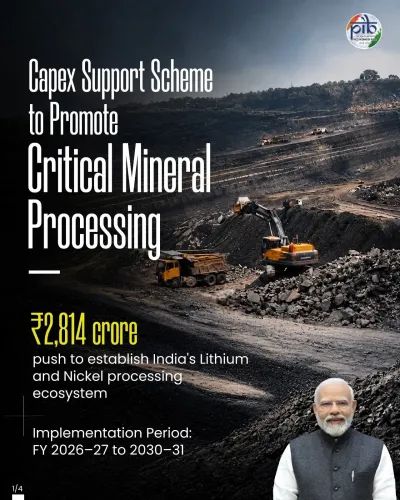
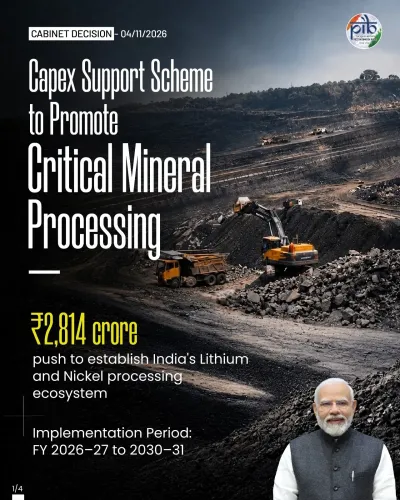
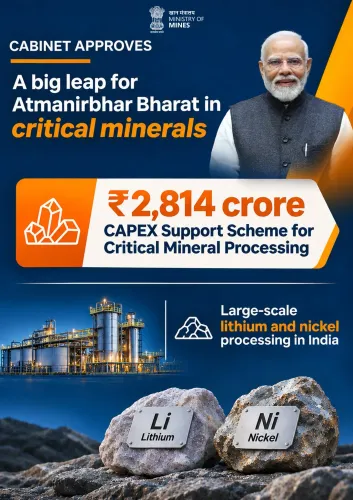
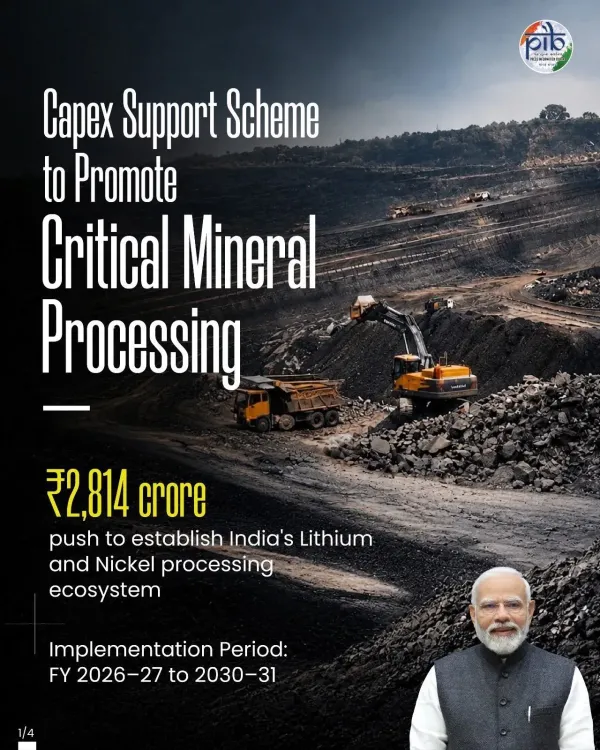
The Union Cabinet has approved the Capex Support Scheme to Promote Critical Mineral Processing with a ₹2,814 crore outlay over five years, aiming to build domestic refining capacity and reduce India's exposure to concentrated global supply chains dominated by China.
Key Takeaways
The Union Cabinet, chaired by PM Narendra Modi , approved the 'Capex Support Scheme to Promote Critical Mineral Processing' on November 4, 2026 .
The scheme carries a financial outlay of ₹2,814 crore spread over five years .
The scheme directly addresses the risk of critical mineral processing being concentrated in a handful of countries, primarily China .
It complements the Mines and Minerals (Development and Regulation) Amendment Act, 2023 , which first opened critical mineral block auctions to private players.
Key beneficiaries include EV battery manufacturers, renewable energy equipment producers and electronics industries dependent on processed mineral inputs.
Detailed scheme guidelines, project selection criteria and disbursement timelines are yet to be released by the nodal ministry.
India is making a direct bet against supply-chain vulnerability. Union Environment Minister Bhupender Yadav announced on Wednesday, November 4, 2026, that the Union Cabinet — chaired by Prime Minister Narendra Modi — has approved the 'Capex Support Scheme to Promote Critical Mineral Processing', committing a financial outlay of ₹2,814 crore over five years to build domestic processing capacity for minerals at the heart of the clean-energy and electronics transition.
Why India is spending ₹2,814 crore on mineral processing now
The minister's post flags the core problem head-on: 'processing of critical minerals remains concentrated in a handful of locations, exposing supply chains to geopolitical uncertainties, price volatility and potential supply disruptions.' That handful is barely a handful at all — China commands a near-monopoly on the refining of lithium, rare earths, cobalt and a range of other inputs that every EV battery, solar panel and semiconductor depends on. For India, whose green-energy and electronics manufacturing ambitions are scaling fast, that concentration is not an abstract risk — it is a live constraint.
The scheme's capital-expenditure focus is deliberate. Processing infrastructure is capital-intensive enough that private players hesitate to commit without fiscal support, particularly when competing against incumbents in China who benefit from decades of state backing. The ₹2,814 crore capex support is designed to close precisely that gap.
The legislative runway that made this possible
The Cabinet approval does not arrive from nowhere. The Mines and Minerals (Development and Regulation) Amendment Act, 2023, cracked open India's critical-mineral sector for the first time by enabling competitive auctions of strategic mineral blocks — bringing private capital into exploration and extraction. The new processing scheme is the downstream complement: auctions put raw material in domestic hands; capex support now gives industry the financial muscle to refine it at home rather than export it for processing abroad and import it back as a finished input.
The Production Linked Incentive scheme for Advanced Chemistry Cells, launched in 2021, had already signalled India's intent to anchor domestic battery manufacturing. The critical-mineral processing scheme slots in one step earlier in that value chain — ensuring the processed feedstock those battery cells require does not remain an imported dependency.
India's place in a global minerals race
India is not moving in isolation. The Minerals Security Partnership — a grouping of like-minded economies — reflects the same strategic logic: diversify processing away from a single dominant geography. India's participation in that framework, combined with domestic legislative reform and now direct capex support, amounts to a three-layer strategy: secure mining rights, attract processing investment, and lock in international supply-chain relationships.
The industries watching this most closely are EV battery manufacturers, renewable-energy equipment producers and the electronics sector — all of which face compounding cost and availability risk when a single country controls the refinery gate. Scheme guidelines, project selection criteria and disbursement timelines are yet to be released by the nodal ministry; those details will determine how quickly India's processing capacity actually moves from announcement to commissioned plant.
The ore is in the ground. The law has opened the door. Now the money is at the table — India's race to own its own mineral supply chain just became official policy.
Point of View
But without domestic refining capacity the extracted material would still flow abroad for processing. By channelling capital-expenditure support — not just production-linked incentives — the government is targeting the highest-barrier step in the value chain. The timing is sharp: as Western economies race to diversify mineral supply chains away from China, India is positioning itself as both a credible processing hub and a secure source for partner nations. The five-year horizon and the relatively contained outlay suggest this is a proof-of-concept phase; the real signal to watch is whether private capital follows the public anchor and what international offtake agreements are signed against new domestic processing lines.
NationPress
4 Nov 2026
Frequently Asked Questions
What is the Capex Support Scheme to Promote Critical Mineral Processing?
It is a Union Cabinet-approved scheme with a ₹2,814 crore outlay over five years that provides capital-expenditure support to companies setting up critical mineral processing facilities in India, reducing dependence on foreign — particularly Chinese — processing capacity.
Which critical minerals does this scheme target?
The scheme targets minerals essential for EVs, electronics and clean energy — broadly including lithium, rare earths, cobalt and similar inputs. Exact mineral categories and project eligibility will be specified in guidelines yet to be released by the nodal ministry.
Why does India need domestic critical mineral processing capacity?
Global processing is heavily concentrated in China , creating supply-chain risks from geopolitical tensions, price volatility and potential disruptions. India's rapidly growing EV, solar and electronics sectors need a secure, domestic supply of processed mineral inputs.
How does this scheme connect to India's existing minerals policy?
It builds directly on the Mines and Minerals (Development and Regulation) Amendment Act, 2023 , which enabled private-sector participation in critical mineral block auctions, and complements the Production Linked Incentive scheme for Advanced Chemistry Cells launched in 2021 .
Who will benefit from the critical mineral processing scheme?
Primary beneficiaries are mineral processing firms, EV battery manufacturers, renewable energy equipment producers and the electronics sector — all of which currently depend on imported processed mineral inputs.