CM Fadnavis: Girls won 85% medals at Wardha convocation
Synopsis
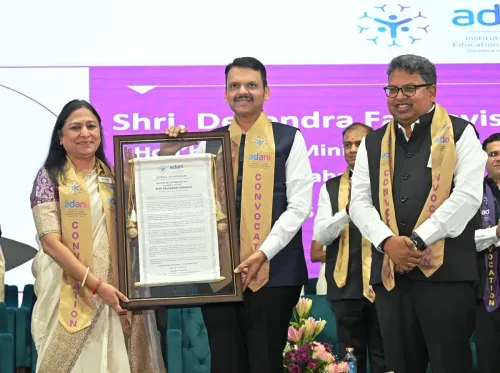
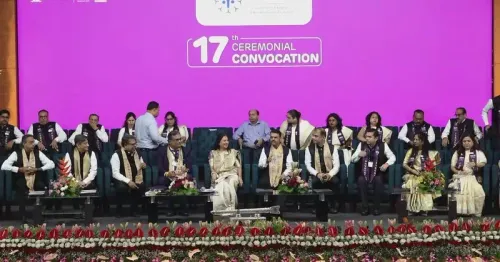
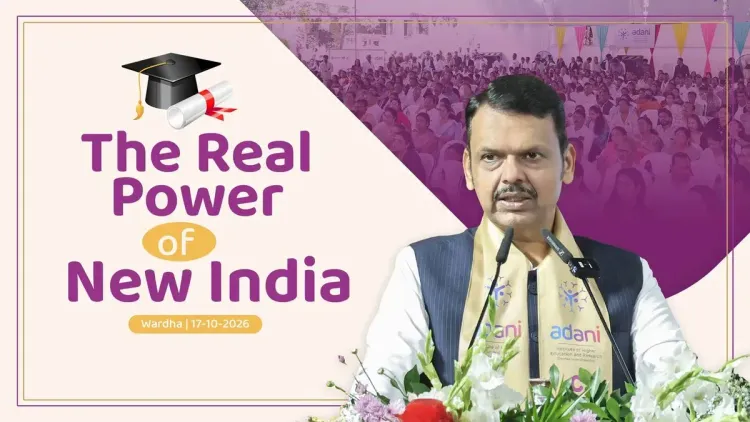
Maharashtra CM Devendra Fadnavis attended the 17th Convocation of the Adani Institute of Higher Education and Research in Wardha on 17 October 2026, highlighting that girl students won 85% of medals — framing the feat as proof of Nari Shakti driving the Viksit Bharat 2047 vision.
Key Takeaways
85 per cent of medals at the Adani Institute's 17th Ceremonial Convocation 2026 in Wardha went to girl students.
CM Devendra Fadnavis linked the achievement to the national Viksit Bharat goal of a developed India by 2047 .
Fadnavis described the statistic as a symbol of Nari Shakti and evidence of women's empowerment in action.
The result aligns with a decade-long rise in female enrolment in higher education tracked through national AISHE data.
Policy foundations cited include the Beti Bachao Beti Padhao scheme (2015) and the National Education Policy 2020 , both of which embed gender equity as a core objective.
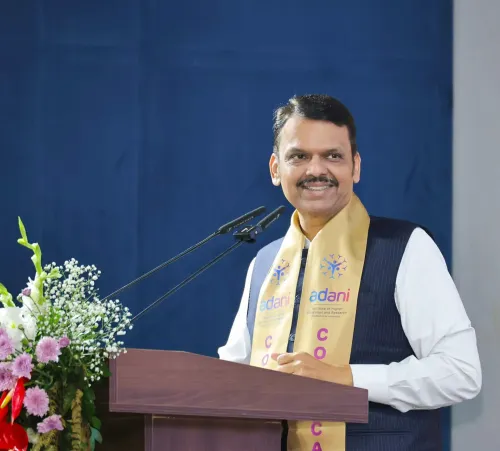
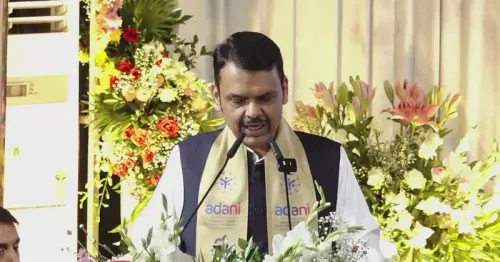
At a convocation stage in Wardha, the numbers told their own story — girls claimed 85 per cent of the medals. Maharashtra Chief Minister Devendra Fadnavis, speaking at the 17th Ceremonial Convocation 2026 of the Adani Institute of Higher Education and Research on 17 October 2026, held that statistic up as proof that women's empowerment is no longer a slogan — it is a scoreboard.
Fadnavis framed the achievement squarely within the national Viksit Bharat vision — India's ambition to emerge as a fully developed nation by 2047, the centenary of independence. 'With girls winning 85% of the medals, this achievement celebrates the strength of Nari Shakti and underscores the pivotal role of women's empowerment in realising the vision of Viksit Bharat by 2047,' he said. In Marathi, he added: 'पदकप्राप्तींमध्ये 85% वाटा विद्यार्थिनींचा असणे, हे नारीशक्तीच्या सामर्थ्याचे प्रतीक आहे' — 'girls accounting for 85% of the medals is a symbol of the power of Nari Shakti.'
Wardha's medal tally and what it signals for Maharashtra
The Adani Institute of Higher Education and Research in Wardha, eastern Maharashtra, hosted the ceremony, and the medal distribution was impossible to ignore. A single campus statistic — 85 per cent of academic honours going to women — maps directly onto a decade-long trend in Indian higher education. National enrolment data tracked through successive All India Survey on Higher Education reports has consistently shown female participation in professional and higher education climbing year on year, and Maharashtra has been among the states logging that upward curve.
Two central policy pillars underpin what Fadnavis pointed to: the Beti Bachao Beti Padhao scheme, launched in 2015 to promote the survival, protection and education of the girl child, and the National Education Policy 2020, which built gender equity and expanded female participation explicitly into its framework. The convocation result, in that light, is less a surprise than a confirmation.
Nari Shakti as a 2047 cornerstone
The Chief Minister's remarks did more than congratulate graduates. They tied a single institution's prize-giving to a national deadline — 2047. That rhetorical move is deliberate: the Viksit Bharat framework positions women's economic and educational advancement not as a welfare goal but as a structural prerequisite for the country reaching developed-nation status. When a state's top elected official uses a convocation to make that argument, it signals that gender equity metrics are increasingly being read as development metrics at the highest levels of governance.
The next data point to watch is the release of the forthcoming AISHE report, which will either reinforce or complicate the optimism on display in Wardha today. If Maharashtra's state-level numbers on female enrolment and graduation mirror what one institute's podium showed, the CM will have more than a speech — he will have evidence.
Point of View
The CM signals that gender metrics are being absorbed into the development scorecard, not siloed as social policy. This aligns with a broader BJP strategy of deploying Nari Shakti as a crossover theme between welfare optics and economic ambition. The move also quietly benchmarks future AISHE data against the party's own stated milestones, making the numbers politically load-bearing.
NationPress
17 Oct 2026
Frequently Asked Questions
What happened at the Adani Institute convocation in Wardha 2026?
The Adani Institute of Higher Education and Research in Wardha held its 17th Ceremonial Convocation on 17 October 2026, where girl students won 85 per cent of the medals awarded. Maharashtra CM Devendra Fadnavis attended and highlighted the achievement as a symbol of Nari Shakti.
What is the Viksit Bharat 2047 vision?
Viksit Bharat is India's national goal to become a fully developed nation by 2047, the centenary of independence. Women's empowerment and education are identified as key pillars of achieving that target.
What is the Adani Institute of Higher Education and Research?
The Adani Institute of Higher Education and Research is a higher education institution located in Wardha, Maharashtra.
How does Beti Bachao Beti Padhao relate to girls excelling in higher education?
Launched in 2015, the Beti Bachao Beti Padhao scheme aims to promote the survival, protection and education of the girl child. It is one of the policy foundations credited with supporting the rising female participation in higher education across India, including Maharashtra.
What does Nari Shakti mean?
Nari Shakti is a Hindi phrase meaning 'the power of women.' It is widely used in Indian political discourse to refer to women's strength, capability and contribution to national development.