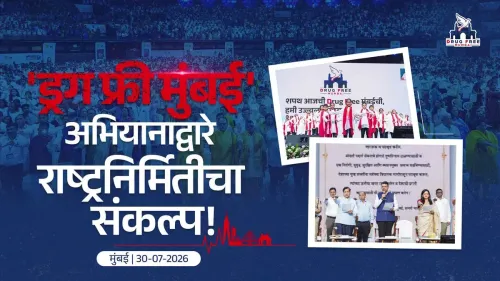
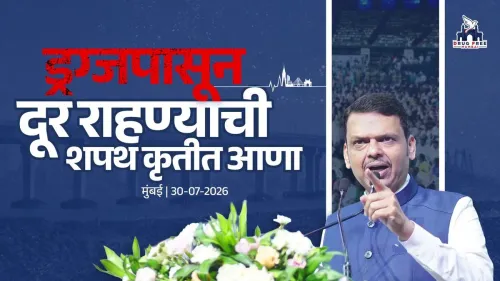
CM Fadnavis Launches Drug Free Mumbai Campaign
Synopsis
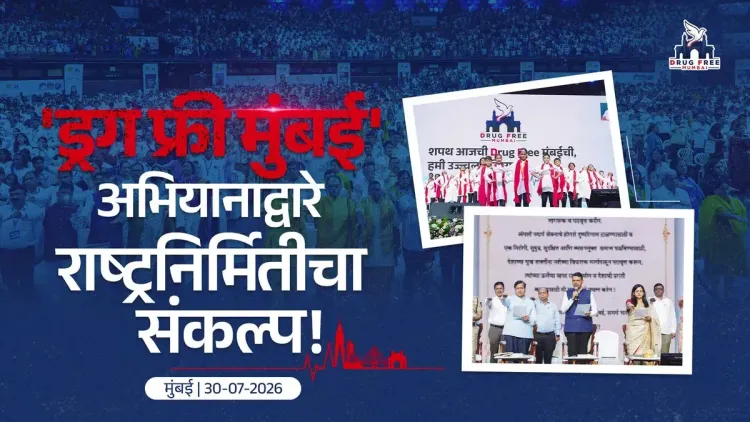
Maharashtra CM Devendra Fadnavis launched 'Drug Free Mumbai' on July 30, 2026, extending PM Modi's national Drug-Free India mission to the state level. The campaign calls on youth, parents, schools, and communities to collectively combat substance abuse in Mumbai and across Maharashtra.
Key Takeaways
Maharashtra CM Devendra Fadnavis launched the 'Drug Free Mumbai' campaign on July 30, 2026 in Mumbai.
The campaign is positioned as Maharashtra's state-level extension of PM Modi's national Drug-Free India mission.
It builds on the Nasha Mukt Bharat Abhiyan , which the central government expanded in 2021 to intensify youth-focused anti-drug outreach.
Minister Mangal Prabhat Lodha and other dignitaries attended the launch event.
Fadnavis emphasised that enforcement alone is insufficient — the campaign explicitly calls for participation from families, educational institutions, communities, and youth .
A dedicated digital presence ( @drugfreemumbai_ , #DrugFreeMumbai ) targets online youth engagement.
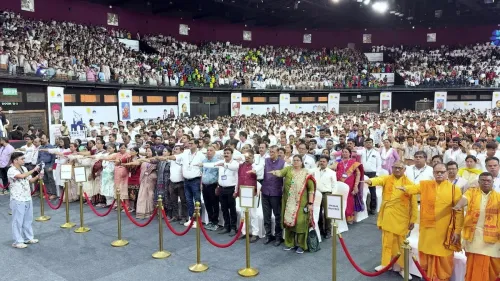
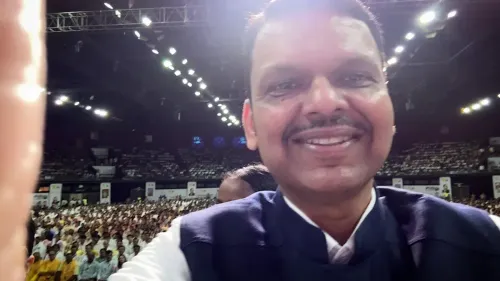
Mumbai's youth got a new ally on Thursday, July 30, 2026, when Maharashtra Chief Minister Devendra Fadnavis formally inaugurated the 'Drug Free Mumbai' anti-drug awareness campaign in the city — framing it as the state's concrete answer to Prime Minister Narendra Modi's national mission of building a Drug-Free India.
A State Campaign Rooted in a National Mission
The launch was not a standalone gesture. It sits squarely within the Nasha Mukt Bharat Abhiyan, the central government's flagship anti-narcotics awareness programme that the Ministry of Social Justice and Empowerment significantly expanded in 2021 to intensify rehabilitation and community outreach, particularly targeting urban youth. Drug Free Mumbai is Maharashtra's state-level translation of that mandate — moving the mission from New Delhi's policy corridors to Mumbai's streets, colleges, and neighbourhoods.
Minister Mangal Prabhat Lodha and other dignitaries were present at the launch. Fadnavis called drug abuse 'a silent threat that seeks to mislead young minds and weaken our society from within' — pointedly distinguishing it from visible, headline-grabbing crimes.
Enforcement Alone Won't Win This Fight
The CM's message carried a clear sub-text: government crackdowns under the Narcotic Drugs and Psychotropic Substances (NDPS) Act are necessary but not sufficient. 'The fight against drugs cannot be won by any one department or institution alone,' Fadnavis said, echoing PM Modi's framing. He called for a coalition of government agencies, law enforcement, educational institutions, parents, communities — and above all, young people themselves.
That pivot toward community ownership is deliberate. Urban centres like Mumbai present a harder enforcement problem than rural supply chains: demand is diffuse, peer pressure is invisible, and no police force can patrol every college corridor. Awareness campaigns attempt to shift the calculus at the individual level, where enforcement cannot reach.
Why Mumbai, Why Now
As India races toward milestones in technology, AI, and space exploration, Fadnavis argued that the country's greatest asset — its youth demographic — is also its most vulnerable. Mumbai, India's financial capital and home to millions of young migrants and students, is both a symbol of that ambition and a city where substance abuse networks have historically found fertile ground. Launching here sends a signal about scale and seriousness.
The campaign hashtag #DrugFreeMumbai and the dedicated handle @drugfreemumbai_ suggest a digital outreach layer aimed at precisely the demographic most at risk — and most online.
If Drug Free Mumbai delivers measurable outcomes, expect the model to travel: similar campaigns across Maharashtra's other major cities are the logical next step, and the state assembly will likely be asked to account for funding and results before the year is out.
Point of View
Fadnavis simultaneously claims policy credit at the state level while reinforcing the national narrative. The emphasis on community participation over pure enforcement also reflects a maturation in anti-narcotics strategy: governments have learned that supply-side crackdowns without demand-side awareness produce limited long-term results. Whether Drug Free Mumbai translates into measurable outcome data — treatment referrals, school enrolments in awareness programmes, reported seizures — will determine if it endures as policy or fades as optics.
NationPress
30 Jul 2026
Frequently Asked Questions
What is the Drug Free Mumbai campaign?
'Drug Free Mumbai' is a state-level anti-drug awareness campaign launched by Maharashtra Chief Minister Devendra Fadnavis on July 30, 2026, in Mumbai. It aims to mobilise youth, families, schools, and communities to combat substance abuse, complementing the national Drug-Free India mission.
Who launched the Drug Free Mumbai campaign?
Maharashtra Chief Minister Devendra Fadnavis launched the campaign, with Minister Mangal Prabhat Lodha and other dignitaries in attendance.
How does Drug Free Mumbai relate to the national Drug-Free India mission?
Drug Free Mumbai is Maharashtra's implementation of PM Narendra Modi's national Drug-Free India vision and the central government's Nasha Mukt Bharat Abhiyan, which was expanded in 2021 to intensify anti-drug awareness and rehabilitation efforts across the country.
What is the Nasha Mukt Bharat Abhiyan?
The Nasha Mukt Bharat Abhiyan is a flagship anti-narcotics programme run by India's Ministry of Social Justice and Empowerment. Significantly expanded in 2021, it focuses on community awareness, youth outreach, and rehabilitation to reduce substance abuse, especially in urban areas.
What role does youth play in the Drug Free Mumbai campaign?
Youth are both the primary target audience and active participants. CM Fadnavis called on every young person to 'Say No To Drugs' and urged them to resist peer pressure, framing India's youth demographic as the country's greatest strength and the generation most at risk from drug abuse.