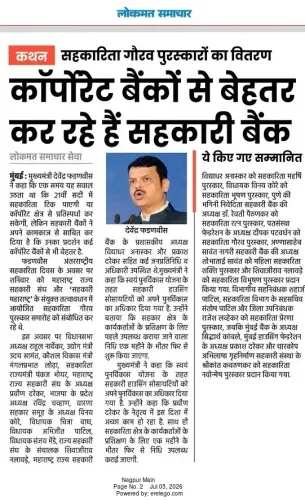
CM Fadnavis: Maharashtra Co-op Banks Outpace Corporate Banks
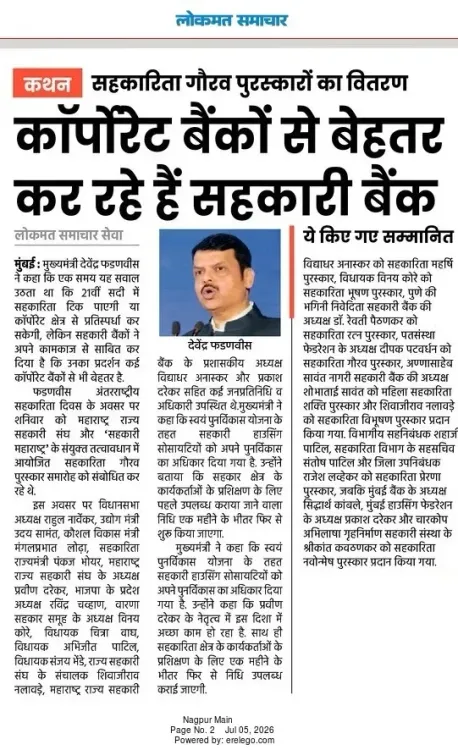
Synopsis
On International Day of Cooperatives, the Chief Minister's Office of Maharashtra quoted CM Devendra Fadnavis as saying cooperative banks in the state are performing better than corporate banks — a statement with broad implications for rural credit policy and the state's cooperative ecosystem.
Key Takeaways
The Chief Minister's Office of Maharashtra posted on 5 July 2026 — International Day of Cooperatives — quoting CM Devendra Fadnavis as saying cooperative banks are outperforming corporate banks.
Maharashtra hosts one of India's largest cooperative banking networks, rooted in agriculture, sugar, and dairy sectors since the Maharashtra State Cooperative Bank's founding in 1947 .
Cooperative banks in India operate under a dual regulatory framework involving the RBI and state registrars; the 2020 Banking Regulation Act amendments expanded RBI oversight.
The primary beneficiaries are rural borrowers — smallholder farmers and agricultural credit society members — who depend on cooperatives for affordable credit.
The RBI's next annual banking report is expected to carry state-wise metrics that could provide data context for the claim.
Any follow-up state budget measures on cooperative recapitalisation will indicate whether the government plans to reinforce its stated confidence in the sector.
The Chief Minister's Office of Maharashtra shared a statement attributed to Chief Minister Devendra Fadnavis on Sunday, 5 July 2026, asserting that cooperative banks in the state are outperforming corporate banks — a claim made on the occasion of International Day of Cooperatives.
Context
The post, shared from the official @CMOMaharashtra handle and tagging @Dev_Fadnavis, carries the message: 'Corporate bankon se behtar kar rahe hain sahakari bank' ('Cooperative banks are performing better than corporate banks'). The statement was made in the context of International Day of Cooperatives, observed annually on the first Saturday of July by the International Co-operative Alliance and recognised by the United Nations.
The remark positions Maharashtra's cooperative banking sector as a success story, drawing a direct and pointed comparison with commercial or corporate banks — a framing that carries both economic and political weight in a state where cooperatives have deep roots in rural life and agriculture.
Policy Backdrop
Maharashtra hosts one of India's largest networks of cooperative banks and credit societies, historically serving farmers, sugar cooperatives, and dairy producers. The Maharashtra State Cooperative Bank, founded in 1947, has long been the apex body channelling rural credit through district central banks and primary agricultural credit societies.
Cooperative banks in India operate under a dual regulatory framework: the Reserve Bank of India (RBI) governs their banking functions, while state registrars oversee their cooperative aspects. 2020 amendments to the Banking Regulation Act extended the RBI's supervisory reach over urban cooperative banks, a move aimed at addressing governance and capital adequacy concerns that had surfaced across several states, including Maharashtra.
Despite past controversies — including high-profile failures of certain urban cooperative banks — the sector has continued to serve as a primary credit channel for rural and semi-urban borrowers who remain underserved by commercial banking networks.
Stakeholders and Impact
The primary beneficiaries of cooperative banking in Maharashtra are rural borrowers — smallholder farmers, agricultural labourers, and members of village-level credit societies — who rely on these institutions for seasonal and long-term credit at rates often below commercial bank offerings. The assertion that cooperatives are outperforming corporate banks, if borne out by data, would be significant for this constituency.
For the state government, a strong cooperative banking sector reduces dependence on commercial credit for agricultural financing, eases rural distress, and reinforces the political capital that has historically accrued to leaders who champion the cooperative movement in Maharashtra. CM Fadnavis has consistently positioned the cooperative sector as central to the state's rural economic policy since his first term beginning in 2014.
What's Next
The RBI's annual report on trends and progress of banking in India is expected to carry state-wise cooperative bank performance metrics that could either substantiate or complicate the claim made by CM Fadnavis. Analysts and opposition leaders are likely to seek granular data — including non-performing asset ratios, credit growth, and capital adequacy figures — before accepting the broad comparative assertion at face value.
Any follow-up state budget announcements on cooperative recapitalisation or governance reform would signal whether the government intends to back its optimistic assessment with fresh policy commitments. The occasion of International Day of Cooperatives may also prompt the state to outline a roadmap for the sector's expansion in Maharashtra's next fiscal cycle.
Point of View
The Chief Minister is staking a reputational claim on a sector that has faced regulatory scrutiny and high-profile failures in recent years. The framing serves a dual purpose: reinforcing the government's rural-credit credentials ahead of any upcoming electoral cycle, and pre-empting criticism from opposition groups that have historically used cooperative bank failures as political ammunition. Whether the claim holds up to data scrutiny from the RBI will determine how durable this narrative proves to be.
NationPress
5 Jul 2026
Frequently Asked Questions
What did CM Devendra Fadnavis say about cooperative banks in Maharashtra?
CM Devendra Fadnavis stated that cooperative banks in Maharashtra are performing better than corporate banks, a claim shared by the Chief Minister's Office on International Day of Cooperatives on 5 July 2026.
What is International Day of Cooperatives?
International Day of Cooperatives is observed annually on the first Saturday of July, recognised by the United Nations and the International Co-operative Alliance to highlight the role of cooperative enterprises in economic and social development.
How are cooperative banks regulated in India?
Cooperative banks in India operate under a dual regulatory framework: the Reserve Bank of India governs their banking functions, while state registrars oversee cooperative aspects. The 2020 Banking Regulation Act amendments expanded RBI's supervisory powers over urban cooperative banks.
Why are cooperative banks important in Maharashtra?
Maharashtra has one of India's largest cooperative banking networks, serving rural borrowers — particularly farmers and agricultural credit society members — who rely on these institutions for affordable seasonal and long-term credit that commercial banks often do not extend.
What data would verify the claim that Maharashtra's cooperative banks are outperforming corporate banks?
The RBI's annual report on trends and progress of banking in India, which contains state-wise cooperative bank performance metrics including non-performing asset ratios, credit growth, and capital adequacy figures, would be the key data source to assess this claim.