CM Fadnavis marks Dhammachakra Pravartan Day, pays tribute to Ambedkar
Synopsis
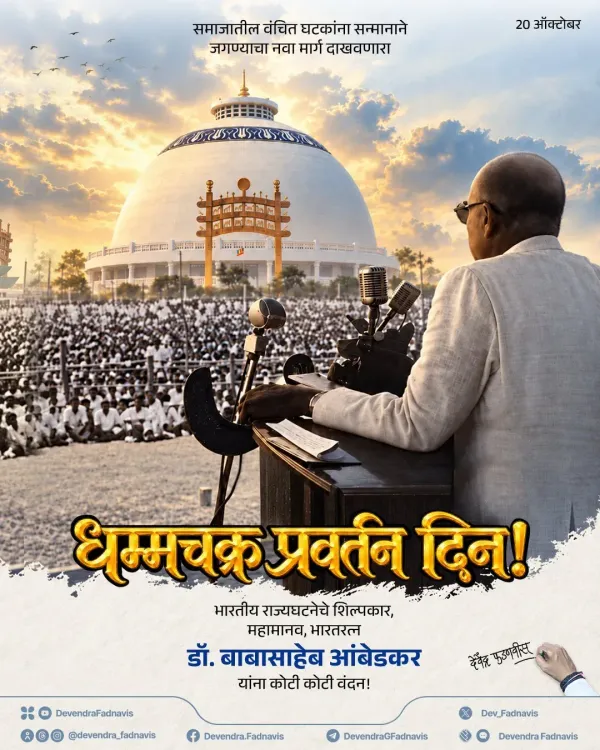
Maharashtra CM Devendra Fadnavis marked Dhammachakra Pravartan Day on 20 October 2026, honouring Dr. B. R. Ambedkar's historic 1956 mass conversion to Buddhism at Nagpur — a movement that transformed millions of lives through the ideals of equality, liberty, and fraternity.
Key Takeaways
CM Devendra Fadnavis posted greetings on Dhammachakra Pravartan Day, 20 October 2026 , paying tribute to Dr.
Ambedkar converted to Buddhism alongside an estimated 500,000 followers at Nagpur on 14 October 1956 .
The day commemorates the 'turning of the wheel of Dhamma' and is a major civic occasion in Maharashtra .
Fadnavis invoked the three pillars of the movement — equality, liberty, and fraternity — mirroring the Constitutional values Ambedkar enshrined.
Ambedkar was awarded the Bharat Ratna and served as principal architect of the Indian Constitution .
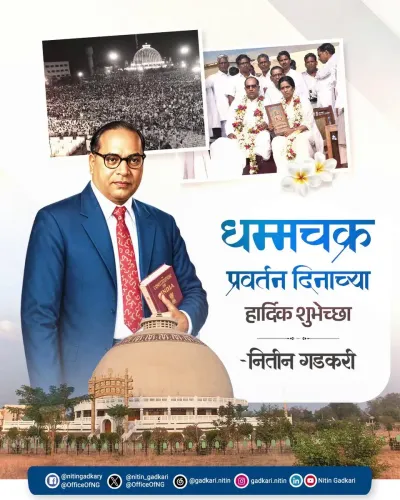
Seventy years after Dr. B. R. Ambedkar led one of history's most consequential acts of mass spiritual assertion, the day he chose to walk away from caste oppression still resonates across Maharashtra and beyond. Maharashtra Chief Minister Devendra Fadnavis marked Dhammachakra Pravartan Day on Tuesday, 20 October 2026, offering greetings and a tribute to the architect of the Indian Constitution.
In his post, Fadnavis wrote: 'A historic movement that transformed the lives of millions through the ideals of equality, liberty and fraternity.' In Marathi, he added — माणसाला माणूस म्हणून समानतेने, सन्मानाने जगण्याचा अधिकार मिळवून देणारा ऐतिहासिक दिवस ('a historic day that secured every person the right to live as a human being, with equality and dignity') — before offering his respects: भारतरत्न डॉ. बाबासाहेब आंबेडकर यांना कोटी कोटी वंदन! ('Crores of salutes to Bharat Ratna Dr. Babasaheb Ambedkar!').The day that remade Maharashtra: Nagpur, 14 October 1956
The occasion commemorates a single afternoon that changed the social fabric of modern India. On 14 October 1956, Dr. Ambedkar — jurist, economist, and the man who chaired the Constitution's drafting committee — converted to Buddhism at Nagpur, accompanied by an estimated 500,000 followers. The act was a deliberate, public rejection of untouchability, channelling the Buddhist principles of equality, compassion, and human dignity into a living political statement.
For Maharashtra, the event carries weight that goes well beyond symbolism. Nagpur remains the epicentre of annual observances, drawing pilgrims and communities who trace their social awakening directly to that 1956 moment. Dhammachakra Pravartan Day — the 'turning of the wheel of Dhamma' — is now a fixed point in the state's civic calendar.
Ambedkar's constitutional legacy alongside his Buddhist mission
Dr. Ambedkar was awarded the Bharat Ratna, India's highest civilian honour, and remains the only person whose portrait hangs in the central hall of both Houses of Parliament as both framer and enduring conscience of the republic. His twin legacies — the Constitution's guarantee of fundamental rights and the Dhammachakra movement's insistence on social dignity — are inseparable. One gave legal architecture to equality; the other gave it a living community.
Political leaders across party lines mark the day, but in Maharashtra the tribute carries a sharper charge. The state's large Dalit Buddhist community, the direct inheritors of the 1956 conversion, watches how public figures engage with the occasion and its underlying ideals.
Point of View
A substantive tribute to Ambedkar on Dhammachakra Pravartan Day is as much political as it is commemorative — the state's large Dalit Buddhist electorate attaches close scrutiny to how ruling-party figures engage with the occasion. Fadnavis's choice to quote the movement's core ideals of equality, liberty, and fraternity — language that mirrors the Constitution's preamble — signals an attempt to position the BJP as a custodian of Ambedkar's full legacy, not merely his constitutional role. Nationally, all major parties have intensified their Ambedkar outreach in recent election cycles, making the day a soft-power contest as much as a solemn tribute. How that rhetoric translates into state-level policy on social equality and Buddhist heritage preservation will be the real measure.
NationPress
20 Oct 2026
Frequently Asked Questions
What is Dhammachakra Pravartan Day?
Dhammachakra Pravartan Day marks the anniversary of Dr. B. R. Ambedkar's conversion to Buddhism on 14 October 1956 at Nagpur , when he and an estimated 500,000 followers embraced Buddhism in a mass ceremony that became a landmark moment in India's social-reform history.
Why did Dr. Ambedkar convert to Buddhism?
Dr. Ambedkar converted to Buddhism as a conscious rejection of caste-based discrimination and untouchability. He saw Buddhism's principles of equality, compassion, and human dignity as aligned with his lifelong fight for social justice and constitutional rights.
What did CM Devendra Fadnavis say on Dhammachakra Pravartan Day 2026?
CM Fadnavis described the day as 'a historic movement that transformed the lives of millions through the ideals of equality, liberty and fraternity,' and offered crores of salutes to Bharat Ratna Dr. Babasaheb Ambedkar in both English and Marathi.
What is Dr. Ambedkar's connection to the Indian Constitution?
Dr. B. R. Ambedkar chaired the drafting committee of the Indian Constitution and is widely regarded as its principal architect. He was posthumously awarded the Bharat Ratna , India's highest civilian honour.
Why does Dhammachakra Pravartan Day matter in Maharashtra?
Maharashtra, and Nagpur in particular, was the site of the 1956 mass conversion, making the state the heartland of the Dhammachakra movement. The day resonates deeply with the state's large Dalit Buddhist community and is a major annual civic observance.