CM Fadnavis Pays Tribute on Dhammachakra Pravartan Day

Synopsis
Maharashtra Chief Minister Devendra Fadnavis greeted citizens on Dhammachakra Pravartan Day, honouring Dr. B. R. Ambedkar's landmark 1956 Buddhist conversion at Nagpur — a milestone in India's social-justice movement — with tributes in both English and Marathi.
Key Takeaways
CM Devendra Fadnavis posted greetings on Dhammachakra Pravartan Day on 20 October 2026 .
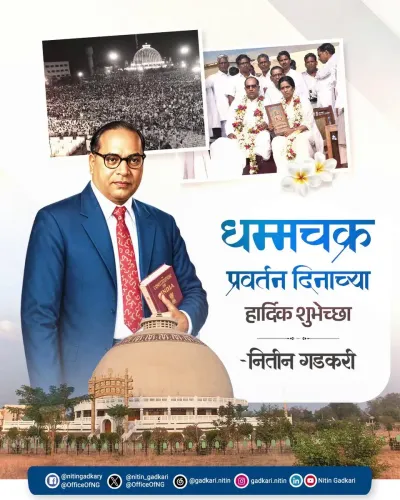
Ambedkar converted to Buddhism on 14 October 1956 at Deekshabhoomi, Nagpur , alongside hundreds of thousands of followers.
The day commemorates a watershed act of social reform, symbolising equality, dignity and rejection of caste discrimination.
Fadnavis paid tribute in both English and Marathi, calling it 'an historic day that gave a new direction to the pursuit of equality, dignity and social justice.' Leaders across Maharashtra's political spectrum routinely mark the occasion, reflecting Ambedkar's enduring centrality to the state's public life.
Seventy years after Dr. B. R. Ambedkar led one of the largest mass conversions in modern history, the day he chose Buddhism remains a living symbol of India's unfinished conversation with dignity and equality. Maharashtra Chief Minister Devendra Fadnavis marked Dhammachakra Pravartan Day on Tuesday, 20 October 2026, offering greetings and paying homage to the Bharat Ratna statesman whose vision reshaped the republic's conscience.
Posting in both English and Marathi, CM Fadnavis called the day 'an historic day that gave a new direction to the pursuit of equality, dignity and social justice.' In Marathi he wrote: 'समाजातील वंचित घटकांना सन्मानाने जगण्याचा नवा मार्ग दाखवणारे, भारतरत्न डॉ. बाबासाहेब आंबेडकर यांना कोटी कोटी वंदन!' — meaning, 'Countless salutations to Bharat Ratna Dr. Babasaheb Ambedkar, who showed a new path of dignified living to the marginalised sections of society!'
The day Dr. Ambedkar changed history at Nagpur
On 14 October 1956, at Deekshabhoomi, Nagpur, Dr. Ambedkar formally converted to Buddhism along with hundreds of thousands of his followers — a deliberate, public act of rejecting caste-based discrimination and claiming a spiritual framework rooted in equality. The event was not merely religious; it was a declaration of social sovereignty. Dhammachakra Pravartan Day — literally, 'the day the wheel of Dhamma was set in motion' — has been observed annually ever since, drawing pilgrims and political figures alike to Nagpur's sacred grounds.
Maharashtra's political leaders and the Ambedkar legacy
In Maharashtra, where Ambedkar's life and legacy are woven into the state's political fabric, marking this day is both a matter of cultural respect and civic affirmation. Leaders across party lines routinely issue public greetings, recognising Ambedkar's foundational role as the principal architect of the Indian Constitution and the champion of Dalit rights. For CM Fadnavis, the tribute carries added weight — Maharashtra is both Ambedkar's birthplace state and the site of his most consequential act of social reform.
Point of View
Constitutional legacy, and electoral politics in Maharashtra — making it one of the most consequential commemorations on the state's calendar. For a BJP chief minister to offer public tribute underlines how Ambedkar's legacy has become a cross-partisan touchstone, with every major party competing to be seen as its rightful custodian. The dual-language post signals deliberate outreach to both Marathi-speaking Dalit communities and a broader national audience. It also reflects the BJP's sustained effort, nationally and in Maharashtra, to stake a claim on Ambedkar's reformist inheritance as a pillar of its social-coalition strategy.
NationPress
20 Oct 2026
Frequently Asked Questions
What is Dhammachakra Pravartan Day?
Dhammachakra Pravartan Day is observed annually to mark Dr. B. R. Ambedkar's mass conversion to Buddhism on 14 October 1956 at Deekshabhoomi, Nagpur, symbolising the pursuit of equality, dignity and social justice.
Why did Dr. Ambedkar convert to Buddhism?
Dr. Ambedkar embraced Buddhism as a rejection of the caste-based discrimination embedded in the social order, choosing a spiritual path he believed was rooted in equality and human dignity.
What did CM Devendra Fadnavis say on Dhammachakra Pravartan Day 2026?
CM Fadnavis called it 'an historic day that gave a new direction to the pursuit of equality, dignity and social justice,' and in Marathi offered 'countless salutations' to Dr. Ambedkar for showing a new path of dignified living to marginalised communities.
Where is Deekshabhoomi and why is it significant?
Deekshabhoomi is a sacred Buddhist monument in Nagpur, Maharashtra, and is the site where Dr. Ambedkar led the historic mass conversion to Buddhism in 1956 — making it one of the most important pilgrimage sites for Buddhists and Dalits in India.
Who was Dr. B. R. Ambedkar?
Dr. B. R. Ambedkar was a Bharat Ratna awardee, the principal architect of the Indian Constitution, and a towering leader of the movement for social equality and Dalit rights in India.