CM Fadnavis Targets Mumbai Infrastructure Overhaul by 2030
Synopsis
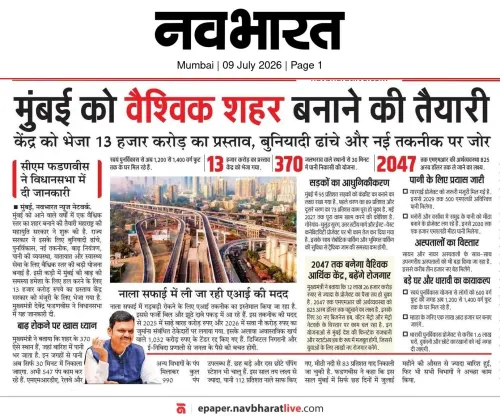
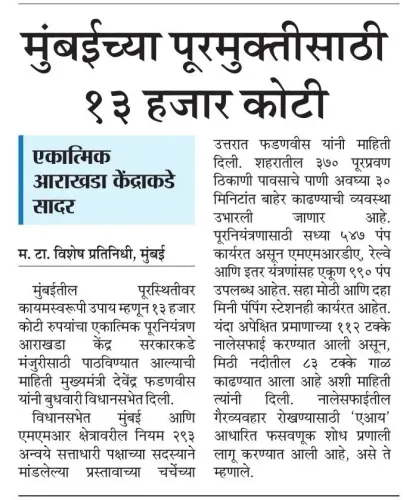
The Chief Minister's Office of Maharashtra announced 'unprecedented momentum' for Mumbai's infrastructure on 9 July 2026, targeting water supply, roads, and redevelopment by 2030 — with details expected to emerge during the ongoing Monsoon Session 2026.
Key Takeaways
The Chief Minister's Office of Maharashtra posted on 9 July 2026 about accelerating Mumbai's infrastructure development.
The announcement covers three sectors: water supply, roads, and urban redevelopment .
A 2030 deadline has been set for this multi-sector infrastructure push.
The post was made during the Monsoon Session 2026 of the Maharashtra legislature.
Chief Minister Devendra Fadnavis was directly tagged, signalling personal ownership of the agenda.
Institutional bodies such as MMRDA and schemes like AMRUT form the policy backbone for these efforts.
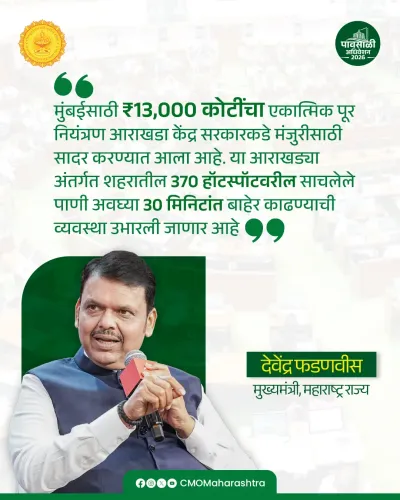
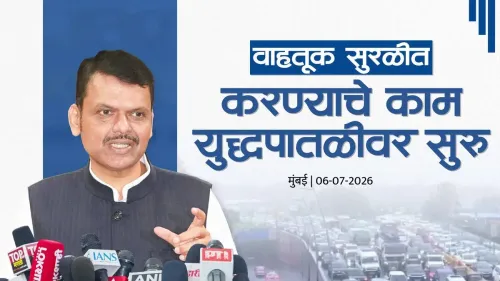
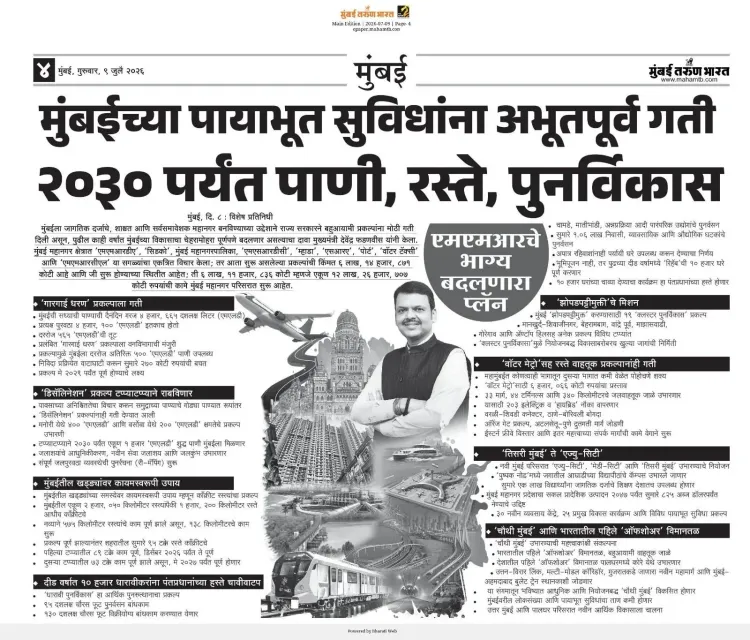
The Chief Minister's Office of Maharashtra on Thursday, 9 July 2026, signalled an ambitious push to fast-track Mumbai's infrastructure across water supply, roads, and redevelopment, with a stated deadline of 2030. The announcement, attributed to Chief Minister Devendra Fadnavis, was made public during the ongoing Monsoon Session 2026 of the Maharashtra legislature.
The post, shared in Marathi, declares 'मुंबईच्या पायाभूत सुविधांना अभूतपूर्व गती' — 'unprecedented momentum for Mumbai's infrastructure' — covering three pillars: water, roads, and redevelopment, all to be delivered by 2030.
Context
Mumbai, Maharashtra's capital and India's financial hub, has long battled chronic deficits in water supply, road connectivity, and housing. The city's infrastructure has struggled to keep pace with its population, with waterlogging, congestion, and sprawling informal settlements remaining persistent concerns for residents and commuters alike. The Monsoon Session of the legislature provides a natural platform for the government to signal development priorities and spending continuity.Policy Backdrop
The Fadnavis administration has a documented record of anchoring urban infrastructure in long-range plans. During his earlier tenure from 2014 to 2019, Devendra Fadnavis pushed through approvals for the Mumbai Coastal Road project, aimed at easing east-west connectivity bottlenecks across the city. Water and sewerage upgrades in Mumbai have also drawn support from the national AMRUT (Atal Mission for Rejuvenation and Urban Transformation) scheme, launched in 2015, which channelled central funds into urban utilities. The Mumbai Metropolitan Region Development Authority (MMRDA) has remained the key institutional vehicle for planning and executing large-scale regional projects. Successive Maharashtra governments have framed such multi-sector infrastructure pushes around decade-long horizons, linking road, water, and redevelopment targets to broader economic growth narratives.Stakeholders and Impact
The three-pronged focus — water, roads, and redevelopment — directly affects Mumbai's millions of daily commuters, residents of ageing housing stock, and real estate developers awaiting policy clarity on urban renewal. Improved water supply infrastructure would benefit both residential zones and industrial corridors. Road upgrades, if delivered on the stated timeline, could ease the city's notoriously high logistics costs. Slum and housing redevelopment remains one of the most politically and socially sensitive components, with large sections of the city's population living in areas earmarked for renewal.What's Next
The Monsoon Session 2026 is expected to be the venue where specific funding allocations, project timelines, and agency mandates are spelled out in greater detail. Progress reports on water supply infrastructure and coastal road components — both of which have phased completion milestones approaching 2030 — are likely to be tabled or discussed on the floor. Observers will watch for budget line items and legislative commitments that give the announcement concrete shape beyond the broad targets outlined in the post.Point of View
Tying his name to a 2030 Mumbai infrastructure deadline is a high-visibility political commitment that will be measured against delivery. The three-pillar framing of water, roads, and redevelopment mirrors the priorities of urban voters in Maharashtra's most electorally significant city. Whether this translates into new allocations or repackages existing project pipelines is the critical question the session's proceedings will need to answer.
NationPress
9 Jul 2026
Frequently Asked Questions
What is the Maharashtra government's 2030 infrastructure plan for Mumbai?
The Chief Minister's Office of Maharashtra announced on 9 July 2026 that the state is targeting 'unprecedented momentum' in Mumbai's infrastructure across water supply, roads, and urban redevelopment by 2030, with details expected during the Monsoon Session 2026.
What did Devendra Fadnavis announce about Mumbai infrastructure?
Chief Minister Devendra Fadnavis was tagged in a post by the CMO of Maharashtra declaring a major push to accelerate Mumbai's water, road, and redevelopment infrastructure with a 2030 completion target.
What is the Monsoon Session 2026 in Maharashtra?
The Monsoon Session 2026 is the ongoing session of the Maharashtra state legislature during which the government is expected to announce and debate key policy and infrastructure priorities, including the Mumbai 2030 infrastructure agenda.
What is MMRDA's role in Mumbai infrastructure?
The Mumbai Metropolitan Region Development Authority (MMRDA) is the primary agency responsible for planning and executing large-scale infrastructure projects in the Mumbai metropolitan region, including roads and urban development initiatives.
How has Maharashtra used the AMRUT scheme for Mumbai?
Maharashtra has drawn on the central government's AMRUT scheme, launched in 2015, to fund water supply and sewerage upgrades in Mumbai as part of broader urban infrastructure improvement efforts.