CM Rekha Gupta Pays Tribute to 'Bihar Kokila' Sharda Sinha
Synopsis
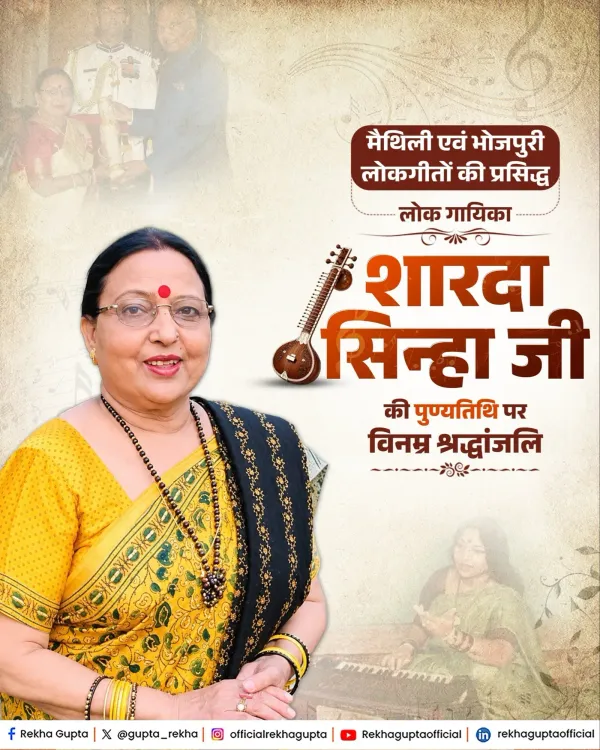
Delhi Chief Minister Rekha Gupta honoured Padma Vibhushan awardee Sharda Sinha, the 'Bihar Kokila', on her death anniversary, remembering the folk legend's unbreakable bond with Chhath Mahaparv and her role in preserving Bihar's cultural heritage across generations.
Key Takeaways
Delhi CM Rekha Gupta paid tribute to folk singer Sharda Sinha on her death anniversary on November 5, 2026 .
Sharda Sinha was a Padma Vibhushan awardee, India's second-highest civilian honour, celebrated for her Maithili and Bhojpuri folk music .
She was widely known as 'Bihar Kokila' — the Nightingale of Bihar.
Her voice had an 'unbreakable' association with Chhath Mahaparv , the major four-day festival honouring the Sun God across Bihar and eastern UP.
CM Gupta credited Sinha with carrying Bihar's cultural traditions, values, and folk customs 'from home to home' across generations.
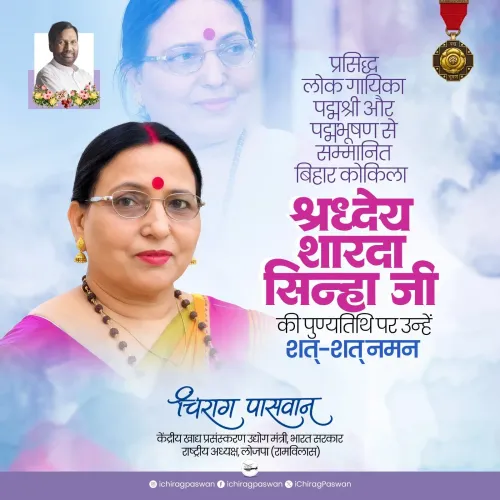
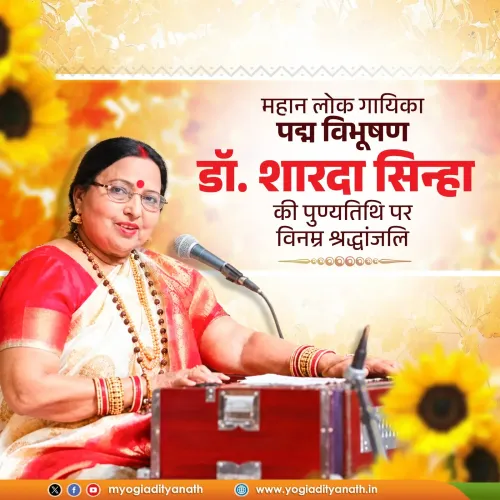
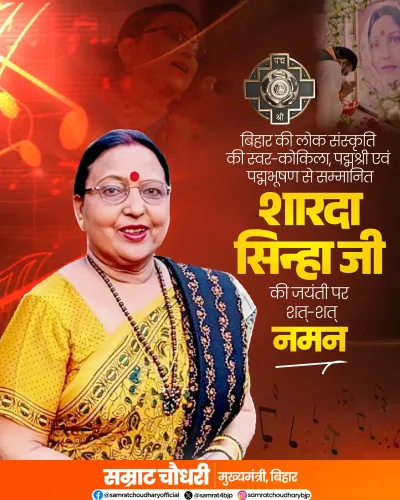
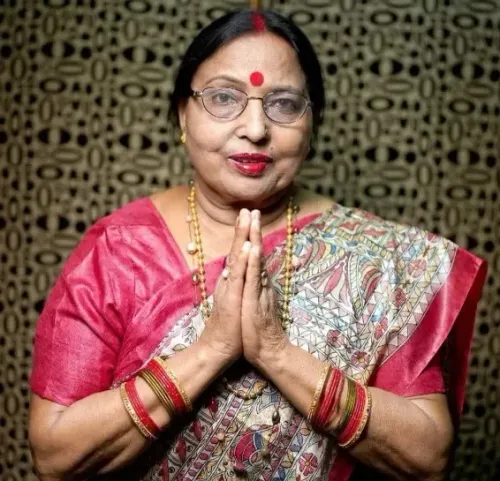
She gave Bihar's soil a voice — and that voice never faded. On the death anniversary of Padma Vibhushan awardee and legendary folk singer Sharda Sinha, Delhi Chief Minister Rekha Gupta on Thursday, November 5 offered a heartfelt tribute to the artist reverently known as 'Bihar Kokila' — the Nightingale of Bihar.
CM Gupta wrote in Hindi: 'Sharda ji ki awaaz mein Bihar ki mitti ki sugandh, Mithila ki mithas aur hamari lokparamparaon ki pavitrta rachi-basi thi' — 'In Sharda ji's voice lived the fragrance of Bihar's soil, the sweetness of Mithila, and the sanctity of our folk traditions.' The tribute underscored the singer's rare ability to carry an entire region's cultural memory within a single song.
The Voice That Made Chhath Come Alive
Sharda Sinha was perhaps India's most celebrated voice in Maithili and Bhojpuri folk music, a singer who turned regional oral traditions into a shared cultural inheritance felt across generations and geographies. Her connection with Chhath Mahaparv — the four-day riverbank festival honouring the Sun God, observed with deep reverence across Bihar and eastern Uttar Pradesh — was, as CM Gupta noted, 'atuut': unbreakable. Her compositions became inseparable from the festival's rituals, sung at river ghats at dawn and dusk by millions.
CM Gupta's tribute stressed that Sinha did not merely lend her voice to folk songs — she 'immortalised our cultural heritage in the hearts of generations,' carrying customs, values, and traditions 'from home to home' through the medium of lokgeet (folk songs).
A Padma Vibhushan and a Living Legacy
The Padma Vibhushan — India's second-highest civilian honour — recognised Sharda Sinha's lifetime of work preserving folk forms that might otherwise have receded from public life. Her repertoire spanned wedding songs, harvest songs, and festival hymns rooted in the Mithila tradition, a region straddling northern Bihar and parts of Nepal.
BJP leaders have periodically marked the death anniversaries of regional cultural icons with public tributes, a pattern that reinforces the party's messaging around India's plural, living heritage. For Delhi's large Bihari diaspora — which celebrates Chhath Puja at the Yamuna ghats and in parks across the capital every year — Sharda Sinha's songs are not archival material. They are still the soundtrack of the festival.
A voice that belonged to one state's soil somehow became the entire subcontinent's memory — and that is the measure of what Bihar lost, and what her recordings ensure it never fully will.
Point of View
Projecting the party's engagement with India's diverse folk heritage. Sharda Sinha's association with Chhath Puja makes this tribute particularly resonant in Delhi, where the Bihari diaspora is a politically significant constituency and Chhath celebrations on the Yamuna ghats are a major civic event. The homage signals cultural continuity as a political value — positioning folk traditions not as relics but as living, vote-relevant identity markers. It also reflects the broader BJP effort to frame custodianship of regional heritage as a national mission.
NationPress
5 Nov 2026
Frequently Asked Questions
Who was Sharda Sinha?
Sharda Sinha was a celebrated Indian folk singer known as 'Bihar Kokila' — the Nightingale of Bihar. She was a Padma Vibhushan awardee renowned for her Maithili and Bhojpuri folk songs, particularly those associated with the Chhath Mahaparv festival.
Why is Sharda Sinha associated with Chhath Puja?
Sharda Sinha recorded and popularised many of the most widely sung devotional folk songs of Chhath Mahaparv , the four-day Hindu festival honouring the Sun God. Her compositions became an inseparable part of the festival's rituals across Bihar, eastern UP, and among the Bihari diaspora.
What award did Sharda Sinha receive?
Sharda Sinha was honoured with the Padma Vibhushan , India's second-highest civilian award, in recognition of her lifetime contribution to preserving and popularising Bihar's folk music traditions.
Why did Delhi CM Rekha Gupta pay tribute to Sharda Sinha?
Delhi CM Rekha Gupta paid tribute on Sharda Sinha's death anniversary, honouring the singer's legacy in keeping Bihar's folk traditions, Mithila's cultural sweetness, and Chhath Puja's heritage alive across generations.
What is Mithila and why is it significant to Sharda Sinha's music?
Mithila is a cultural and historical region spanning northern Bihar and parts of Nepal, known for its distinct folk traditions, art, and language. Sharda Sinha's music was deeply rooted in Maithili folk forms from this region, giving her work a unique cultural texture that resonated across the Bihari diaspora.