CM Himanta: Assam's encroached land now home to new industries
Synopsis
Assam CM Himanta Biswa Sarma declared on October 8, 2026, that new industries are being established on land recovered from encroachments, positioning the state's controversial anti-encroachment campaign as a driver of economic growth and investment.
Key Takeaways
Assam CM Himanta Biswa Sarma announced on October 8, 2026 , that new industries are coming up on previously encroached land in the state.
The Sarma government has run one of Assam's most aggressive anti-encroachment drives since 2021 , clearing government and forest land across multiple districts.
Freed land is being positioned as a fresh industrial supply pipeline to attract domestic and international investment.
Assam contributes roughly 65 per cent of the Northeast's economic output, giving its land-use decisions outsized regional significance.
The move attempts to reframe a politically divisive eviction campaign as a concrete developmental dividend.
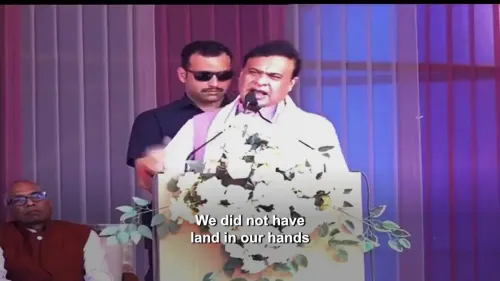
Where encroachments once stood, factory floors are rising — and Assam Chief Minister Himanta Biswa Sarma wants the world to notice. On Thursday, October 8, 2026, the Chief Minister posted on X, framing the state's anti-encroachment drive not merely as a law-and-order exercise but as an economic pivot — one that is actively converting freed land into industrial opportunity.
From eviction drives to industrial zones
The Sarma government has, since 2021, pursued one of the most aggressive anti-encroachment campaigns in Assam's post-Independence history, clearing forest reserves, riverbed land, and government plots of illegal settlers across districts including Darrang, Hojai, and Lumding. The Chief Minister's framing — 'turning adversaries into advantages' — signals that the administration now sees those recovered tracts as the state's next investment frontier rather than contested political terrain.
New industrial units, logistics corridors, and warehousing hubs have been positioned by the government as the natural next chapter for land that has been cleared and legally demarcated. The logic is straightforward: land with clear title attracts investors; ambiguous tenure keeps them away.
Why this narrative matters for Assam's investment pitch
Assam has been actively courting domestic and international capital, anchored by successive 'Advantage Assam' investor summits. A credible pipeline of clean, documented land parcels is among the most persistent asks from industrialists evaluating the Northeast. By publicly linking the anti-encroachment outcome to an industrial supply story, CM Sarma is doing two things simultaneously: defending the political cost of the eviction drives to his base, and signalling to investors that the state has done the hard work of land preparation.
The Northeast, historically underserved by manufacturing investment, stands to gain disproportionately if even a fraction of the freed land is converted into operational industrial estates. Assam accounts for roughly 65 per cent of the region's economic output, making its land-use decisions outsized in regional significance.
The political tightrope Sarma is walking
The eviction drives have not been without controversy — opposition parties and rights groups have raised questions about displacement and rehabilitation of affected communities. By pivoting the conversation toward jobs and industries, the Chief Minister is attempting to recast a divisive policy as a developmental one. Whether the industrial activity materialises at the scale and speed the government implies will be the real test of that argument.
For now, the message from Dispur is unambiguous: Assam is not just clearing its land — it is putting it to work.
Point of View
He converts a socially contested action into an economic-development narrative. This is consistent with the BJP's broader Northeast strategy of pairing identity-and-order politics with investor-friendly optics. The durability of the narrative, however, hinges entirely on how quickly and credibly industrial activity materialises on the recovered parcels — empty cleared land would hand the opposition its counter-argument on a plate.
NationPress
8 Oct 2026
Frequently Asked Questions
What did Assam CM Himanta Biswa Sarma say about encroached land and industries?
CM Sarma said new industries are being established in areas that were earlier encroached upon, describing it as Assam 'turning adversaries into advantages.'
Which areas in Assam were cleared of encroachments?
The Sarma government's anti-encroachment drives since 2021 have covered districts including Darrang, Hojai, and Lumding, among others, targeting forest reserves, riverbed land, and government plots.
How does the anti-encroachment drive connect to Assam's industrial growth?
The state government is positioning land cleared of encroachments as ready-to-use, legally clean parcels for new industrial units, logistics corridors, and warehousing hubs to attract investors.
What is the Advantage Assam investor summit?
Advantage Assam is an investor summit organised by the Assam government to attract domestic and international capital to the state, with clear land tenure being a key ask from potential investors.
Why is Assam's land policy significant for the Northeast?
Assam accounts for roughly 65 per cent of the Northeast's economic output, so its land-use and industrial-investment decisions have an outsized impact on the broader region's development.