CM Himanta Puts Assam Farmers at Centre of Credit Push

Synopsis
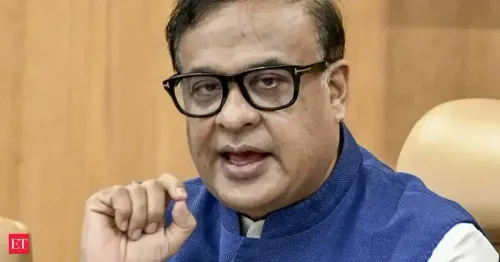
Assam Chief Minister Himanta Biswa Sarma on October 23, 2026 pledged to strengthen agricultural credit and expand formal finance access for farmers, framing Assam's Annadatas as drivers of the state's prosperity and self-reliance.
Key Takeaways
Assam CM Himanta Biswa Sarma posted on October 23, 2026 reaffirming the state's commitment to agricultural credit and farmer finance.
The Chief Minister used the term 'Annadata' (food-giver) to frame farmers as leaders of Assam's economic progress, not passive beneficiaries.
The messaging aligns with national schemes including the Kisan Credit Card (1998) and PM-KISAN (2019, Rs 6,000/year) that form India's formal farm-credit architecture.
Agriculture employs a majority of Assam's workforce, making formal credit access a structural economic priority for the state.
The Northeast has historically lagged in formal agricultural credit penetration — a gap the BJP-led Assam government has targeted since 2016 .
Specific new schemes or disbursement targets behind the announcement remain to be confirmed through state budget and economic survey documents.
Assam's fields feed millions — and Chief Minister Himanta Biswa Sarma wants the state's Annadatas (food-givers) to be the engine of its next growth chapter. On Friday, October 23, 2026, the Chief Minister posted a message underlining his government's commitment to strengthening agricultural credit and expanding formal finance access for farmers across the state.
The 'Annadata' Vision: What Sarma's Message Actually Signals
Sarma's post frames agricultural credit not as welfare, but as an economic lever — a deliberate choice of language. 'By strengthening agricultural credit and expanding access to finance, we are working towards a future where our Annadatas have greater opportunities to grow and lead Assam's progress,' he wrote. The framing positions farmers as protagonists of prosperity, not passive beneficiaries of subsidy.
This matters in Assam, where agriculture employs a majority of the workforce and informal borrowing has historically trapped rural households in cycles of debt. Formal credit channels — both state-backed and national — are widely seen as the structural break that small and marginal farmers need.
National Credit Architecture Assam Plugs Into
The messaging dovetails with two landmark national schemes. The Kisan Credit Card (KCC), launched in 1998, was designed precisely to solve the problem Sarma is invoking — delivering timely, affordable crop loans through banking channels and cutting out moneylenders. Decades later, the scheme remains the backbone of formal farm credit across India's states, including the Northeast.
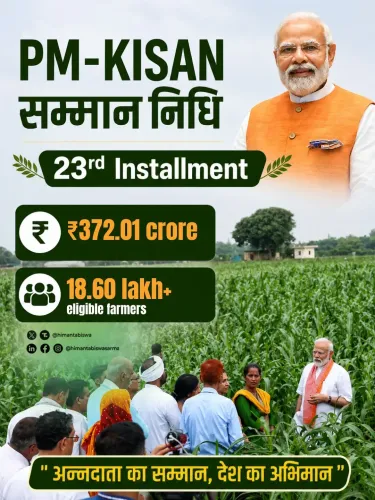
Alongside it, the PM-KISAN scheme, introduced in 2019, provides direct income support of Rs 6,000 per year to eligible farmer families — a cash floor that reduces distress borrowing and gives households a baseline to plan ahead. Assam's push to strengthen credit access builds on top of this national architecture.
Northeast Agriculture and the Formal Finance Gap
The Northeast has historically lagged behind peninsular India in formal agricultural credit penetration — a gap that successive state governments have tried to close. Under the BJP-led administration in Assam since 2016, agriculture-led growth and rural finance have been consistent policy themes. Sarma's current emphasis continues that thread, with the political economy logic being clear: a self-reliant farming community is both an economic asset and a stable electoral constituency.
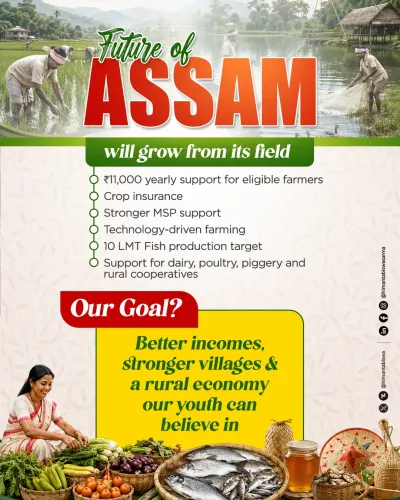
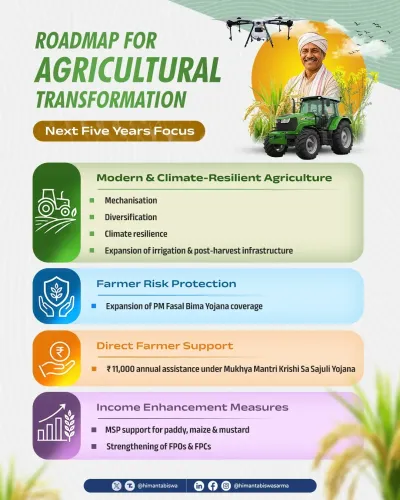
What the Chief Minister's post does not specify — and what observers will watch for — is whether a new state-level credit scheme, disbursement target, or institutional partnership sits behind the messaging. Assam's state budget presentations and annual economic surveys will be the telling documents.
If agricultural credit in Assam actually scales the way Sarma envisions, the Northeast could quietly become a model for how a lagging region closes its formal-finance gap — one Annadata at a time.
Point of View
Reflecting the BJP's national grammar of 'empowerment over entitlement' in agrarian messaging. It also maps onto a longer Assam-specific project: pulling the Northeast's agricultural economy into the formal credit mainstream, where loan costs are lower and farmer leverage is higher. The timing, ahead of potential budget cycles, suggests the messaging may be laying the rhetorical groundwork for a concrete credit-expansion announcement. Whether delivery matches declaration will be the real test of this administration's agricultural ambition.
NationPress
23 Oct 2026
Frequently Asked Questions
What did Assam CM Himanta Biswa Sarma say about farmers on October 23 2026?
Sarma posted that Assam's farmers are at the heart of the state's vision for prosperity and self-reliance, pledging to strengthen agricultural credit and expand access to formal finance so that Annadatas can lead the state's progress.
What is the Kisan Credit Card scheme and how does it help Assam farmers?
The Kisan Credit Card (KCC) is a national scheme launched in 1998 that provides farmers with timely, affordable crop loans through formal banking channels, reducing dependence on informal moneylenders — a key tool in states like Assam where informal borrowing has historically been prevalent.
What is PM-KISAN and does it apply to Assam farmers?
PM-KISAN is a central government scheme introduced in 2019 that provides eligible farmer families with direct income support of Rs 6,000 per year. It applies across India, including Assam, and provides a financial floor that helps farmers reduce distress borrowing.
Why is agricultural credit important for Assam?
Agriculture employs a majority of Assam's workforce, and the Northeast has historically lagged in formal agricultural credit penetration. Expanding access to formal credit lowers borrowing costs, reduces informal debt traps, and is seen as essential to the state's economic self-reliance.
Is there a new farm scheme announced by the Assam government in 2026?
As of the Chief Minister's October 23, 2026 post, no specific new state-level credit scheme or disbursement target has been officially detailed. Observers are watching Assam's upcoming budget presentations and economic surveys for concrete announcements.