CM Himanta Frames Atmanirbhar Assam on Farm Strength
Synopsis
Assam Chief Minister Himanta Biswa Sarma has reaffirmed that the Atmanirbhar Assam vision is rooted in agricultural strength, citing farmer empowerment, allied sector growth, and technology adoption as the pillars driving higher rural incomes and stronger village economies across the state.
Key Takeaways
Himanta Biswa Sarma declared on 30 May 2026 that the future of Atmanirbhar Assam rests on the state's farming sector.
The Chief Minister identified four pillars: farmer empowerment, allied sector strengthening, technology-driven farming, and new rural opportunities.
Atmanirbhar Assam is the state-level adaptation of the Centre's Atmanirbhar Bharat Abhiyan launched in May 2020 .
The Assam Agribusiness and Rural Transformation Project (APART) , backed by the World Bank since 2018 , underpins the state's agricultural modernisation drive.
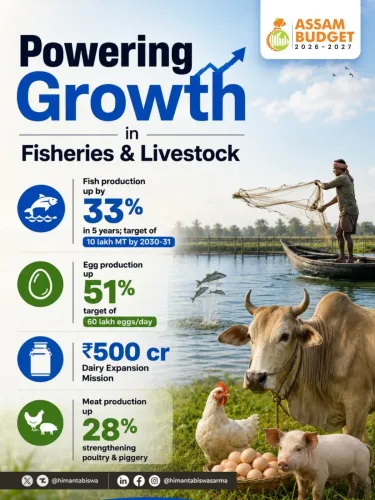
Allied sectors including dairy, fisheries, and horticulture are being developed alongside crop farming to diversify and raise rural incomes.
State agriculture budget allocations for 2026-27 and district-level tech farming pilots are the next milestones to watch.
Assam Chief Minister Himanta Biswa Sarma on Saturday, 30 May 2026 outlined his government's rural economic vision, asserting that the future of Atmanirbhar Assam rests on empowering farmers, modernising agriculture through technology, and building allied rural sectors to generate higher incomes across the state's villages.
Context
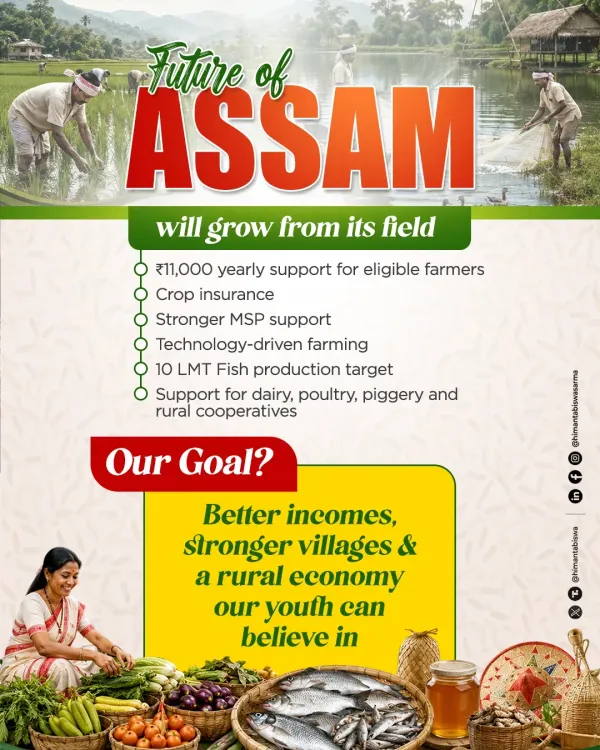
Sarma posted on X that 'the future of Atmanirbhar Assam is based in our fields,' framing farmers — referred to as annadatas (food providers) — as the foundation of the state's self-reliance agenda. The statement ties rural prosperity directly to the broader Atmanirbhar Assam campaign, the state-level adaptation of the Centre's Atmanirbhar Bharat Abhiyan launched in May 2020.
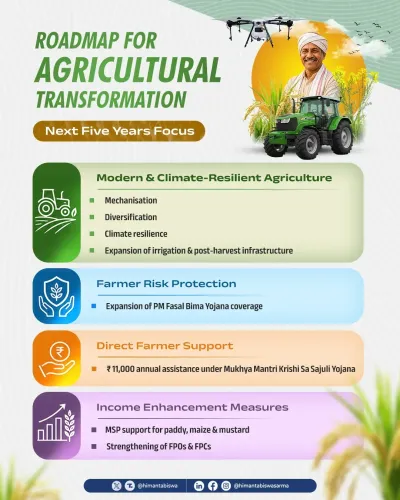
The post identifies four pillars of the approach: empowering farmers, strengthening allied sectors, adopting technology-driven farming, and creating new rural opportunities. Together, the Chief Minister said, these are 'building stronger villages, higher incomes and a thriving rural economy.'
Policy Backdrop
Assam is a predominantly agrarian state where farming employs a majority of the workforce and rural income levels have historically lagged behind national averages. Since Sarma took office in May 2021, successive state budgets have raised outlays for irrigation, organic farming, precision agriculture, and rural infrastructure.
The Assam Agribusiness and Rural Transformation Project (APART), initiated in 2018 with World Bank support, laid the groundwork for modernising agricultural value chains and raising farmer incomes. Allied sectors including dairy, fisheries, and horticulture have been identified as growth levers alongside crop farming under these frameworks.
The state's alignment with the national self-reliance framework reflects a broader pattern across Northeast India, where states have sought to leverage central schemes to address persistent challenges of low farm productivity and rural out-migration.
Stakeholders and Impact
The primary beneficiaries of the policies referenced are Assam's farming households and rural communities, who depend on agricultural income as their main livelihood. Technology-driven farming initiatives — covering precision inputs, digital market access, and climate-adaptive practices — are intended to reduce input costs and improve yields for smallholder farmers.
Allied-sector development in dairy, fisheries, and horticulture creates supplementary income streams, reducing dependence on single-crop revenues. Rural infrastructure investment supports these shifts by improving connectivity, cold-chain logistics, and access to credit in village economies.
What's Next
Attention will turn to Assam's agriculture budget allocations for 2026-27 and the rollout of district-level technology farming pilots under existing rural transformation projects. The degree to which stated policy priorities translate into measurable income gains for Assam's annadatas will be the benchmark against which the Atmanirbhar Assam vision is ultimately judged.
Point of View
Anchoring the BJP government's rural credentials in a state where the farming vote remains decisive. By invoking the Sanskrit term 'annadata,' he connects a technocratic policy agenda to a culturally resonant identity for farmers, a rhetorical move consistent with the national BJP playbook. The four-pillar structure — empowerment, allied sectors, technology, new opportunities — mirrors the language of central rural schemes, reinforcing the state government's positioning as an effective delivery arm of New Delhi's self-reliance framework. Whether the vision translates into verifiable income gains will determine its political durability as the 2026-27 budget cycle unfolds.
NationPress
20 Sept 2026
Frequently Asked Questions
What is Atmanirbhar Assam?
Atmanirbhar Assam is a state-level self-reliance campaign promoted by the Assam government, focusing on agriculture, rural development and economic autonomy. It is modelled on the Centre's Atmanirbhar Bharat Abhiyan launched in May 2020.
What did Himanta Biswa Sarma say about farmers on 30 May 2026?
Sarma stated that the future of Atmanirbhar Assam is based in its fields, pledging to empower farmers, strengthen allied sectors, adopt technology-driven farming, and create new rural opportunities to build higher incomes and stronger village economies.
What is the Assam Agribusiness and Rural Transformation Project (APART)?
APART is a rural development initiative launched in 2018 with World Bank support, designed to modernise agricultural value chains and raise farmer incomes across Assam.
How is Assam promoting technology in farming?
The Assam government has been increasing budget outlays for precision agriculture, organic farming, and digital rural infrastructure, with district-level technology farming pilots planned under existing rural transformation projects.
Which allied sectors is Assam focusing on alongside crop farming?
Dairy, fisheries, and horticulture are the key allied sectors being developed alongside crop farming to diversify income sources and reduce dependence on single-crop revenues for rural households in Assam.