CM Himanta Reaffirms Assam's Farmer-First Growth Vision
Synopsis
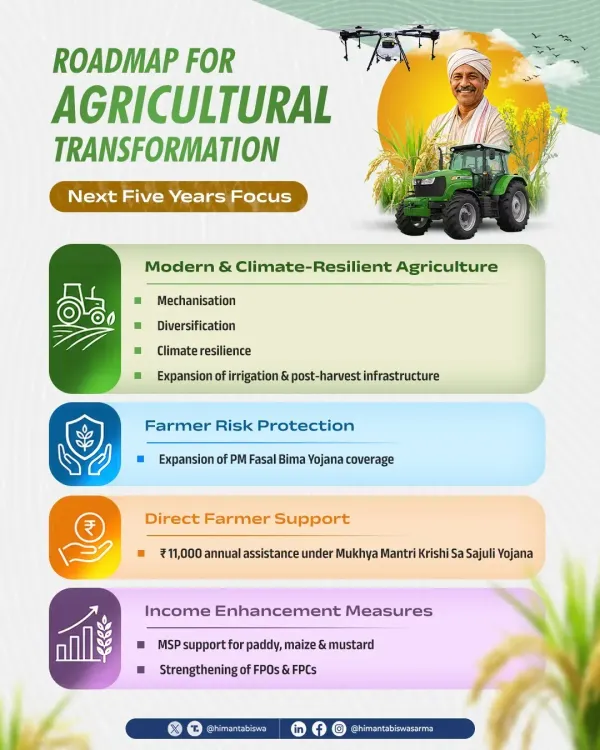
Assam Chief Minister Himanta Biswa Sarma on 24 May 2026 reaffirmed his government's commitment to farmers, pledging a roadmap for modern, resilient agriculture and stronger income support to ensure stability and prosperity for every farmer in the state.
Key Takeaways
CM Himanta Biswa Sarma described Assam's farmers as central to the state's growth journey on 24 May 2026 .
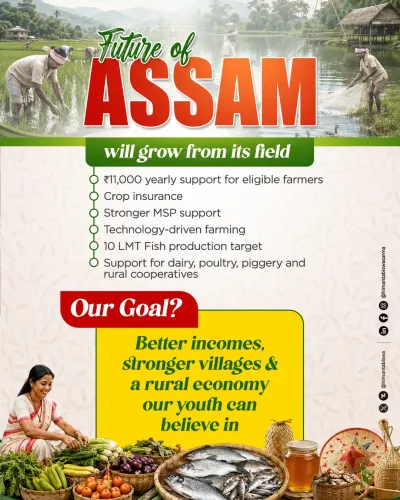
The statement pledges a 'clear roadmap for modern, resilient agriculture' and stronger income support for Assam 's farming community.
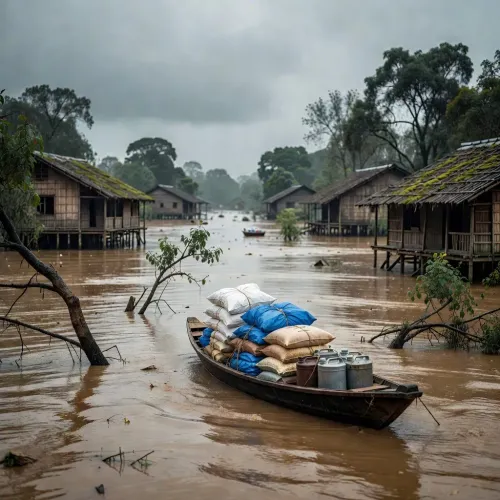
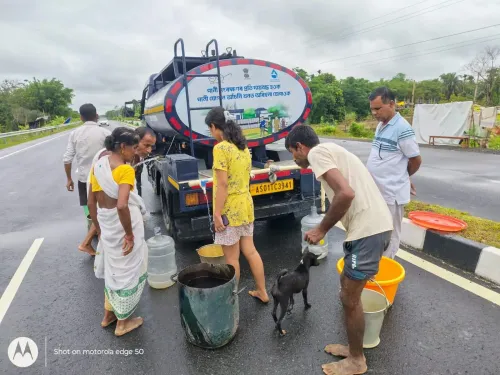
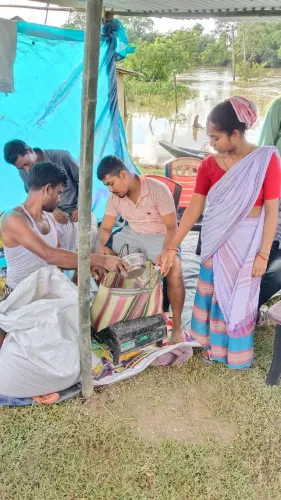
Assam 's agriculture sector faces recurrent flood and climate challenges that affect rice, tea, and horticulture farmers.
The state's agricultural policy aligns with the national Doubling Farmers' Income initiative launched in 2016 and the PM-KISAN direct-benefit scheme active since 2019 .
As NEDA convenor, CM Sarma 's farm-sector focus carries broader significance for agricultural policy across the Northeast.
Specifics of the roadmap are expected to emerge through Assam Assembly budget sessions and policy announcements.
Assam Chief Minister Himanta Biswa Sarma on Sunday, 24 May 2026, reaffirmed his government's commitment to the state's farming community, describing Assam's farmers — referred to as Annadatas (providers of food) — as central to the state's development trajectory. The statement, shared on his official social media handle, pledged a 'clear roadmap for modern, resilient agriculture and stronger income support' aimed at delivering stability, security, and prosperity to every farmer in Assam.
Context
Agriculture remains a foundational pillar of Assam's economy, with the state's farming households engaged primarily in the cultivation of rice, tea, and horticulture. The sector, however, faces persistent structural challenges — including recurrent flooding, climate variability, and fragmented landholdings — that constrain income stability for small and marginal farmers. CM Sarma's statement signals a continued policy focus on addressing these vulnerabilities through modernisation and direct income support.
The term Annadata, meaning 'one who provides food,' is widely used in Indian political discourse to acknowledge the dignity and centrality of farmers. Its use by CM Sarma underscores the political and moral framing his administration has adopted for agricultural welfare in the state.
Policy Backdrop
Assam's agricultural policy sits within a broader national framework. The Government of India's Doubling Farmers' Income initiative, launched in 2016, prompted state governments across the country to develop their own roadmaps for agriculture modernisation and income enhancement. Assam has aligned its efforts with this framework, participating in the National Mission for Sustainable Agriculture since the early 2010s to promote climate-resilient farming practices suited to the Northeast's ecological conditions.
The centrally sponsored PM-KISAN scheme, operational since 2019, provides direct income support to landholding farmers and has been implemented across Assam. State-level initiatives have complemented this central transfer, with the Assam government working on value-chain development and flood-adaptive agriculture to reduce year-on-year crop losses.
Stakeholders and Impact
The primary beneficiaries of the policies referenced by CM Sarma are Assam's small and marginal farmers, who constitute the majority of the agricultural workforce in the state. For these households, income volatility linked to floods and market fluctuations remains a persistent concern, making direct support mechanisms and crop resilience programmes critically important.
As convenor of the North-East Democratic Alliance (NEDA), CM Sarma's articulation of an agricultural roadmap also carries regional significance. Northeastern states under NEDA have increasingly emphasised climate adaptation and agricultural value-chain development as shared priorities, reflecting the region's common ecological vulnerabilities.
What's Next
Observers will look to the Assam Legislative Assembly's budget sessions and agricultural policy documents for specifics on the 'clear roadmap' referenced by the Chief Minister. Any concrete scheme announcements or budget allocations toward farmer income support will be the next measure of the government's stated intent. NEDA coordination meetings may also provide a platform to extend similar agricultural frameworks across the Northeast, amplifying the regional impact of Assam's farm-sector priorities.
With climate pressures on agriculture intensifying across the Northeast, the direction of Assam's farm policy will be closely watched as a template for how BJP-governed states in the region balance welfare delivery with long-term agricultural resilience.
Point of View
Resilient' agricultural roadmap reflects the Northeast's acute exposure to climate risk, where flood-linked crop losses make income stability a politically salient issue. As NEDA convenor, Sarma is also positioning Assam as a model for agricultural modernisation across the region, reinforcing his role as a regional policy anchor. The statement's vagueness on specifics, however, means its credibility will ultimately rest on measurable budget commitments and scheme outcomes in the coming legislative cycle.
NationPress
8 Oct 2026
Frequently Asked Questions
What did Assam CM Himanta Biswa Sarma say about farmers in May 2026?
On 24 May 2026, CM Himanta Biswa Sarma stated that Assam's farmers are at the heart of the state's growth journey and pledged a clear roadmap for modern, resilient agriculture along with stronger income support for every farmer in Assam.
What is PM-KISAN and does it cover Assam farmers?
PM-KISAN is a central government scheme launched in 2019 that provides direct income support to landholding farmers across India, including those in Assam.
What are the main challenges facing Assam's farmers?
Assam's farmers face recurrent flooding, climate variability, and fragmented landholdings that create income instability, particularly for small and marginal farmers engaged in rice, tea, and horticulture cultivation.
What is the Doubling Farmers' Income initiative?
The Doubling Farmers' Income initiative was launched by the Government of India in 2016 to prompt state-level roadmaps for agriculture modernisation and income enhancement, which Assam has aligned its policies with.
What is NEDA and what is Himanta Biswa Sarma's role in it?
NEDA, the North-East Democratic Alliance, is a political coalition of BJP and allied parties in the Northeast. CM Himanta Biswa Sarma serves as its convenor and uses the platform to coordinate regional governance priorities, including agriculture.