CM Himanta Biswa Sarma Mobilises Cabinet for Assam Flood Relief

Synopsis
Assam Chief Minister Himanta Biswa Sarma on 30 June 2026 announced that his Cabinet colleagues are deployed on the ground overseeing flood relief and protection measures, while he personally monitors the situation. The state faces its annual monsoon flood crisis along the Brahmaputra basin.
Key Takeaways
CM Himanta Biswa Sarma declared on 30 June 2026 that the Assam government is leaving 'no stone unturned' in its flood response.
Multiple Cabinet ministers have been deployed on the ground across flood-affected areas to oversee relief efforts and protection measures.
The Chief Minister is personally and closely monitoring the evolving flood situation in Assam .
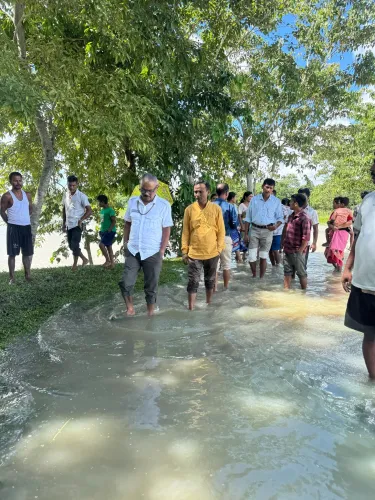
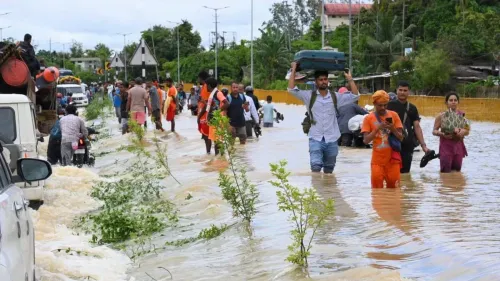
The post was accompanied by four images , indicating active documentation of the on-ground response.
Assam faces recurring annual flooding driven by the Brahmaputra river and its tributaries during the June-September monsoon season.
Timely assistance to affected residents is a stated priority, with Cabinet-level oversight aimed at reducing administrative delays.
Assam Chief Minister Himanta Biswa Sarma on Tuesday, 30 June 2026, declared that his government is leaving 'no stone unturned' in responding to ongoing flood conditions across the state, with Cabinet ministers deployed on the ground to oversee relief and protection measures.
Context
The Chief Minister posted on X that he is personally monitoring the flood situation while his Cabinet colleagues are stationed in affected areas to ensure timely assistance reaches residents. The post was accompanied by four images, indicating active, on-ground documentation of the response effort. The language of the post — direct and action-oriented — signals a government keen to project administrative responsiveness during what appears to be a significant flood event in Assam.
Assam is one of India's most flood-prone states, with the Brahmaputra river and its tributaries inundating large swathes of the state almost every monsoon season between June and September. The 2026 monsoon has once again triggered a flood emergency, prompting the state administration to activate its disaster response machinery.
Policy Backdrop
Flood management in Assam has historically been a perennial governance challenge. The state government has in recent years worked to strengthen embankment infrastructure, early warning systems, and coordination with the National Disaster Response Force (NDRF) and the State Disaster Response Force (SDRF). Cabinet-level field deployment — as described in Sarma's post — reflects a protocol increasingly used by the Assam government to ensure accountability and speed in disaster response.
Chief Minister Sarma has previously drawn attention to the structural nature of Assam's flood problem, calling for long-term solutions including river basin management and central funding support. The deployment of multiple Cabinet ministers to the ground simultaneously suggests the scale of the current flooding is significant enough to require distributed administrative oversight across districts.
Stakeholders and Impact
The primary stakeholders are the residents of flood-affected districts across Assam, many of whom face displacement, crop damage, and disruption to livelihoods every monsoon cycle. Timely relief distribution — food, shelter, and medical assistance — is critical in the days immediately following inundation. The involvement of Cabinet ministers as on-ground supervisors is intended to cut bureaucratic delays and ensure that district administrations are directly accountable to political leadership.
Farmers, particularly those in low-lying agricultural belts along the Brahmaputra valley, stand to suffer significant crop losses. Communities in areas with weakened embankments or poor drainage infrastructure are especially vulnerable. The government's stated commitment to 'protection measures' suggests active efforts to prevent further breaches or displacement beyond what has already occurred.
What's Next
The Chief Minister's statement indicates that monitoring will continue at the highest level of the state government. As floodwaters recede, the focus is expected to shift toward damage assessment, compensation disbursal, and infrastructure repair. The coming days will test whether the government's on-ground deployment translates into measurable relief outcomes for affected communities. A formal state disaster declaration or a request for enhanced central assistance could follow if the scale of damage warrants it.
Point of View
Flood response is a high-stakes test where optics and outcomes are equally consequential. The coming days will reveal whether the mobilisation translates into relief that reaches the most vulnerable before the next wave of inundation.
NationPress
29 Sept 2026
Frequently Asked Questions
What is Himanta Biswa Sarma doing about the Assam floods in 2026?
Chief Minister Himanta Biswa Sarma announced on 30 June 2026 that he is personally monitoring the flood situation while Cabinet ministers are deployed on the ground overseeing relief efforts and protection measures across affected areas of Assam.
Which areas of Assam are affected by floods in June 2026?
While CM Sarma's post does not specify individual districts, Assam's recurring flood zones typically include low-lying areas along the Brahmaputra river and its tributaries, which inundate during the June-September monsoon season every year.
What relief measures is the Assam government taking for flood victims?
According to CM Sarma, Cabinet ministers are on the ground overseeing relief efforts, protection measures, and ensuring timely assistance reaches affected residents, with the Chief Minister personally monitoring the overall situation.
Why does Assam flood every year?
Assam experiences annual flooding primarily because the Brahmaputra river and its numerous tributaries swell significantly during the June-September monsoon season, inundating low-lying plains and areas with weakened embankments.
Has the Assam government declared a flood emergency in 2026?
CM Sarma's post on 30 June 2026 signals active disaster response with Cabinet deployment, but no formal state disaster declaration or specific emergency notification was mentioned in the post.