CM Himanta Flags Broad-Based Growth Across Assam's Key Sectors

Synopsis
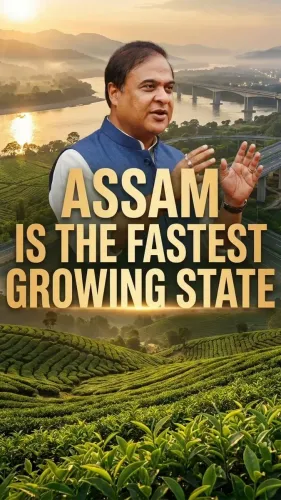
Assam Chief Minister Himanta Biswa Sarma on 8 July 2026 declared the state's growth trajectory 'broad based and balanced', citing equal policy focus on tea, technology and tourism under the #AssamRising banner as the government pursues grassroots transformation.
Key Takeaways
CM Himanta Biswa Sarma on 8 July 2026 described Assam 's economic growth as 'broad based and balanced' across multiple sectors.
The post specifically names tea , technology , and tourism as the three pillars of the state's diversification strategy.
The messaging aligns with the Union government's Act East Policy (launched 2014 ), which has directed increased investment into Northeast India's connectivity and economic infrastructure.
Sarma 's role as convenor of the North-East Democratic Alliance (NEDA) gives the statement a regional dimension beyond Assam alone.
Key stakeholders include tea growers , urban technology entrepreneurs, and tourism-dependent communities across the Brahmaputra and Barak valleys.
Upcoming state budget sessions and investor summits will be watched for concrete policy measures to back the broad-based growth claim.
Assam Chief Minister Himanta Biswa Sarma on Wednesday, 8 July 2026, highlighted the state's multi-sector economic momentum, asserting that growth is 'broad based and balanced' across industries ranging from tea and technology to tourism. The statement, shared on X under the hashtag #AssamRising, frames the government's development push as a deliberate effort to drive grassroots transformation and expand opportunities for Assam's people.
Context
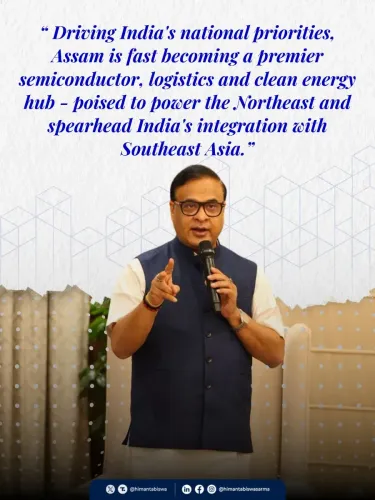
In his post, Sarma stated: 'From tea to technology to tourism, we are advancing every sector with equal focus to drive grassroots transformation and create opportunities for our people.' The framing is notable for its explicit rejection of a single-sector narrative — a departure from Assam's historical identity as an economy anchored almost entirely in tea and petroleum. The Chief Minister has consistently used social media to project a modernising image for the state since assuming office in May 2021.
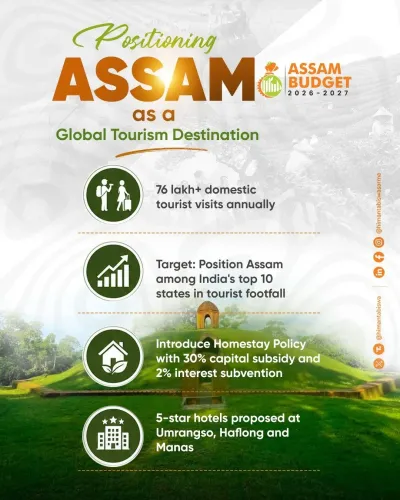
Assam remains one of India's largest tea-producing states, accounting for a significant share of national output. However, successive state budgets under Sarma's administration have sought to channel investment into information technology parks, tourism circuits in the Brahmaputra river belt and the hill districts, and agri-processing units that add value beyond the farm gate.
Policy Backdrop
The broader policy environment has been shaped by the Union government's Act East Policy, launched in 2014, which aims to improve physical and economic connectivity between Northeast Indian states — including Assam — and the ASEAN region. Increased central allocations for roads, rail, and digital infrastructure in the Northeast have provided a platform on which state-level diversification efforts are being built.
Sarma also serves as convenor of the North-East Democratic Alliance (NEDA), a political grouping of regional parties aligned with the BJP at the Union level. This dual role gives him both a state and a regional platform to advocate for coordinated development across the eight northeastern states, reinforcing the 'balanced growth' message he projected on 8 July.
Stakeholders and Impact
The sectors named in the post represent distinct but interconnected constituencies. Tea growers — including both large estate owners and the hundreds of thousands of small growers who have expanded the industry's footprint in recent decades — are a politically significant group in Assam. Any policy signal affecting their livelihoods carries electoral weight across multiple districts in the Brahmaputra Valley and the Barak Valley.
The technology and tourism segments, by contrast, primarily benefit urban entrepreneurs, educated youth seeking white-collar employment, and communities in ecologically sensitive areas where low-impact tourism can generate income without displacing agriculture. Sarma's 'equal focus' framing is an attempt to signal that the government is not trading one constituency's interests against another's.
What's Next
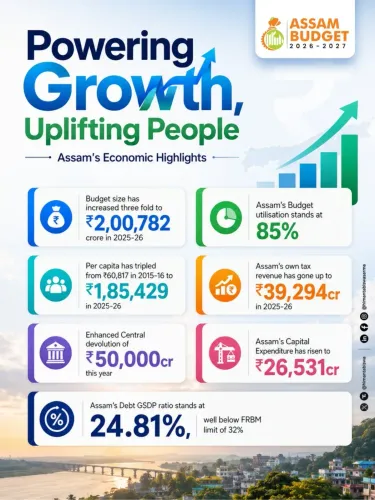
Observers will watch upcoming state budget presentations and investor summits for concrete policy announcements that operationalise the multi-sector vision Sarma has outlined. The release of Assam's annual economic survey data will be a key test of whether the broad-based growth narrative is supported by measurable indicators across tea, technology, and tourism. Regional development advocates will also track whether NEDA-aligned states mirror similar diversification strategies, potentially consolidating a Northeast-wide growth model under Sarma's coordination.
Point of View
He signals continuity with the state's traditional base while projecting ambition toward higher-value sectors. This mirrors a broader BJP governance pattern in which chief ministers use social media to set the terms of economic discourse, framing state performance as a direct output of central-state policy alignment. The real test will come when auditable data — growth rates, employment numbers, investment inflows — either validates or complicates the balanced-growth claim.
NationPress
6 Oct 2026
Frequently Asked Questions
What did Assam CM Himanta Biswa Sarma say about Assam's economy?
On 8 July 2026 , CM Himanta Biswa Sarma said Assam's growth trajectory is 'broad based and balanced', with equal policy focus on tea, technology and tourism to drive grassroots transformation.
What is the #AssamRising campaign about?
#AssamRising is a hashtag used by the Assam government and CM Sarma to highlight the state's development initiatives, economic diversification and improved governance under the current administration.
What is the Act East Policy and how does it affect Assam?
The Act East Policy , launched by the Union government in 2014 , aims to boost connectivity and trade between Northeast Indian states including Assam and the ASEAN region, providing infrastructure and investment support that underpins the state's diversification efforts.
What sectors is Assam focusing on for economic growth?
Under CM Sarma , Assam is focusing on its traditional tea industry alongside emerging sectors such as information technology and tourism , with the government pursuing investment in IT parks, tourism circuits and agri-processing.
What is NEDA and what is Himanta Biswa Sarma's role in it?
The North-East Democratic Alliance (NEDA) is a political grouping of regional parties aligned with the BJP ; CM Himanta Biswa Sarma serves as its convenor, giving him influence over development and political coordination across all eight northeastern states.