CM Himanta Charts Assam's Shift From Bandhs to Industry
Synopsis
Assam Chief Minister Himanta Biswa Sarma used a Substack essay on October 12, 2026, to frame the state's economic pivot away from its bandh-era past toward industry and investment, with youth retention at home as his headline measure of success.
Key Takeaways
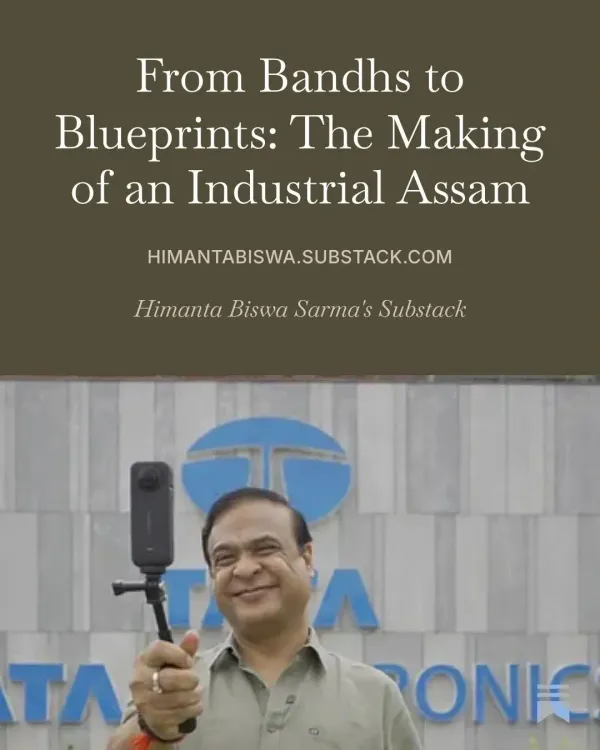
Assam CM Himanta Biswa Sarma published a Substack essay titled 'From Bandhs to Blueprints: The Making of a New Assam' on October 12, 2026 .
Sarma explicitly contrasts the state's historical culture of political bandhs with a present focused on industry and investment.
The Chief Minister frames youth retention — young people building their lives in Assam rather than migrating — as the defining measure of the state's progress.
The essay was shared via his personal X account and Substack newsletter, bypassing traditional press-release channels for direct long-form communication.
The post signals a continuing effort to reposition Assam's national and investor perception from instability to economic opportunity.
Assam was once synonymous with shutdowns — political bandhs that paralysed markets, grounded transport, and kept an entire generation economically marooned. Assam Chief Minister Himanta Biswa Sarma says that era is definitively over, and on Monday, October 12, 2026, he laid out the argument in a Substack essay that frames the state's transformation not merely as an industrial story, but as a generational one.
Writing under the headline 'From Bandhs to Blueprints: The Making of a New Assam,' Sarma argued that the state is 'moving from a history of bandhs to a future built on industry, investment and opportunity.' The shift, he insisted, is 'bigger than factories — it is about creating a future where our young people can build their lives at home.'
The Bandh Legacy Assam Is Leaving Behind
For decades, Assam's political culture made the bandh — the forced shutdown of public life called by political or insurgent groups — a near-routine disruption. Businesses lost revenue, students missed school, and the broader investor perception of the state was coloured by instability. That association with shutdowns carried a real economic cost, deterring the kind of long-horizon capital that builds factories and creates stable employment.
Sarma's framing deliberately inverts that image. By naming the bandh explicitly as the baseline he is moving away from, the Chief Minister is signalling that the old political economy — where leverage was extracted through disruption — has been replaced by one where leverage comes from opportunity.
Youth Retention as the True Measure of Progress
The most telling line in the post is not about investment figures or industrial corridors — it is about young people building their lives 'at home.' Brain drain and labour migration out of the Northeast have long undercut any headline growth numbers the region posts. Young Assamese have historically moved to metro cities for jobs that their home state could not generate.
By making youth retention the explicit yardstick, Sarma is setting a benchmark that goes beyond ribbon-cutting at new plants. It positions Assam's economic transformation as a social compact: the state will generate enough local opportunity that leaving becomes a choice, not a necessity.
A Substack as Policy Platform
The medium itself is worth noting. Publishing the argument on Substack — a long-form newsletter platform — rather than issuing a government press release signals an intent to speak directly to an educated, engaged audience beyond traditional media cycles. It allows the Chief Minister to control both the length and the framing of his narrative, and to build a recurring intellectual case for Assam's development trajectory.
Whether the blueprints match the ambition on the ground will ultimately be judged by employment numbers and investor follow-through — not by the eloquence of the essay. But the direction Sarma is staking out is clear: Assam is no longer asking to be seen as a conflict-prone periphery. It is demanding to be read as a destination.
Point of View
He is adopting a metric that is politically resonant but also harder to fake — if young people keep leaving, the argument collapses regardless of industrial announcements. The Substack format reflects a broader trend among BJP chief ministers who have used direct digital communication to shape policy narratives outside the traditional news cycle. The real test will be whether investor commitments announced at summits translate into operational factories and measurable local employment over the next few years.
NationPress
12 Oct 2026
Frequently Asked Questions
What did Assam CM Himanta Biswa Sarma write on Substack?
Sarma published an essay titled 'From Bandhs to Blueprints: The Making of a New Assam,' arguing that Assam has shifted from a history of political shutdowns to a focus on industry, investment, and creating local opportunities for its youth.
What is a bandh and why is it significant in Assam's history?
A bandh is a forced shutdown of public life — shops, transport, and schools — called by political or insurgent groups as a form of protest. Assam experienced frequent bandhs for decades, which damaged its economy and deterred investment.
Why is youth retention important to Assam's development?
Young Assamese have historically migrated to larger cities for employment opportunities unavailable at home. Sarma has made keeping young people in Assam — by generating local jobs — a central benchmark of the state's economic transformation.
Why did Himanta Biswa Sarma use Substack instead of a press release?
Substack allows the Chief Minister to publish long-form arguments directly to a subscribed audience, controlling the framing and depth of his narrative without mediation, which is increasingly common among senior politicians building direct communication channels.
What is Himanta Biswa Sarma's role beyond being Assam CM?
Sarma is a senior BJP leader and also serves as the convenor of the North-East Democratic Alliance (NEDA), a coalition that coordinates BJP-aligned governance across multiple northeastern states.