CM Himanta marks Assam's shift from insurgency to industry

Synopsis
Assam Chief Minister Himanta Biswa Sarma on 26 May 2026 contrasted the state's violent past with its present trajectory of growth, infrastructure and semiconductor investment, crediting peace efforts that began after the BJP came to power in 2016.
Key Takeaways
Himanta Biswa Sarma posted on 26 May 2026 framing Assam's decade-long shift from insurgency and bandhs to economic growth.
The BJP -led alliance first came to power in Assam in 2016 , ending 15 years of Congress rule.
The Bodo Peace Accord of 2020 was a key milestone, ending decades of armed conflict in the Bodoland Territorial Region .
The India Semiconductor Mission , launched in 2021 , underpins Sarma's references to chips and high-tech industry for Assam .
Sarma convenes the North-East Democratic Alliance (NEDA) , giving the 'New Assam' narrative a regional political dimension beyond the state.
Progress on semiconductor project ground-breakings and job creation will serve as the practical test of the government's claims.
Assam Chief Minister Himanta Biswa Sarma on Tuesday, 26 May 2026, invoked the state's turbulent past to underscore what he described as a transformation driven by peace initiatives begun in 2016, arguing that Assam has moved from an era of violence and bandhs to one defined by growth, infrastructure, jobs and semiconductors.
Context
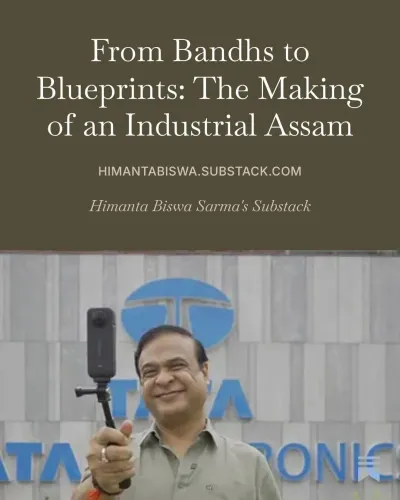
In his post, Sarma drew a sharp before-and-after contrast: 'Earlier Assam was defined by violence, bandhs, strikes and bomb blasts — all that changed post 2016 when efforts started to bring back lasting peace to Assam.' He then declared: 'Today, a New Assam is defined by fast growth, infrastructure, jobs and semiconductors.' The statement is accompanied by a video and appears designed to frame the BJP-led government's decade-long record ahead of what analysts expect will be an intensifying political cycle in the Northeast.
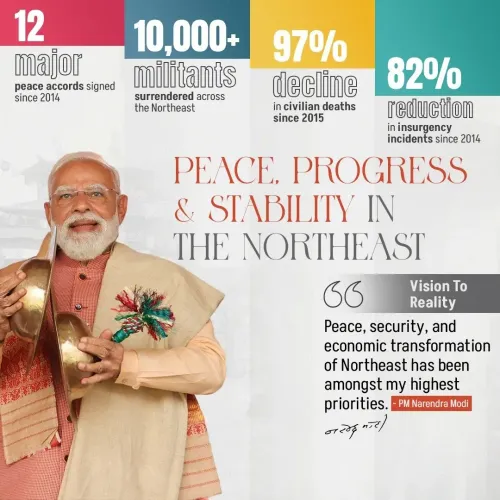
For much of the late twentieth and early twenty-first century, Assam was among India's most conflict-affected states. Insurgent groups, ethnic clashes and near-daily economic blockades kept investment away and displaced communities across the Brahmaputra valley and the hills.
Policy Backdrop
The 2016 assembly election ended 15 years of Congress rule in Assam and brought the BJP-led alliance to power for the first time. The Union government subsequently prioritised a series of peace negotiations in the Northeast, culminating in the landmark Bodo Peace Accord of 2020 — a tripartite agreement that ended decades of armed conflict in the Bodoland Territorial Region and demobilised thousands of cadres from the National Democratic Front of Bodoland factions.
Alongside security normalisation, the Centre launched the India Semiconductor Mission in 2021, offering production-linked incentives to attract chip fabrication units. Sarma has repeatedly positioned Assam as a candidate destination for electronics and semiconductor investment, citing improving logistics connectivity and a young workforce. The reference to semiconductors in Tuesday's post echoes that positioning.
Heavy capital expenditure on highways, railways and power infrastructure under programmes such as PM Gati Shakti has also reshaped the region's connectivity profile, reducing the isolation that historically made the Northeast a difficult operating environment for industry.
Stakeholders and Impact
Assam's youth stand as the most direct stakeholders in the narrative Sarma is advancing: a peace dividend is meaningful only if it translates into formal employment. Former insurgent groups that signed accords have been promised rehabilitation and economic integration, making industrial growth a political as well as developmental imperative for the government.
Investors and businesses eyeing the Northeast watch Assam as the region's commercial gateway. Improved law-and-order metrics and the end of frequent bandhs — which once paralysed supply chains for days at a stretch — have made the state more attractive on ease-of-doing-business rankings. The North-East Democratic Alliance (NEDA), which Sarma convenes, has used such narratives to consolidate support across eight states.
What's Next
The immediate test of the 'New Assam' claim will be tangible progress on semiconductor and electronics manufacturing proposals, where announcements have so far outpaced ground-breaking ceremonies. The next tranche of central infrastructure funding under PM Gati Shakti and the pace of job creation in non-agricultural sectors will be closely watched by opposition parties and civil society groups as benchmarks against which the government's narrative can be measured.
Sarma closed his post with a forward commitment — 'This journey will continue' — signalling that the transformation framing will remain central to the BJP's political messaging in Assam through the coming electoral cycle.
Point of View
A framing that doubles as a campaign asset ahead of future assembly contests. By pairing the Bodo accord's security legacy with the futuristic vocabulary of semiconductors, he is attempting to hold two voter cohorts simultaneously: communities that lived through the violence and a younger electorate that wants jobs in sunrise industries. The 'New Assam' brand also serves a regional purpose, reinforcing NEDA's argument that BJP-aligned governance delivers stability across the Northeast. The durability of the narrative, however, will depend on whether industrial announcements convert into operational plants and measurable employment — a gap that opposition parties are certain to exploit.
NationPress
21 Oct 2026
Frequently Asked Questions
What did Himanta Biswa Sarma say about Assam's transformation?
Sarma said that before 2016 Assam was defined by violence, bandhs, strikes and bomb blasts, and that today a 'New Assam' is defined by fast growth, infrastructure, jobs and semiconductors.
When did peace efforts begin in Assam according to Sarma?
According to Sarma , efforts to bring lasting peace to Assam started in 2016 when the BJP -led alliance came to power, ending 15 years of Congress rule.
What is the Bodo Peace Accord and how does it relate to Assam's peace?
The Bodo Peace Accord is a tripartite agreement signed in 2020 that ended decades of armed insurgency in the Bodoland Territorial Region of Assam, demobilising thousands of armed cadres and integrating them into civilian life.
Why is Assam talking about semiconductors?
Assam has been positioning itself as a destination under the India Semiconductor Mission , a central scheme launched in 2021 with production-linked incentives for chip manufacturing; CM Sarma has cited the state's improving connectivity and young workforce as advantages.
What is NEDA and what role does Himanta Biswa Sarma play in it?
The North-East Democratic Alliance (NEDA) is a BJP -led coalition of regional parties across the eight northeastern states; Himanta Biswa Sarma serves as its convenor and uses it to coordinate political and developmental messaging across the region.