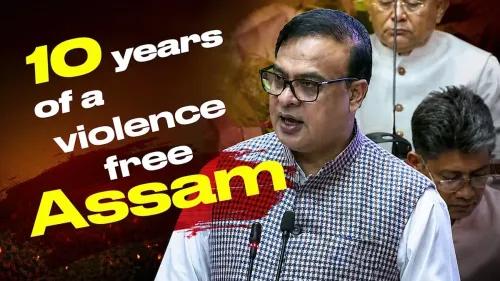
CM Himanta Highlights Assam's Peace Dialogue Progress

Synopsis
Chief Minister Himanta Biswa Sarma told the Assam Legislative Assembly on 26 May 2026 that meaningful peace dialogues have given the state a fresh direction, and that Assam is steadily becoming a violence-free and progressive state, building on accords including the 2020 Bodo Peace Accord.
Key Takeaways
Himanta Biswa Sarma addressed the Assam Legislative Assembly on 26 May 2026 , highlighting progress through peace dialogues.
He described Assam as steadily transforming into a 'violence-free and progressive state.' The Chief Minister emphasised that dialogues have respected public aspirations, signalling a people-centric peace framework.
The remarks build on a policy lineage anchored by the Assam Accord of 1985 and the Bodo Peace Accord of 2020 .
Implementation of existing accords and potential new development packages remain the key indicators to watch in coming sessions.
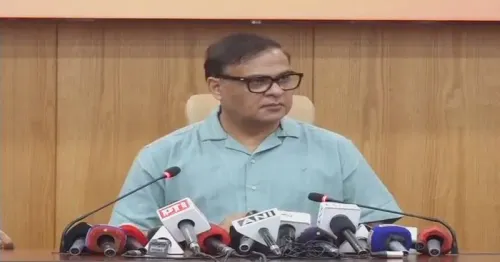
The Chief Minister's Office of Assam on Tuesday, 26 May 2026 shared remarks by Chief Minister Dr. Himanta Biswa Sarma made during the ongoing Assam Legislative Assembly session, in which he underscored that the state has achieved a fresh direction through meaningful peace dialogues that respect public aspirations.
Speaking on the floor of the assembly, CM Himanta stated that Assam is steadily transforming into a 'violence-free and progressive state' — a formulation that signals the government's intent to consolidate gains from successive rounds of negotiations with former armed groups.
Context
Assam has a decades-long history of ethnic insurgencies that shaped its political and social fabric. The state's transition from conflict to dialogue has been gradual, spanning multiple governments and a range of negotiated settlements with armed organisations. Dr. Himanta Biswa Sarma, who assumed office as Chief Minister in 2021, has presided over continued implementation of earlier accords while pursuing fresh engagements with groups that had not yet laid down arms.
The Assam Legislative Assembly serves as the primary forum where the government is accountable to elected representatives on such policy matters, making the Chief Minister's address a significant public statement of direction.
Policy Backdrop
The architecture of peace in Assam rests on two landmark agreements. The Assam Accord of 1985 established the foundational framework for addressing immigration and identity questions through structured dialogue rather than armed confrontation. More recently, the Bodo Peace Accord of 2020 created an autonomous territorial council and a dedicated development package, effectively ending the long-running Bodo militancy.
These agreements reflect a broader shift across Northeast India — from security-first approaches toward negotiated settlements that offer political recognition and economic incentives to former combatants. The Chief Minister's remarks in the assembly appear to reinforce this trajectory, framing peace not merely as the absence of violence but as a platform for development and progressive governance.
Stakeholders and Impact
The communities most directly affected by this shift include Assam's residents in conflict-affected districts, former militants who have re-entered civilian life, and the state's diverse ethnic groups whose aspirations the Chief Minister specifically cited. For these communities, the transition to a 'violence-free' environment has tangible consequences — from improved mobility and economic activity to greater access to state welfare schemes.
Elected representatives in the assembly also have a stake in how peace dividends are distributed, particularly as development packages tied to accords flow through local governance structures. The Chief Minister's address is therefore as much a political signal to legislators as it is a policy statement to the public.
What's Next
Attention will now turn to the implementation status of existing accords and whether the current assembly session produces fresh announcements on development packages or new rounds of dialogue. The Bodo Territorial Council and other autonomous bodies created under past agreements remain key institutions through which the government's peace commitments are tested in practice.
Any new dialogue frameworks or funding allocations announced in subsequent sessions will be closely watched as indicators of whether Assam's stated transformation toward a progressive, violence-free state is advancing on the ground.
Point of View
He positions the ruling dispensation as responsive rather than coercive, a framing that carries electoral as well as administrative value. The speech also fits a wider Northeast India pattern where state governments use legislative forums to signal readiness for continued engagement, keeping the door open for groups still outside formal accords. The real test, however, lies in whether assembly sessions translate into concrete budget allocations and institutional strengthening for the autonomous bodies created under existing agreements.
NationPress
10 Oct 2026
Frequently Asked Questions
What did CM Himanta say in the Assam Assembly on 26 May 2026?
CM Dr. Himanta Biswa Sarma stated that Assam has achieved a fresh direction through meaningful peace dialogues that respect public aspirations, and that the state is steadily transforming into a violence-free and progressive state.
What is the Bodo Peace Accord and how does it relate to Assam's peace process?
The Bodo Peace Accord, signed in 2020 , ended the long-running Bodo militancy by creating an autonomous territorial council and a dedicated development package, and is one of the key agreements underpinning Assam's current peace framework.
How long has Himanta Biswa Sarma been Chief Minister of Assam?
Dr. Himanta Biswa Sarma has served as Chief Minister of Assam since 2021 , overseeing multiple rounds of peace talks with former insurgent groups during his tenure.
What is the Assam Accord of 1985?
The Assam Accord of 1985 is the foundational agreement that established a framework for addressing immigration and identity issues in Assam through structured dialogue, and it remains the bedrock of the state's peace architecture.
What should we watch for next in Assam's peace process?
Key indicators include the implementation status of the Bodo Peace Accord and other agreements, any new development packages announced in the current assembly session, and whether fresh dialogue frameworks are initiated with groups not yet covered by existing accords.