CM Himanta Flags ISI-Backed Network Busted by Assam Police
Synopsis
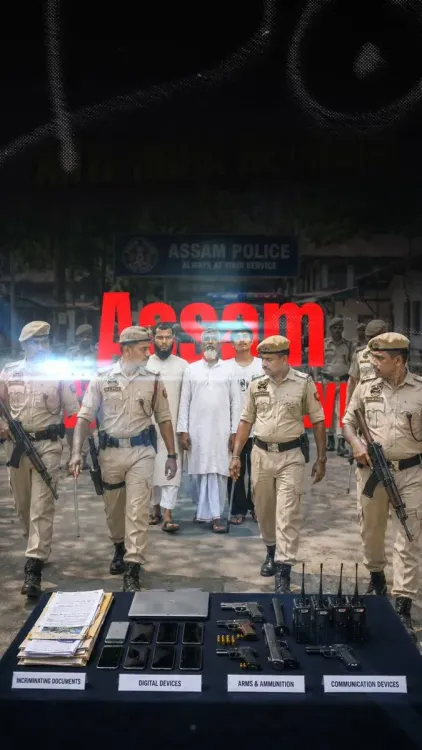
Assam Chief Minister Himanta Biswa Sarma announced on 27 July 2026 that operatives of the ISI-backed Shehzad Bhatti Network have been busted by Assam Police, warning that attempts to destabilise the region will not succeed. The disclosure signals a major counter-espionage operation in Northeast India.
Key Takeaways
CM Himanta Biswa Sarma confirmed the busting of operatives linked to the Shehzad Bhatti Network on 27 July 2026 .
The Chief Minister directly attributed the network's backing to Pakistan's ISI , calling it evidence of active external interference in the region.
Assam Police conducted the operation, reinforcing the state's counter-espionage capabilities under Sarma's home ministry charge.
Assam has a documented history of ISI-linked arrests, with multiple cases recorded between 2018 and 2022 .
A follow-up from Assam Police and possible NIA involvement is anticipated given the alleged foreign-intelligence dimension.
The announcement aligns with the BJP -led government's broader security narrative in Northeast India .
Assam Chief Minister Himanta Biswa Sarma on Monday, 27 July 2026, declared that the busting of operatives linked to the Shehzad Bhatti Network confirms that ISI-backed groups are actively attempting to destabilise the region, asserting that Assam Police will always prevail against such threats.
Context
In the post, CM Sarma stated: 'We will not allow nefarious designs of the enemy to fructify and harm India. The busting of the operatives of the Shehzad Bhatti Network proves that ISI-backed groups are active in the region, trying to foment trouble.' The statement, punctuated with 'Jai Hind' and the Indian tricolour, was accompanied by a video, suggesting the announcement was tied to a specific operational disclosure by state security forces.
The reference to the Shehzad Bhatti Network points to what authorities are characterising as a structured espionage or subversion cell with alleged links to Pakistan's Inter-Services Intelligence (ISI). While full operational details are yet to be officially released, the Chief Minister's framing positions the arrest as part of a broader counter-intelligence effort in Assam.
Policy Backdrop
Assam shares a long border with Bangladesh and has historically been a zone of concern for infiltration and external intelligence activity. Between 2018 and 2022, multiple individuals accused of having ISI links were arrested in the state through coordinated action between state police and central agencies, establishing a pattern of such operations.
State-level counter-terrorism efforts in Northeast India are typically conducted in tandem with central bodies including the National Investigation Agency (NIA) and the Intelligence Bureau (IB). CM Sarma, who also holds the home portfolio in Assam, has consistently projected internal security as a governance priority, frequently communicating crackdowns on militant and espionage networks through public channels.
The North-East Democratic Alliance (NEDA), which Sarma convenes, has made regional security coordination a central plank, with member states sharing intelligence on cross-border threats from both Bangladesh and Myanmar corridors.
Stakeholders and Impact
The most immediate stakeholders are residents of Assam and the broader Northeast, for whom external-intelligence-linked networks represent a tangible security concern. The disclosure, if followed by formal charges and a chargesheet, will also engage the Union Ministry of Home Affairs and potentially the NIA, given the cross-border dimension of ISI-linked cases.
For Assam Police, the operation reinforces the force's public profile as an effective counter-espionage unit under CM Sarma's administration. Politically, such announcements also serve to underline the BJP-led government's emphasis on national security as a core governance deliverable in the region.
Civil liberties observers and opposition groups are likely to seek transparency on the evidence underpinning the network designation and the legal process governing the detained operatives.
What's Next
A formal statement from Assam Police detailing the number of arrests, the charges framed, and the operational scope of the Shehzad Bhatti Network is expected to follow. Central agencies may issue a parallel advisory or take cognisance of the case given its alleged foreign-intelligence dimension.
Any escalation in the India-Pakistan diplomatic context — particularly given ongoing tensions — could elevate this case to a national security conversation at the Union Home Ministry level. Observers will watch whether the NIA formally takes over the investigation, which would signal the centre's assessment of the network's scale and reach.
Point of View
A framing Northeast chief ministers have increasingly adopted. This also fits a broader pattern in which state-level disclosures pre-empt central agency communications, allowing the state government to own the narrative. The key variable going forward is whether formal legal proceedings substantiate the ISI-linkage claim, which will determine the case's durability as a security landmark.
NationPress
27 Jul 2026
Frequently Asked Questions
What is the Shehzad Bhatti Network in Assam?
The Shehzad Bhatti Network is described by Assam Chief Minister Himanta Biswa Sarma as an ISI-backed group whose operatives were busted by Assam Police in July 2026 . Full details of the network's structure and the number of arrests are yet to be officially disclosed by the police.
What did Himanta Biswa Sarma say about the ISI in Assam?
CM Sarma stated that the busting of the Shehzad Bhatti Network proves that ISI -backed groups are active in the region and are trying to foment trouble, but asserted that Assam Police will always have the upper hand.
Has Assam Police busted ISI-linked networks before?
Yes. Between 2018 and 2022 , multiple individuals accused of having links to Pakistan's ISI were arrested in Assam through coordinated operations between state police and central intelligence agencies.
Will the NIA take over the Shehzad Bhatti Network case?
No formal announcement of NIA takeover has been made. However, given the alleged foreign-intelligence dimension, central agencies including the NIA and Intelligence Bureau are expected to be involved or at least briefed on the investigation.
Why is Assam a target for ISI-backed networks?
Assam shares a border with Bangladesh and has a history of infiltration concerns. Its location in Northeast India makes it strategically significant, and external intelligence agencies have historically attempted to exploit local grievances and porous borders to establish footholds in the region.