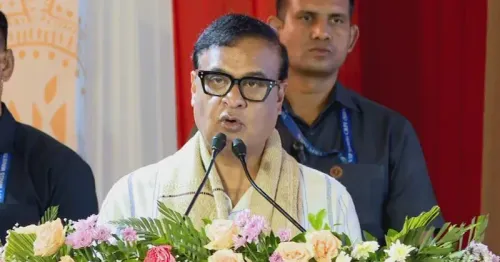
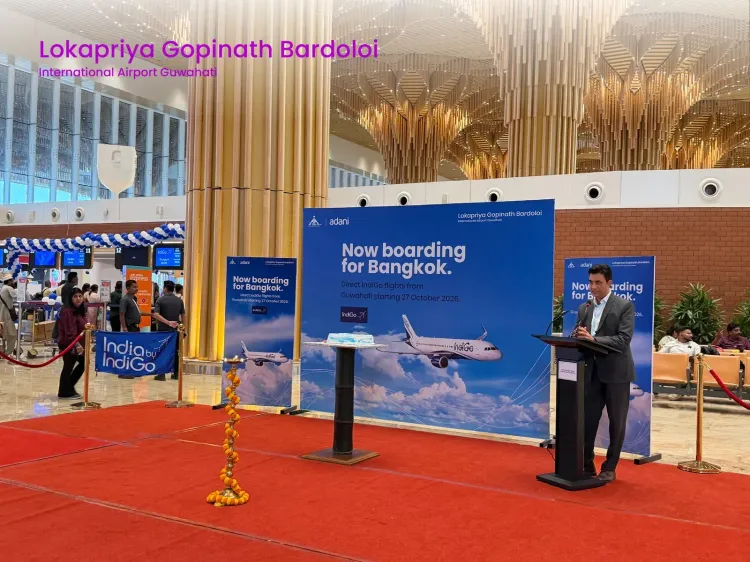
CM Himanta flags off Guwahati-Bangkok direct flight
Synopsis
Assam CM Himanta Biswa Sarma on 27 October 2026 announced direct Guwahati-Bangkok flight services, positioning the city as a major regional aviation hub and citing the launch as a milestone within India's Act East Policy framework connecting Northeast India with ASEAN.
Key Takeaways
Guwahati-Bangkok direct flight services launched on 27 October 2026 , announced by Assam CM Himanta Biswa Sarma .
The route removes the need for connecting flights via Delhi , Kolkata , or Chennai for Northeast travellers heading to Southeast Asia .
CM Sarma framed the launch as part of India's Act East Policy , the strategic initiative launched in 2014 to deepen ties with ASEAN nations.
Guwahati has been identified in national connectivity plans as the primary aviation gateway for Northeast India's eight-state region.
Bangkok is a major ASEAN aviation hub, giving the new route onward connectivity across Southeast and East Asia.
The launch is expected to boost both outbound tourism from Northeast India and inbound international arrivals to the region.
A new air bridge linking Northeast India to Southeast Asia lifted off on Tuesday, 27 October 2026, as Assam Chief Minister Himanta Biswa Sarma announced the launch of direct flight services between Guwahati and Bangkok — a route that transforms the region's connectivity calculus overnight.
Guwahati steps up as Northeast's aviation gateway
Guwahati, the capital of Assam and the largest city in Northeast India, has been earmarked in successive national connectivity plans as the primary gateway for the eight-state region. A direct link to Bangkok — one of ASEAN's busiest and best-connected aviation hubs — removes the layovers through Delhi, Kolkata, or Chennai that have long added hours and cost to journeys for millions of Northeast travellers. CM Sarma described it as 'a new frontier of global connectivity' that furthers the city's positioning as a major travel and tourism hub.
The timing is deliberate. Bangkok serves as a regional interchange point for onward connections across Southeast and East Asia, meaning the Guwahati route is not merely a bilateral link — it is an entry ramp to a much wider network. For the Northeast's fast-growing middle class and its diaspora, that matters enormously.
Act East Policy finds a runway in Assam
India's Act East Policy, formally unveiled at the India-ASEAN Summit in 2014, was designed to do precisely what this flight represents: deepen economic, cultural, and people-to-people ties with ASEAN nations through hard connectivity. The policy succeeded the earlier 'Look East' framework and explicitly prioritised Northeast India as the natural bridge between the Indian subcontinent and Southeast Asia — geographically, culturally, and commercially.
Direct air routes to ASEAN capitals are among the most visible deliverables of that architecture. Successive governments have announced, and incrementally delivered, such connections, and the Guwahati-Bangkok service now joins that list as one of its most consequential additions. CM Sarma framed the launch explicitly within that policy lineage, calling it 'a part of the Act East architecture.'
What travellers and the tourism sector stand to gain
Thailand is consistently among the top international destinations for Indian tourists, and Bangkok draws millions of visitors annually for leisure, medical tourism, and business. A direct connection from Guwahati cuts travel friction sharply — lower fares, fewer transit hours, and simpler itineraries. For the Northeast's inbound tourism sector, the reverse flow matters equally: international travellers, particularly from ASEAN nations, gain a direct gateway into one of India's most scenically and culturally distinct regions.
Analysts watching the sector will now track whether the Guwahati-Bangkok launch accelerates announcements of additional direct routes from Northeast airports to other ASEAN destinations, and whether complementary visa-facilitation or tourism-promotion measures follow from the Ministry of Civil Aviation or state governments.
For a region long defined by its geographical remoteness, a direct flight to one of Asia's great capitals is more than a timetable addition. It is a statement of arrival.
Point of View
Visible deliverable of the Act East Policy at a moment when India is keen to demonstrate strategic depth in its ASEAN engagement. For CM Himanta Biswa Sarma, it serves a dual political purpose: cementing Guwahati's status as a regional capital of consequence and linking Assam's development story directly to the BJP-led Centre's flagship foreign-policy architecture. The broader pattern — incremental air-route additions from Northeast airports to ASEAN capitals — suggests this is a chapter in a longer connectivity story, not a standalone event. The critical question is whether the route generates the commercial volumes needed to sustain it and catalyse further ASEAN connections from the Northeast.
NationPress
27 Oct 2026
Frequently Asked Questions
When did the Guwahati to Bangkok direct flight start?
The Guwahati-Bangkok direct flight service was launched on 27 October 2026 , as announced by Assam Chief Minister Himanta Biswa Sarma .
Which airline operates the Guwahati-Bangkok direct route?
The specific airline operating the Guwahati-Bangkok direct service has not been confirmed in official announcements covered here. CM Sarma's post announced the launch of the service without naming the carrier.
What is India's Act East Policy?
India's Act East Policy was formally launched at the India-ASEAN Summit in 2014 . It is a strategic initiative to deepen economic, cultural, and connectivity ties with Southeast Asian nations , succeeding the earlier 'Look East' policy, with Northeast India positioned as the natural bridge.
Why is Guwahati important for India-ASEAN connectivity?
Guwahati is the largest city in Northeast India and has been consistently identified in national plans as the primary aviation and trade gateway for the region, making it the natural launchpad for direct routes to ASEAN capitals like Bangkok .
What does the Guwahati-Bangkok flight mean for Northeast India tourism?
The direct route reduces travel time and costs for outbound travellers from Northeast India heading to Thailand , while also opening a direct international gateway for inbound tourists from Southeast Asia to one of India's most distinctive regions.