CM Dhami Pitches 2026-27 Supplementary Budget for Uttarakhand

Synopsis
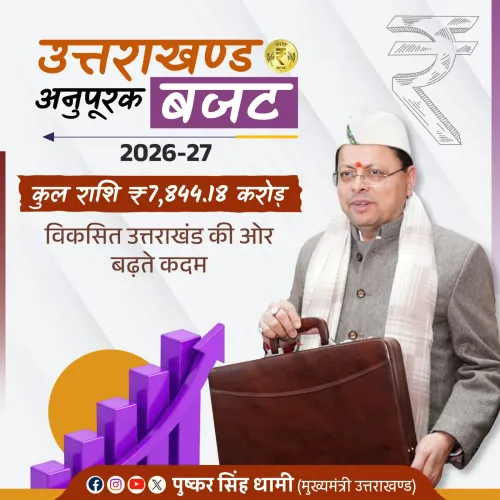
Uttarakhand CM Pushkar Singh Dhami on 27 October 2026 unveiled the FY2026-27 supplementary budget, promising new allocations for farmer procurement, digital education, health, roads, energy, and targeted welfare for women, youth, and athletes under the 'Atmanirbhar Uttarakhand' vision.
Key Takeaways
CM Pushkar Singh Dhami announced the FY2026-27 supplementary budget for Uttarakhand on 27 October 2026 .
Key spending areas include farmer produce procurement , health , digital education , drinking water , energy , and road and infrastructure development .
Dedicated provisions have been made for youth, women, athletes , and economically vulnerable communities.
The budget is framed under the government's 'Atmanirbhar Uttarakhand' (self-reliant Uttarakhand) vision of balanced, self-sufficient development.
The supplementary demands must next be passed by the Uttarakhand Legislative Assembly before funds reach departments.
A mid-year financial injection is now the centrepiece of Uttarakhand Chief Minister Pushkar Singh Dhami's development pitch — and on Tuesday, 27 October 2026, he made clear exactly who it is meant to reach: farmers, students, women, athletes, and the state's most vulnerable communities.
What the supplementary budget promises
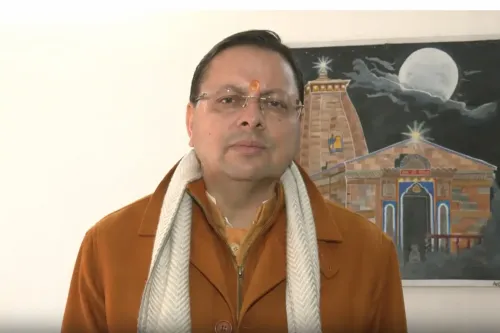
In a post on X, CM Dhami described the Financial Year 2026-27 supplementary budget as 'an important step towards giving new momentum to the state's development and strengthening public welfare schemes.' He listed procurement of farmers' produce, health facilities, digital learning in education, drinking water, energy, roads, and infrastructure development as the core pillars of the additional allocation.
The statement, posted in Hindi, reads: 'हमारी सरकार आत्मनिर्भर और समृद्ध उत्तराखण्ड के संकल्प के साथ जनहित, सुशासन और प्रदेश के संतुलित विकास के लिए निरंतर कार्य कर रही है' — 'Our government is continuously working for public interest, good governance, and balanced development of the state, with the resolve of a self-reliant and prosperous Uttarakhand.'
Farmers, youth, and women at the forefront
The supplementary budget explicitly names farmers — through guaranteed produce procurement — alongside youth, women, and athletes as priority groups receiving dedicated provisions. This signals a deliberate broadening of the fiscal outreach beyond infrastructure into human-capital spending ahead of what is expected to be a politically active legislative session.
Digital learning earmarks within the education component are particularly notable for a Himalayan state where remote topography has historically made conventional schooling connectivity a challenge. The drinking-water and energy provisions similarly address chronic rural supply gaps in Uttarakhand's hill districts.
Supplementary budgets as a mid-course tool in Uttarakhand
Supplementary demands for grants are a standard legislative instrument across Indian states, allowing governments to revise allocations after the main budget is passed — typically when revenues come in ahead of projections or when welfare priorities shift. Uttarakhand governments have routinely used this mechanism to top up agriculture, health, and connectivity spending mid-year. The Dhami administration's consistent emphasis on 'self-reliance' — Atmanirbhar Uttarakhand — frames these allocations within a broader BJP governance narrative.
The next visible milestones will be the tabling and debate of the supplementary demands in the Uttarakhand Legislative Assembly, followed by the department-wise release of sanctioned funds — the point at which on-ground impact can actually be measured.
Whether the budget's breadth of intent translates into comparable breadth of execution is the question the Assembly floor will now have to answer.
Point of View
Using fiscal additions to reinforce its 'self-reliant Uttarakhand' narrative across a deliberately wide coalition of beneficiaries — farmers, youth, women, and athletes. Politically, the breadth of sectors named reduces any single opposition attack surface while tying each constituency to a tangible promise ahead of assembly scrutiny. The inclusion of digital education and produce procurement also aligns Uttarakhand's state messaging with central BJP themes of technology-led governance and agricultural support. The real test, as always, is translating supplementary allocation orders into departmental disbursements before the fiscal year closes.
NationPress
28 Oct 2026
Frequently Asked Questions
What is the Uttarakhand 2026-27 supplementary budget?
It is a mid-year revision of the state's existing budget for Financial Year 2026-27, tabled by the Dhami government to add or redirect funds across sectors such as agriculture, health, education, roads, energy, and drinking water.
Who benefits from Uttarakhand's supplementary budget 2026-27?
CM Dhami has specified farmers (through produce procurement), students (digital learning), women, youth, athletes, and economically vulnerable groups as the primary beneficiaries of the new provisions.
What is the 'Atmanirbhar Uttarakhand' goal CM Dhami refers to?
'Atmanirbhar Uttarakhand' means a self-reliant Uttarakhand — a governance vision under which the Dhami administration frames its spending decisions as building the state's economic independence and balanced regional development.
What sectors does the Uttarakhand supplementary budget cover?
The supplementary budget covers farmers' produce procurement, health facilities, digital learning in schools, drinking water supply, energy, road construction, and broader infrastructure development alongside welfare schemes for special groups.
What happens after a supplementary budget is announced in Uttarakhand?
The supplementary demands for grants must be tabled and passed by the Uttarakhand Legislative Assembly, after which individual departments receive the sanctioned funds to implement their respective programmes.